Tag: cognitive bias

  • How Search Boxes Shape the Way We Think

    The Invisible Influence of Algorithms in the Digital Age

    Search box autocomplete shaping user questions

    1. When Search Boxes Decide the Question

    Search boxes do more than provide answers.
    They subtly change the way we ask questions in the first place.

    Think about autocomplete features.
    You begin typing “today’s weather,” and before finishing, the search box suggests
    “today’s weather air pollution.”

    Without intending to, your attention shifts.
    You were looking for the weather, but now you are thinking about air quality.

    Autocomplete does not simply predict words.
    It redirects thought.
    Questions that once originated in your mind quietly become questions proposed by an algorithm.


    2. How Search Results Shape Our Thinking

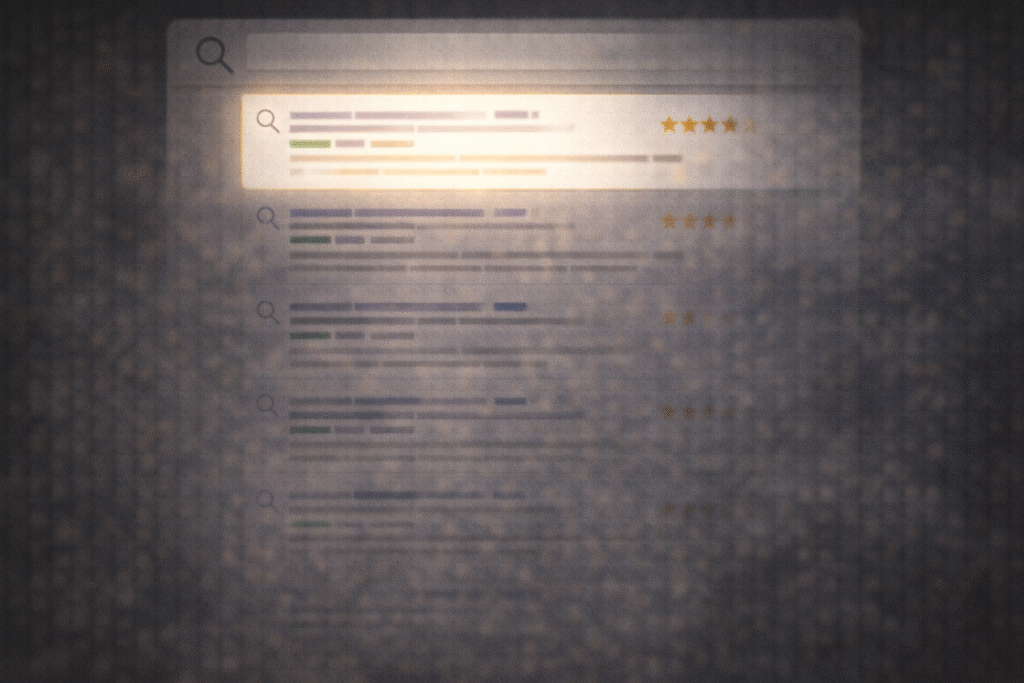
    Algorithmic bias in ranked search results

    Search results are not neutral lists.
    They are ranked, ordered, and designed to capture attention.

    Most users focus on the first page—often only the top few results.
    Information placed at the top is easily perceived as more accurate, reliable, or “true.”

    For example, when searching for a diet method, if the top results emphasize dramatic success,
    we tend to accept that narrative, even when contradictory evidence exists elsewhere.

    In this way, search results do not merely reflect opinions.
    They actively guide the direction of our thinking.


    3. The Invisible Power Behind the Search Box

    At first glance, a search box appears to be a simple input field.
    Behind it, however, lie powerful algorithms shaped by commercial and institutional interests.

    Sponsored content often appears at the very top of search results.
    Even when labeled as advertisements, users unconsciously associate higher placement with credibility.

    As a result, companies invest heavily to secure top positions,
    knowing that visibility translates directly into trust and choice.

    Our decisions—what we buy, read, or believe—are often influenced
    long before we realize it.


    4. Search Boxes Across Cultures and Nations

    Search engines differ across countries and cultures.
    Google dominates in the United States, Naver in South Korea, Baidu in China.

    Searching the same topic on different platforms can yield strikingly different narratives,
    frames, and priorities.

    A historical event, for instance, may be presented through contrasting lenses depending on the search environment.

    We do not simply search the world as it is.
    We see the world through the window our search box provides—and each window has its own tint.


    5. Learning to Question the Search Box

    How can we avoid being confined by algorithmic guidance?

    The answer lies in cultivating critical habits:

    • Ask whether an autocomplete suggestion truly reflects your original question
    • Look beyond the top-ranked results
    • Compare information across platforms and languages

    These small practices widen the intellectual space in which we think.

    Critical awareness of algorithmic influence

    Conclusion

    Search boxes are not passive tools for finding answers.
    They shape questions, guide attention, and quietly train our ways of thinking.

    In the digital age, the challenge is not to reject these tools,
    but to use them without surrendering our autonomy.

    True digital literacy begins when we recognize
    that the most powerful influence of a search box
    lies not in the answers it gives,
    but in the questions it encourages us to ask.


    References

    Pariser, E. (2011). The Filter Bubble: What the Internet Is Hiding from You. New York: Penguin Press.
    → Explores how personalized algorithms narrow users’ worldviews while shaping perception and judgment.

    Noble, S. U. (2018). Algorithms of Oppression: How Search Engines Reinforce Racism. New York: NYU Press.
    → Critically examines how search engines reflect and amplify social biases rather than remaining neutral tools.

    Beer, D. (2009). Power through the Algorithm? New Media & Society, 11(6), 985–1002.
    → Analyzes algorithms as invisible forms of power that structure everyday cultural practices.

  • The Illusion of “Free”: How Zero Price Changes Our Decisions

    A consumer drawn toward a free offer in a store

    1. The Magic of Free: The Belief That We Lose Nothing

    From an economic perspective, “free” does not necessarily mean beneficial.
    Sometimes, free offers lead people to buy more than they originally intended—resulting in greater loss rather than gain.

    Yet psychologically, humans are strongly drawn to the idea that free equals advantage.
    The word itself triggers an instinctive belief: there is no risk, only reward.

    Behavioral economist Dan Ariely famously demonstrated this through a simple experiment.
    Participants were asked to choose between a premium chocolate priced at 15 cents and a regular chocolate priced at 1 cent.
    Many chose the premium option.

    But when the prices were changed to 14 cents and 0 cents, the majority switched to the free chocolate.
    The difference was only one cent, yet the presence of “free” completely reversed their decisions.


    2. The Psychological Reward Behind Free

    Free offers provide more than financial benefit—they generate emotional satisfaction.
    People experience a sense of gain, relief, and even pride in “getting a good deal.”

    Consider free shipping.
    A delivery fee of $2.50 may cause hesitation, but when stores offer free shipping above a certain purchase amount, consumers often add unnecessary items just to qualify.

    Rationally, paying the shipping fee would cost less.
    Psychologically, however, the reward of avoiding loss outweighs careful calculation.

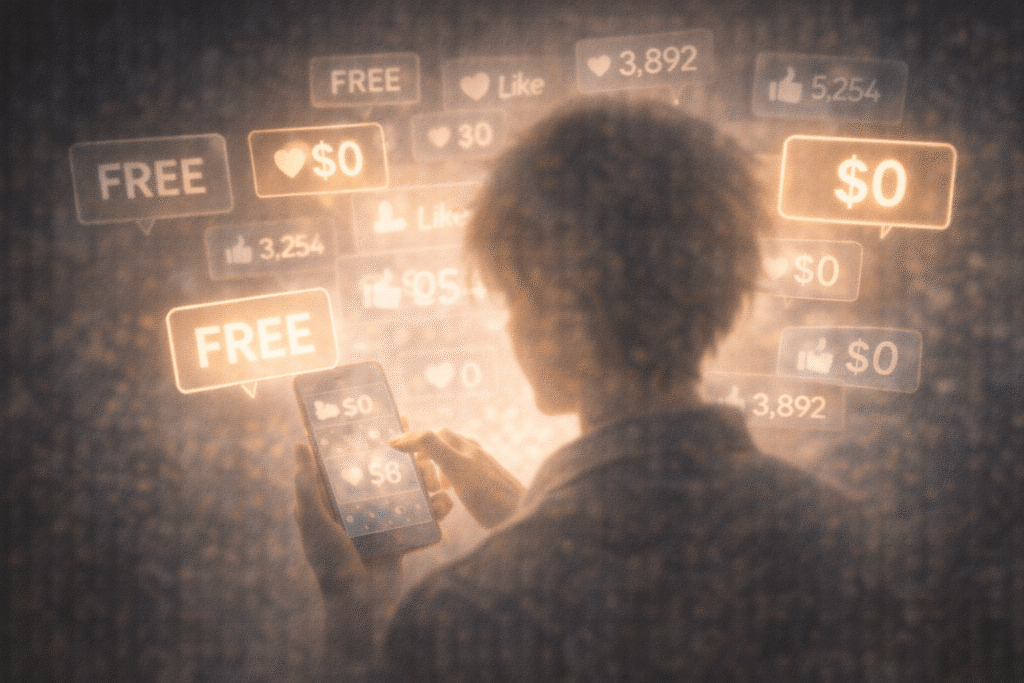
    Psychological bias triggered by free digital offers

    3. The Hidden Costs of Free

    Free rarely comes without conditions.

    Free apps often require users to watch advertisements, surrender personal data, or accept future pressure to upgrade to premium services.
    What disappears in monetary cost reappears as attention, privacy, or long-term commitment.

    Free samples work in similar ways.
    They are not acts of generosity but strategic investments—designed to cultivate future paying customers.

    In this sense, “free” is not free at all.
    It is a delayed transaction.


    4. How Free Changes Social Relationships

    The influence of free extends beyond markets into social life.

    When someone says, “I got this for free—take it,” we feel gratitude, but also subtle obligation.
    Psychologists call this the principle of reciprocity: receiving creates pressure to return the favor.

    This is why companies offer free tastings or trial products.
    Even small gifts can significantly increase purchase rates by activating an unconscious desire to reciprocate.


    5. Self-Defense in the Age of Free

    We live surrounded by free offers, free trials, and free content.
    Not all of it is harmful—but not all of it is beneficial either.

    To respond wisely, three habits help:

    • Ask whether you truly needed it before it was free
    • Identify hidden costs behind “zero price”
    • Recognize the psychological bias itself

    Awareness alone weakens the illusion.


    Conclusion

    Mindful decision making beyond free offers

    Free is a powerful psychological trigger.
    It does not merely reduce cost—it reshapes judgment, desire, and choice.

    Understanding the illusion of free allows us to reclaim agency over our decisions,
    ensuring that “no cost” does not quietly become a greater one.


    References

    1. Ariely, D. (2008). Predictably Irrational: The Hidden Forces That Shape Our Decisions.
      Explains the “zero price effect” and how free offers distort rational decision-making.
    2. Cialdini, R. B. (2006). Influence: The Psychology of Persuasion.
      Introduces the principle of reciprocity and why people feel compelled to respond to free gifts.
    3. Shampanier, K., Mazar, N., & Ariely, D. (2007).
      Zero as a Special Price: The True Value of Free Products. Marketing Science, 26(6), 742–757.
      Empirically demonstrates why free products trigger emotional rather than rational responses.