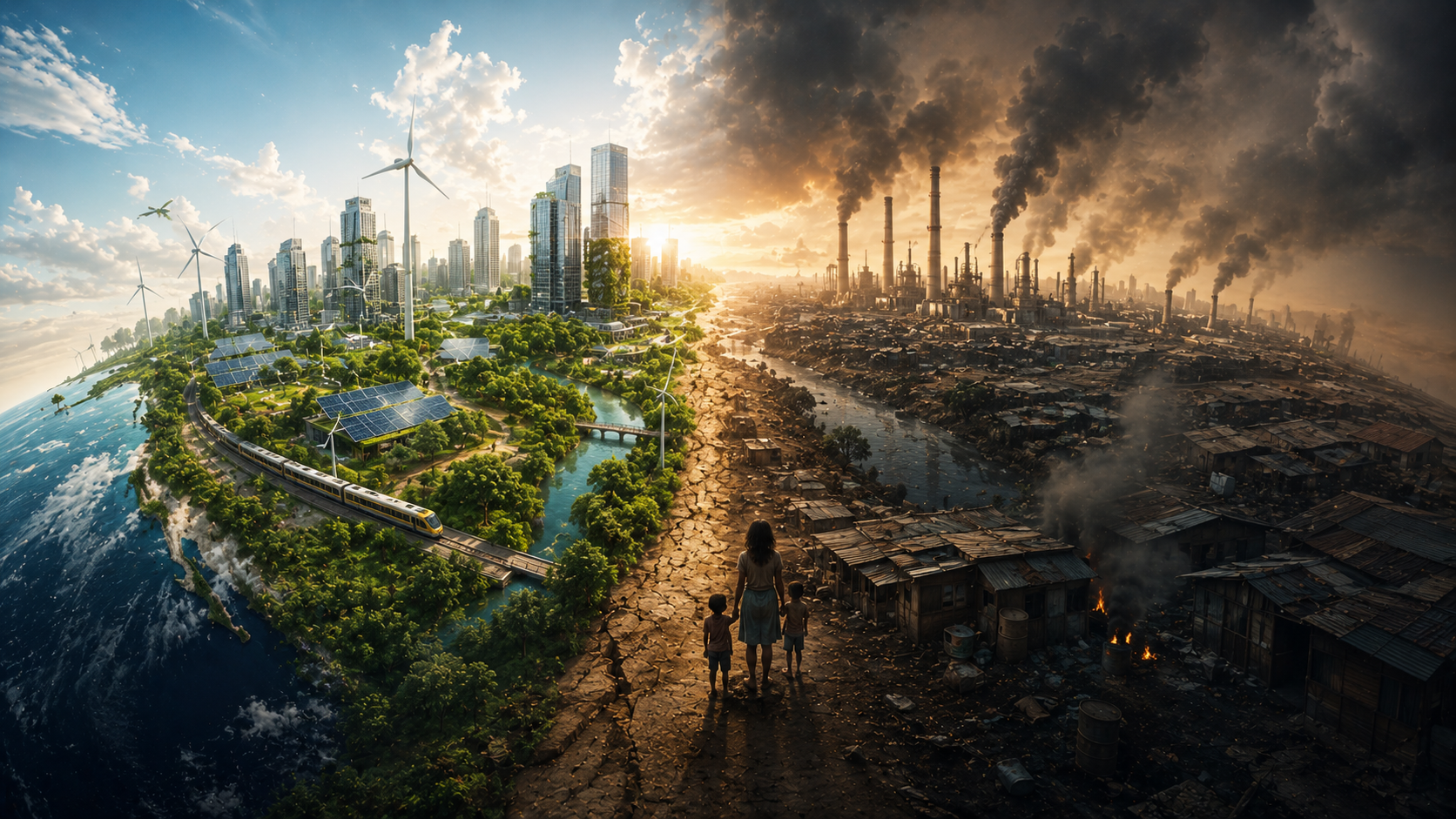
Climate Justice and the Economics of the Global Energy Transition
“Saving the planet” sounds like a universal moral goal.
Governments pledge to achieve carbon neutrality.
Companies advertise sustainability initiatives.
Consumers are encouraged to drive electric cars and reduce their carbon footprints.
The transition away from fossil fuels is now presented as both necessary and urgent.
But beneath this global consensus lies a difficult question:
Who is actually paying the price of decarbonization?
For many developing countries, the path toward a green economy does not feel equally fair.
Some nations became wealthy through two centuries of industrial pollution.
Others are now being told to limit emissions before they have fully industrialized at all.
This tension lies at the heart of what is now called climate justice.
1. The Past of Industrialization Still Shapes the Present
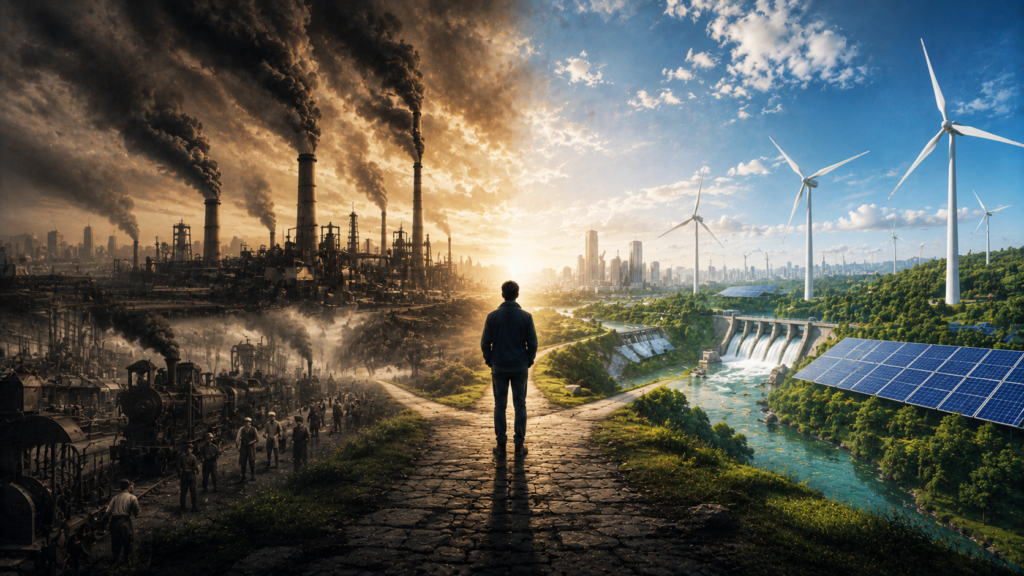
Climate change did not emerge equally from all countries.
The largest historical emitters of greenhouse gases were primarily industrialized nations such as:
- the United States
- Western Europe
- Japan
These economies built their wealth through coal, oil, steel, and mass industrial production.
As a result, they accumulated not only economic power,
but also technological advantages.
Today, many of these same countries lead the renewable energy industry, producing solar panels, batteries, and green technologies.
Developing nations face a very different reality.
Many are still struggling to provide stable electricity, transportation infrastructure, and basic industrial growth.
In parts of Africa and South Asia, diesel generators remain essential sources of energy.
For these countries, rapid decarbonization can feel less like environmental responsibility
and more like a limitation placed upon development itself.
A difficult question emerges:
Is it fair to demand equal sacrifice from countries that did not contribute equally to the crisis?
2. Green Technology Is Not Equally Accessible
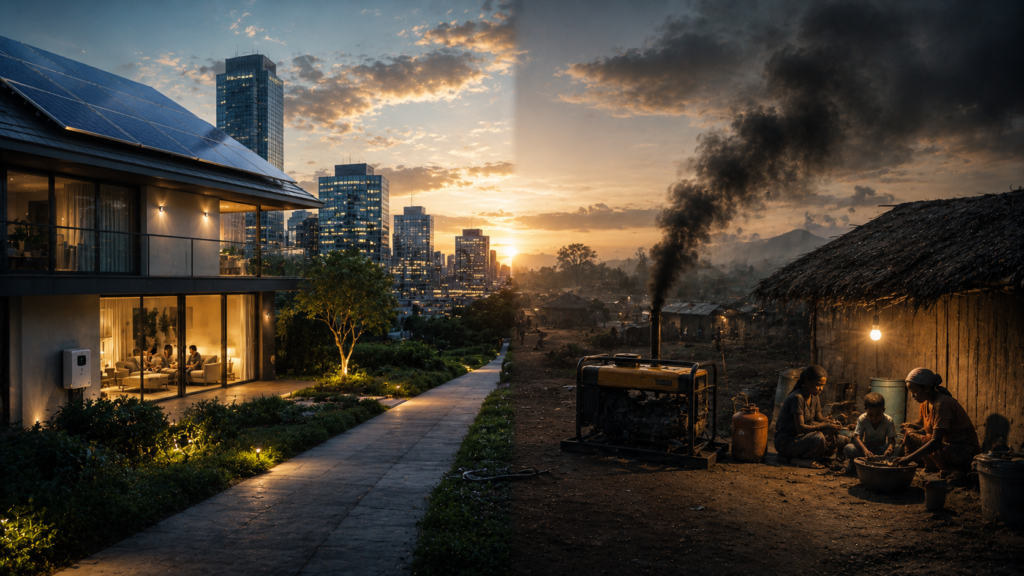
In wealthier nations, installing rooftop solar panels or purchasing electric vehicles is increasingly normalized.
Government subsidies, technological infrastructure, and financial systems support the transition.
But for poorer countries, green technology often remains expensive and inaccessible.
Renewable energy requires:
- investment capital
- technical expertise
- stable infrastructure
- long-term policy support
Without these conditions, even environmentally beneficial technologies become difficult to adopt.
As a result, the global transition toward sustainability risks deepening economic inequality.
Some countries move quickly toward carbon neutrality.
Others remain trapped between climate pressure and economic survival.
This imbalance is one reason why climate policy is no longer viewed only as an environmental issue.
It has become an ethical and economic debate.
3. Climate Justice and “Common but Differentiated Responsibilities”
The international community has attempted to address this imbalance through the principle known as:
Common but Differentiated Responsibilities (CBDR).
The idea is simple:
All nations share responsibility for addressing climate change,
but wealthier nations should bear greater obligations because of their historical emissions and greater economic capacity.
Under international climate agreements, developed countries pledged to provide billions of dollars annually in climate finance to support developing nations.
However, critics argue that these promises have often been insufficient, delayed, or politically conditional.
Many developing countries therefore view climate negotiations with skepticism.
They ask:
If industrialized nations created most of the historical emissions,
should they not also carry a larger share of the transition cost?
4. The Meaning of a “Just Transition”
The debate is no longer only about reducing carbon emissions.
It is about how the transition itself is managed.
A just transition means that environmental policies should not create new forms of inequality while solving ecological problems.
This includes questions such as:
- Who loses jobs during the energy transition?
- Which communities bear rising energy costs?
- Who controls green technologies and supply chains?
- Who profits from sustainability?
There is also the issue of hidden carbon responsibility.
Many products consumed in wealthy countries are manufactured in developing nations.
The emissions occur in one part of the world,
while consumption occurs in another.
So whose carbon footprint is it really?
The producer’s?
Or the consumer’s?
Climate justice forces the world to confront these uncomfortable questions.
Conclusion: A Green Future Must Also Be a Fair One
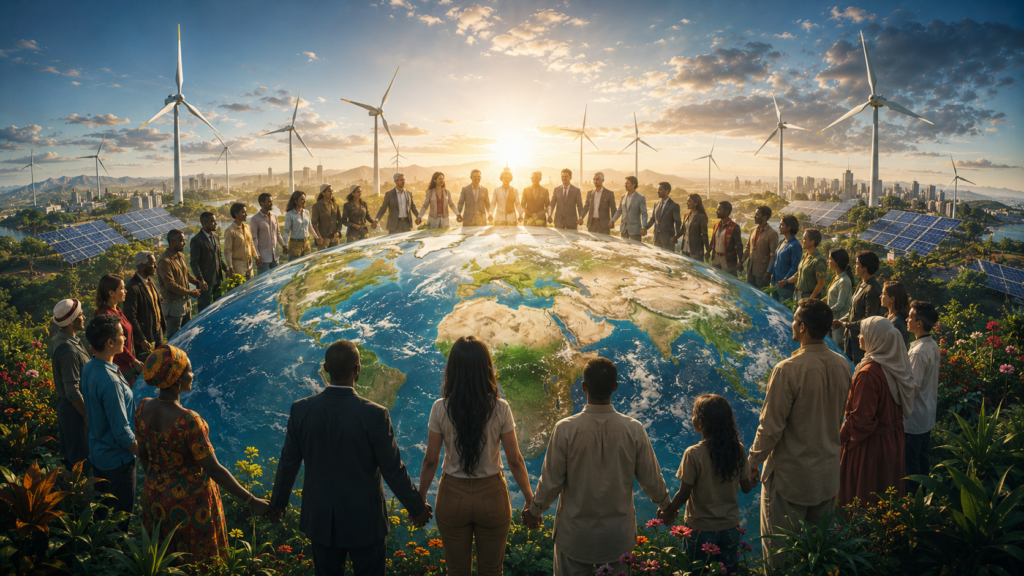
Climate change is undeniably a global crisis.
But fairness matters.
A sustainable future cannot be built on unequal sacrifice.
If decarbonization becomes a system in which wealthy countries maintain prosperity while poorer nations absorb the economic burden,
then the transition itself risks becoming another form of global inequality.
The future requires more than technological innovation.
It also requires solidarity, ethical responsibility, and international cooperation.
The real challenge is not only:
How fast can humanity transition to a green economy?
But also:
How can that transition happen without leaving parts of the world behind?
A truly sustainable future must be environmentally sustainable—
and socially just at the same time.
A Question for Readers
Should wealthy countries bear a greater share of the economic burden for climate change because of their historical emissions?
Related Reading
The debate over climate justice is ultimately also a debate about power, responsibility, and the role of states in protecting collective well-being.
In Is the State a Guardian of Freedom—or a Leviathan of Control?, the tension between public authority and social responsibility helps illuminate why climate governance remains politically controversial across nations.
Environmental ethics also raises a deeper philosophical question about humanity’s relationship with the natural world.
In Can Nature Have Rights Above Humans?, the discussion expands beyond economics and asks whether ecosystems themselves should possess moral and legal standing in the age of climate crisis.
References
- IPCC. (2022). Climate Change 2022: Mitigation of Climate Change. Sixth Assessment Report, Working Group III.
→ The IPCC report provides comprehensive scientific analysis of decarbonization strategies, global emissions inequalities, and pathways toward carbon neutrality. - Newell, P., & Mulvaney, D. (2013). “The Political Economy of the ‘Just Transition’.” Geographical Journal, 179(2), 132–140.
→ This article examines how energy transitions create uneven economic burdens and explores the political dimensions of climate justice. - Roberts, J. T., & Parks, B. C. (2007). A Climate of Injustice: Global Inequality, North-South Politics, and Climate Policy. MIT Press.
→ A foundational text on climate justice, analyzing historical responsibility, global inequality, and the politics of international climate negotiations. - Puaschunder, J. M. (2022). Ethics of Climate Finance: Sustainability, Governance and Policy. Palgrave Macmillan.
→ This book explores the ethics of climate finance, including unequal access to funding, fairness in adaptation policy, and accountability in international commitments. - UNFCCC. Principles and Provisions of the Convention.
→ The UNFCCC framework establishes the principle of “Common but Differentiated Responsibilities,” which remains central to global climate governance debates.