How Can We Balance Development and Preservation?
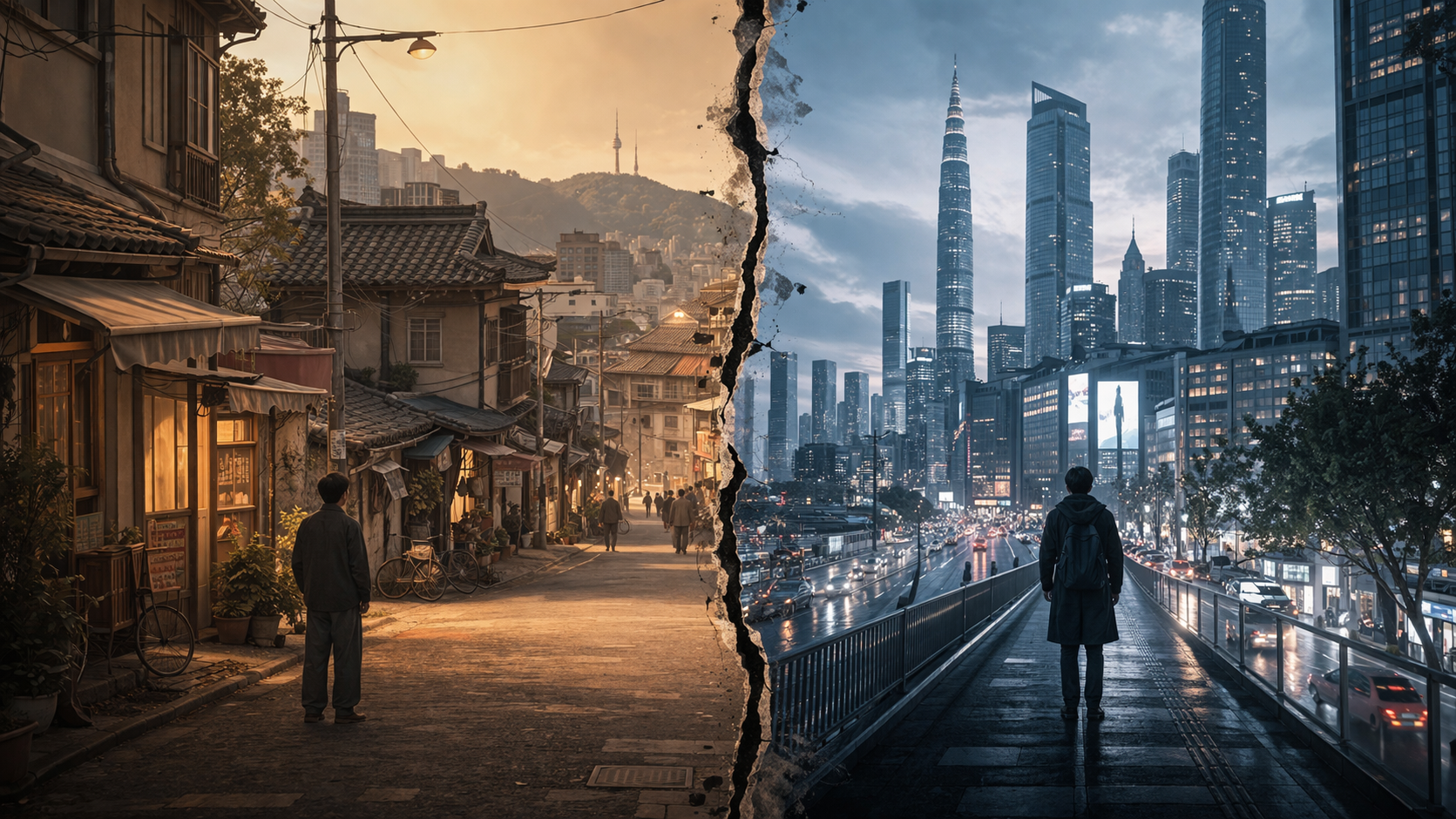
Have you ever returned to a place you once knew—
only to find it completely changed?
A familiar street replaced by glass towers.
A small shop gone without a trace.
In moments like these, we are not just losing buildings.
We are losing pieces of memory.
This raises a deeper question:
Are cities meant to preserve our past—
or to constantly erase and rebuild it?
1. Cities as Spaces of Memory

Cities are not just collections of buildings and infrastructure.
They are living archives of human experience.
Old alleys, schools, cinemas, factories, and even faded signs—
these are not simply outdated structures.
They are carriers of collective memory.
Yet, across the world, such places are disappearing rapidly.
Urban redevelopment often replaces them with standardized spaces—
efficient, modern, but emotionally detached.
2. Why Memory and Development Collide
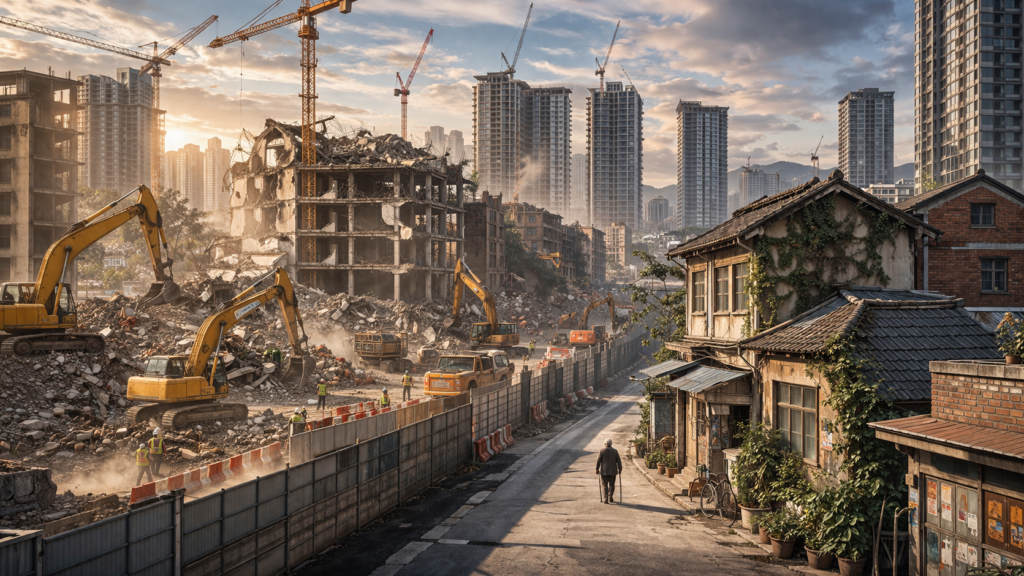
The disappearance of historical spaces is not due to neglect alone.
It is the result of a deeper conflict between two values.
2.1. Development Logic
Cities must grow—accommodating population, economy, and infrastructure.
Old structures are often seen as inefficient or unprofitable.
2.2. Preservation Logic
At the same time, these spaces hold identity, history, and emotional meaning.
They are not just physical assets—but cultural ones.
This conflict reflects a fundamental question:
What role should the past play in the future of cities?
3. Case Studies: Conflict in Practice
3.1. Seoul: Cheonggyecheon & Sewoon Arcade
The restoration of Cheonggyecheon transformed the city into a greener, pedestrian-friendly space.
Yet it also displaced long-standing communities and local economies.
Sewoon Arcade, once a symbol of industrial modernization,
faced repeated threats of demolition before partial preservation efforts emerged.
3.2. Kyoto: Preservation Through Consensus
Kyoto represents a different approach.
Strict building regulations, height limits, and cultural protections
have allowed the city to maintain its historical identity.
This reflects a strong social agreement:
the past must coexist with the future.
4. Can Development and Preservation Coexist?
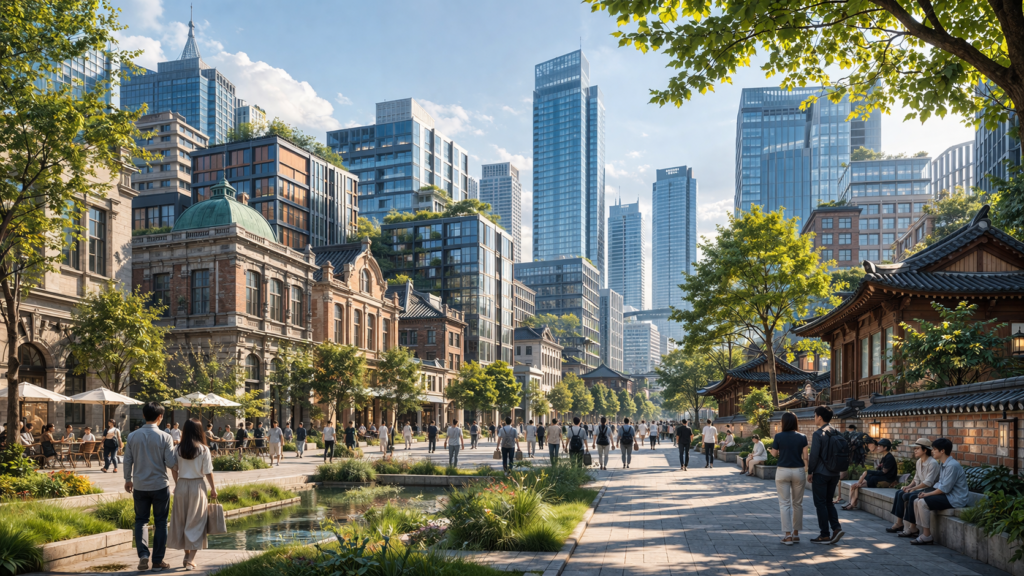
Development and preservation are not necessarily opposites.
Cities can evolve without erasing their past.
The concept of “places of memory”, introduced by Pierre Nora,
suggests that physical spaces hold emotional and cultural significance.
Development, therefore, should not eliminate memory—
but reinterpret and integrate it.
5. Toward a Balanced Future
Preserving urban memory requires more than nostalgia.
It requires:
- Institutional systems to evaluate historical value
- Citizen participation in planning
- Cultural reinterpretation through art and storytelling
- Hybrid models combining preservation and development
Cities must be designed not only for efficiency—
but for meaning.
Conclusion
Cities are always changing.
But how they change matters.
When a place disappears, we do not just lose space—
we lose memory, relationships, and identity.
A city that preserves memory becomes more than livable—
it becomes meaningful.
So we are left with a choice:
Will our cities remember—
or will they forget?
💬 A Question for Readers
Have you ever lost a place that mattered to you—
and felt like a part of your memory disappeared with it?
Related Reading
The tension between preservation and change becomes even more complex when we consider how societies interpret the past.
In Is There a Single Historical Truth—or Many Narratives?, the idea of collective memory reveals how different groups construct and contest the meaning of history.
At the same time, the fragility of memory itself is further explored in If Memory Can Be Manipulated, What Can We Really Trust?, where the instability of personal and collective memory raises deeper questions about what should be preserved—and why.
References
- Nora, P. (1996). Realms of Memory: Rethinking the French Past. New York: Columbia University Press.
→ This work introduces the concept of “sites of memory,” explaining how physical places carry collective emotional and historical meaning. It provides a foundational framework for understanding cities as spaces where memory is preserved and constructed. - Hayden, D. (1997). The Power of Place: Urban Landscapes as Public History. Cambridge, MA: MIT Press.
→ This book explores how urban spaces function as living histories, especially for marginalized communities. It highlights the importance of incorporating diverse social memories into city planning and development. - Zukin, S. (1982). Loft Living: Culture and Capital in Urban Change. Baltimore: Johns Hopkins University Press.
→ Zukin analyzes how urban redevelopment and gentrification transform cultural spaces into economic assets. It critically examines how such processes often erase historical traces while creating new forms of consumption. - Huyssen, A. (2003). Present Pasts: Urban Palimpsests and the Politics of Memory. Stanford: Stanford University Press.
→ This work conceptualizes cities as layered spaces where past and present coexist and interact. It emphasizes how memory is not static but constantly reshaped through political and cultural forces. - Lynch, K. (1960). The Image of the City. Cambridge, MA: MIT Press.
→ Lynch introduces the idea of the “mental image” of the city, showing how individuals perceive and remember urban environments. His framework connects spatial structure with human experience and urban identity.