
Tag: behavioral science

  • Why Do People Prefer the Right Side Over the Left?

    Why Do People Prefer the Right Side Over the Left?

    The Psychology of Spatial Bias and Human Behavior

    Have you ever noticed which direction you naturally choose?

    When walking down a street, entering a store, or pressing an elevator button, many people unconsciously turn to the right.

    This is not just a coincidence.

    Studies suggest that a large majority of people tend to favor the right side when making quick, unconscious decisions.

    But why does this happen?

    Is it simply because most people are right-handed, or is there something deeper at work within the human mind?


    1. The Subtle Bias in Everyday Life

    people unconsciously moving to the right side

    Right-side preference appears in many aspects of daily life:

    • People often browse the right side of store displays first
    • Queue designs in public spaces frequently guide movement to the right
    • In debates or visual layouts, right-positioned individuals are sometimes perceived more positively

    These patterns suggest that our choices are not always fully conscious.

    Instead, they are influenced by underlying cognitive tendencies.

    This tendency reflects a deeper pattern known as right side bias psychology, where the brain and body shape our unconscious directional preferences.


    2. The Brain and Body Connection

    One explanation lies in the asymmetry of the brain.

    The left hemisphere of the brain controls the right side of the body and is typically associated with:

    • language
    • logic
    • analytical thinking

    Since most people are right-handed, actions on the right side feel more natural, efficient, and comfortable.

    This familiarity reinforces a subtle bias toward the right.


    3. Evolution and Habit
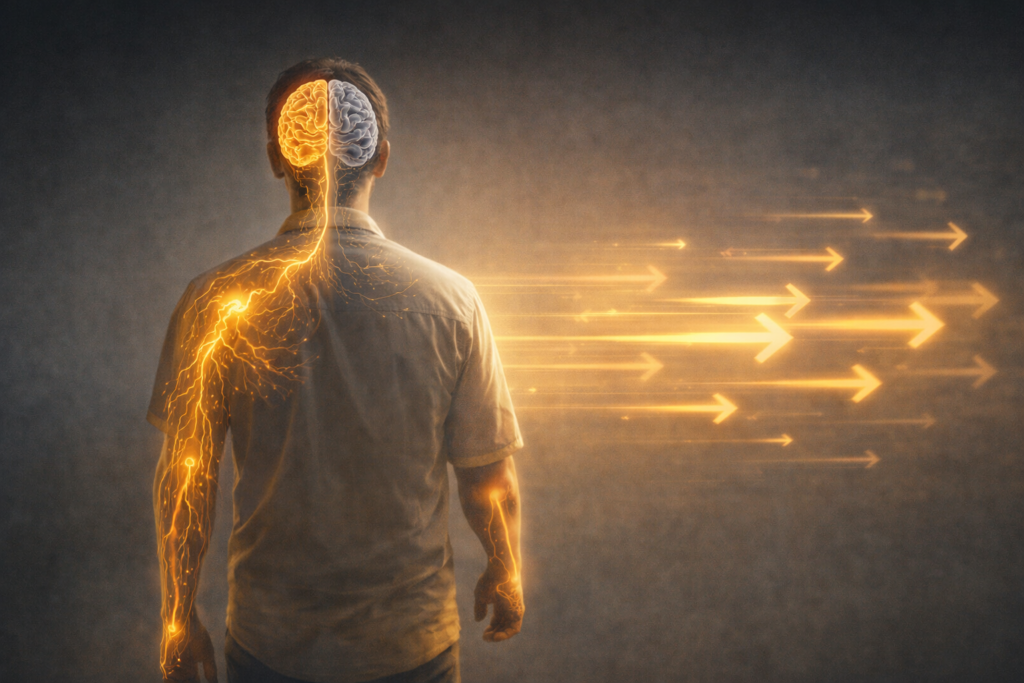
    brain asymmetry influencing right side preference

    From an evolutionary perspective, right-handedness may have provided advantages in tool use and coordination.

    Over time, these tendencies became ingrained in human behavior.

    As a result, cultural systems and environments began to reflect and reinforce this bias.

    What starts as a biological tendency gradually becomes a social norm.


    4. Language and Cultural Symbolism

    Language also plays a powerful role.

    In English, the word “right” means both:

    • a direction
    • something correct or morally good

    In contrast, “left” has historically been associated with less favorable meanings.

    For example, the Latin word sinister originally meant “left” but later came to imply something negative.

    These linguistic patterns subtly influence how we perceive directions.

    Over time, “right” becomes associated with correctness, trust, and preference.


    5. A Surprising Reversal: When Left Feels More Emotional

    Interestingly, the left side is not always disadvantaged.

    In emotional and expressive contexts, the left side may be more powerful.

    Research suggests that:

    • the left side of the face often conveys emotion more vividly
    • visual compositions place emotional elements on the left side for stronger impact

    This indicates a fascinating balance:

    • the right side → associated with action, control, and decision-making
    • the left side → associated with emotion and expression

    person reflecting on left and right choices

    Conclusion: The Invisible Direction of Choice

    The next time you reach for something or choose a direction, pause for a moment.

    Are you choosing consciously, or following a deeply embedded pattern?

    Preferring the right side may not be a simple habit.

    It may reflect a complex interaction between the brain, the body, culture, and language.

    And sometimes, choosing the left
    may be a small but meaningful way to step outside of automatic thinking.


    Question for Readers

    When you make quick, everyday choices, do you notice a preference for one side over the other?

    Is your sense of comfort shaped by habit, or by deeper patterns in your mind and culture?

    If we are influenced by such subtle biases,
    how many of our “free choices” are truly our own?


    Related Reading

    The hidden patterns behind everyday decision-making are further explored in Why Do We Remember Regret Longer Than Failure?, where the role of cognitive processes and imagined possibilities reveals how the mind shapes our perception of past experiences.

    At a deeper level, the structure of human thought itself is examined in 0 and 1 in the Age of Artificial Intelligence, where binary systems reflect not only digital logic but also the way humans simplify complex realities into directional or categorical choices.


    References

    Corballis, M. C. (2014). The Wandering Mind: What the Brain Does When You’re Not Looking. University of Chicago Press. This book explores brain asymmetry and cognitive processes, explaining how lateralization influences attention, behavior, and directional preference in everyday life.

    Kinsbourne, M. (1978). Asymmetries of the Brain. Scientific American, 239(3), 128–139. This classic article examines spatial attention biases and explains why human perception and movement often show directional asymmetry, particularly toward the right.

    Chatterjee, A. (2001). Language and Space: Some Interactions. Trends in Cognitive Sciences, 5(2), 55–61. This paper investigates how language and spatial cognition interact, highlighting how cultural and linguistic structures influence directional preferences and perception.

  • Why Do We Remember Regret Longer Than Failure?

    Why Do We Remember Regret Longer Than Failure?

    The Psychology of Memory, Emotion, and Decision-Making

    We often forget our failures.

    The disappointment of failing an exam fades with time.
    The pain of a lost opportunity slowly weakens.

    Yet regret remains.

    “I should have tried harder.”
    “I shouldn’t have said that.”
    “I should have taken that chance.”

    Why does regret stay with us longer than failure?

    The answer lies not only in emotion, but in how the human mind processes possibility. The difference between regret vs failure psychology lies in how the brain processes imagined possibilities rather than completed events.


    1. Failure Fades, but Regret Persists

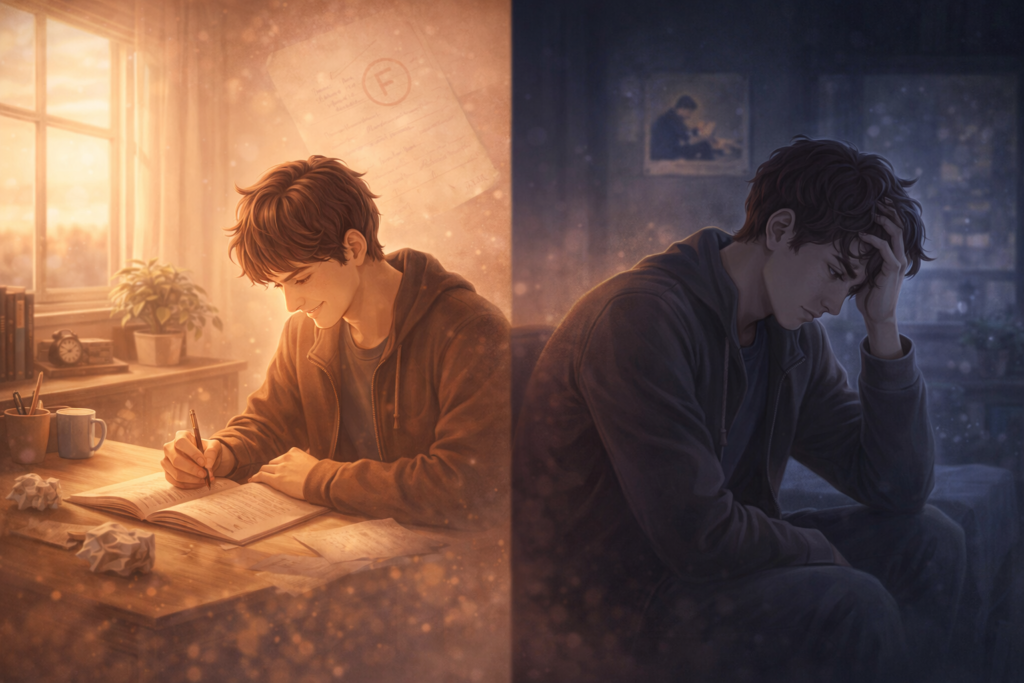
    contrast between failure fading and regret lasting

    Failure is an event that has already happened.

    It belongs to the past — fixed, unchangeable, and eventually processed by the brain as a completed experience.

    Regret, however, is different.

    Regret is not about what happened.
    It is about what could have happened.

    This difference makes regret far more persistent.

    Instead of closing a memory, regret keeps it open.


    2. Regret Lives in “What If”

    Think about common experiences of regret:

    • words spoken in anger during an argument
    • a missed opportunity that never returned
    • a decision not taken at a crucial moment

    Regret does not come from reality alone.
    It comes from imagined alternatives.

    The mind constantly asks:

    • What if I had acted differently?
    • What if I had chosen another path?

    These imagined scenarios are replayed again and again.

    This repetition is what makes regret last longer than failure.


    3. The Brain Replays Possibilities

    Psychologist Daniel Gilbert explains regret as the brain’s attempt to “edit the past.”

    This process is known as counterfactual thinking — imagining alternative outcomes to real events.

    The human brain, particularly the prefrontal cortex, actively simulates these “what if” scenarios.

    What is remarkable is this:

    The brain responds to imagined possibilities almost as strongly as it does to real events.

    This means that regret is not just a memory —
    it is a continuously recreated emotional experience.

    Research also suggests that regrets about inaction often last longer than regrets about actions.

    In other words, what we did not do may stay with us longer than what we did.

    person imagining alternative life scenarios

    4. Can Regret Be Useful?

    At first glance, regret seems like a negative emotion.

    But from an evolutionary perspective, regret serves an important function.

    It helps us:

    • learn from past decisions
    • adjust future behavior
    • reflect on moral and social actions

    Regret is a form of cognitive feedback.

    It allows us to simulate better choices without actually reliving the situation.

    In this sense, regret is not just pain.
    It is a tool for growth.


    Conclusion: Learning to Live with Regret

    Regret is not something we need to erase.

    It is something we need to understand.

    Failure ends.
    Regret continues.

    But that continuation also gives us direction.

    Instead of saying,
    “I should have done that,”

    we can learn to say,
    “Next time, I will do it differently.”

    A life without regret may not be possible.
    But a life that knows how to use regret wisely —
    that is a life shaped by reflection and growth.

    Question for Readers

    When you think about your past, do you remember your failures — or your regrets more clearly?

    Are there moments where you find yourself replaying what could have been, rather than what actually happened?

    In a world shaped by constant choices, we might ask a deeper question:

    Is regret something we should avoid, or something we can learn to use as a guide for better decisions?

    Related Reading

    The tension between emotion and judgment is further examined in Why We Excuse Ourselves but Blame Others, where the way we interpret our own actions and others’ mistakes reveals how memory and bias shape our sense of responsibility and regret.

    From a broader perspective on emotional awareness, Why It Feels Like Everyone Is Watching You: The Spotlight Effect explores how our perception of being observed amplifies emotional experiences, suggesting that the intensity of self-consciousness can make certain memories—especially those tied to regret—linger longer than others.


    References

    1. Gilbert, D. T. (2006). Stumbling on Happiness. New York: Knopf. This book explores how humans predict and mispredict their emotional futures, offering key insights into the psychology of regret and counterfactual thinking. Gilbert explains how the mind continuously reconstructs past experiences, which helps explain why regret lingers over time.
    2. Zeelenberg, M., & Pieters, R. (2007). A Theory of Regret Regulation 1.0. Journal of Consumer Psychology, 17(1), 3–18. This paper presents regret as a regulatory emotion that influences decision-making and behavior. It highlights how regret functions as a cognitive mechanism for evaluating choices and guiding future actions.
    3. Camille, N., Coricelli, G., Sallet, J., Pradat-Diehl, P., Duhamel, J. R., & Sirigu, A. (2004). The Involvement of the Orbitofrontal Cortex in the Experience of Regret. Science, 304(5674), 1167–1170. This neuroscientific study identifies the brain regions associated with regret, showing how the orbitofrontal cortex processes alternative outcomes and emotional responses tied to decision-making.