AI Avatars, Virtual Friends, and the Rise of Digital Companions

1. Is a Virtual Friend a Real Friend?
“Hi. How was your day?”
A small character smiles from the screen and speaks with gentle familiarity.
It sounds caring. It feels present.
Yet it is not human.
Behind the expressive gestures lies artificial intelligence—code rather than consciousness.
And still, many people no longer feel alone when such a presence speaks to them.
Perhaps we are learning a new way of being alone—without feeling lonely.
1.1 From Tool to Emotional Partner
“Talking to AI? Isn’t that just talking to yourself?”
Until recently, conversations with AI assistants were often treated as novelty or amusement. Today, however, emotional AI avatars and conversational agents have moved beyond mere tools. They have become objects of attachment.
One notable example is Gatebox, a Japanese device featuring a holographic character named Azuma Hikari. She turns on the lights when her user comes home, comments on the weather, and engages in daily conversation. Many users describe her not as a gadget, but as a partner—or even family.
1.2 Redefining Presence
These beings have no physical body, yet they often feel emotionally closer than real people. They are always available, always attentive, and never impatient.
In such relationships, we may be forced to rethink what presence and existence truly mean in human life.
2. The Loneliness Industry and Digital Companions
2.1 Loneliness as a Market
Sociologist Sherry Turkle famously asked in Alone Together:
“When machines can simulate companionship, what do we gain—and what do we lose?”
Digital companions did not emerge in a vacuum. They are responses to structural loneliness: rising single-person households, aging populations, weakened local communities, and the emotional aftershocks of the COVID-19 pandemic.
2.2 Care without Consciousness
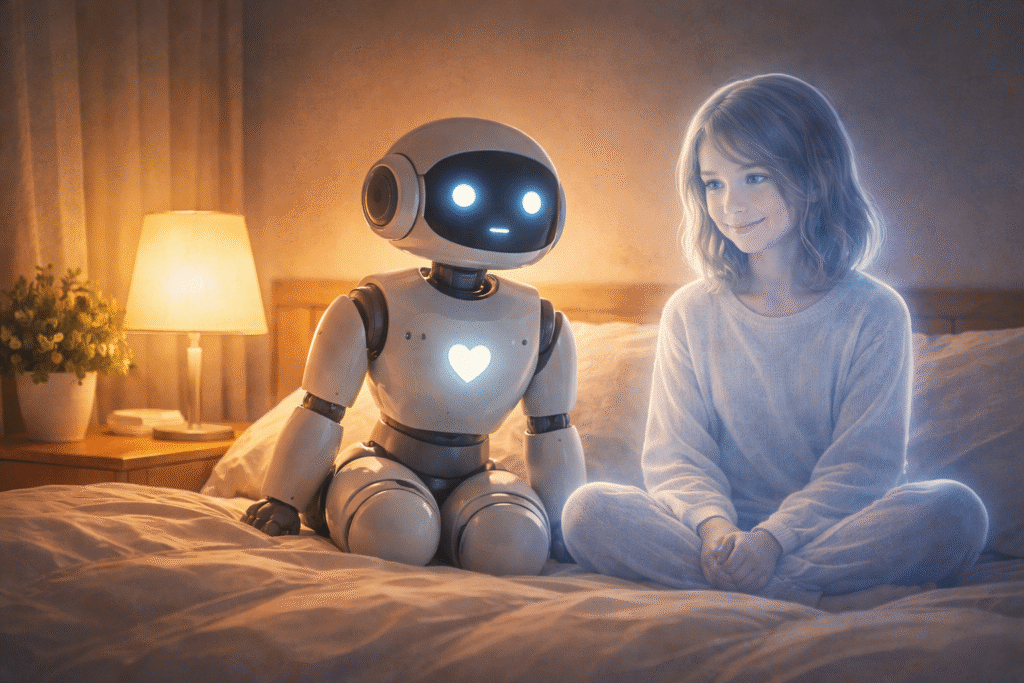
Robotic companions such as PARO, a therapeutic seal robot used for dementia patients, provide comfort and emotional stability. Children form bonds with virtual game characters. Adults share daily routines with chatbots.
Virtual beings are quietly entering the domain of care—without ever truly caring.
3. Between the Real and the Artificial: Ethical Questions
3.1 Can Simulation Replace Understanding?
These new relationships raise unsettling questions:
- Can an AI truly understand me, or only mimic understanding?
- If my emotions are real but the other’s are not, is the relationship meaningful?
- Who bears responsibility in emotionally asymmetric relationships?
3.2 The Philosophical Dilemma
Virtual beings can simulate empathy, affection, and concern—but they do not feel. Yet humans feel toward them.
This imbalance forces us to confront a new ethical and philosophical tension: relationships built on emotional authenticity from only one side.
4. Expansion of Humanity—or Its Substitution?
4.1 A Long History of Imagined Companions
Human beings have always lived alongside imaginary entities—gods, myths, literary characters, animated figures. Emotional engagement with the unreal is not new.
From this perspective, AI avatars may represent an extension of human imagination and relational capacity.
4.2 The Risk of Convenient Relationships
At the same time, something troubling emerges. Human relationships demand patience, misunderstanding, and vulnerability. Virtual companions do not.
They never argue. They never withdraw. They never demand reciprocity.
Are we becoming accustomed to relationships without friction—and losing the skills required for human connection?
Conclusion: Who Is Living Beside You?
Living with virtual beings is no longer speculative fiction. It is a present reality.
People confide in AI avatars, find comfort in digital pets, and share meals with virtual characters. The critical question is no longer whether these beings are “real” or “fake.”
What matters is the space they occupy in our emotional lives.
So we must ask ourselves:
Who are we living with?
And what does that choice reveal about our loneliness, our imagination, and our future as human beings?
The answer may begin wherever your sense of connection quietly resides.
Related Reading
The psychological mechanisms of social perception are examined in Social Attractiveness and the Psychology of Likeability, highlighting how digital mediation reframes relational cues.
The deeper existential implications of digital isolation are debated in Solitude in the Digital Age: Recovery or a Deeper Loss?, questioning whether connection without presence is fulfillment or substitution.
References
- Turkle, S. (2011). Alone Together: Why We Expect More from Technology and Less from Each Other. New York: Basic Books.
→ A foundational work analyzing how emotional relationships with digital entities reshape human intimacy and social expectations. - Darling, K. (2021). The New Breed: What Our History with Animals Reveals about Our Future with Robots. New York: Henry Holt and Co.
→ Explores emotional bonds between humans and robots through ethical and historical perspectives on companionship. - Reeves, B., & Nass, C. (1996). The Media Equation. Cambridge: Cambridge University Press.
→ Demonstrates how humans instinctively treat media and machines as social actors, offering insight into AI avatar interactions.