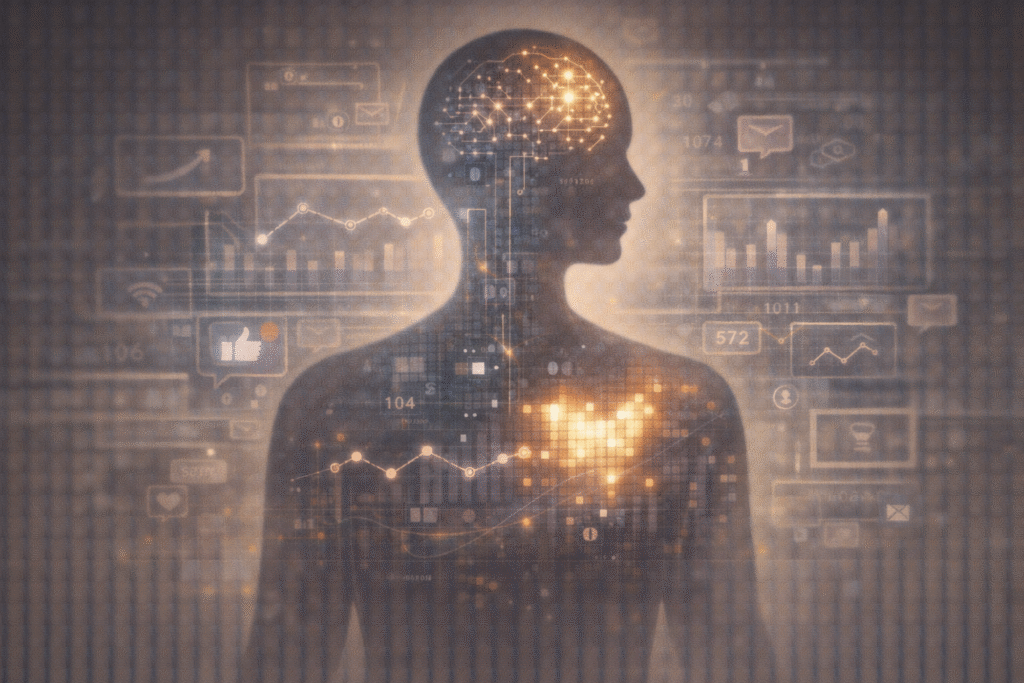
Big Data, Algorithms, and the Limits of Freedom
Can technology predict what we will do before we do it?
What once sounded like a line from science fiction is rapidly becoming part of everyday life. Every online search, GPS route, social media interaction, purchase, and wearable health record contributes to an expanding digital footprint. Together, these data streams allow machine learning systems to identify patterns and estimate future behavior with increasing accuracy.
Recommendation engines already predict what we are likely to watch, buy, or read next, while predictive analytics helps governments, hospitals, and businesses anticipate risks before they become visible. These developments promise greater efficiency, safety, and convenience—but they also raise profound ethical questions about privacy, autonomy, and freedom.
A predictable society offers undeniable advantages. Crimes may be prevented before they occur. Natural disasters can be anticipated earlier. Medical care can become preventive rather than reactive. Yet the same technologies that improve public safety may also reshape the boundaries of personal freedom.
When prediction becomes powerful enough, a deeper question emerges:
Does a predictable society make us safer—or does it create new forms of risk and control?
1. The Power of Prediction – Reading the Future Through Data

The foundation of a predictive society lies in big data and machine learning algorithms.
When vast amounts of digital records accumulate, algorithms can identify behavioral patterns that humans would struggle to detect.
Insurance companies analyze medical histories and lifestyle data to estimate an individual’s probability of illness.
Online retailers study browsing and purchasing behavior to predict what a customer might buy next.
Predictive policing systems attempt to estimate where crimes are most likely to occur and deploy police resources accordingly.
In many cases, these systems increase efficiency and allow institutions to act preventively rather than reactively.
However, efficiency raises a deeper ethical question:
What values are sacrificed when society becomes optimized for prediction?
Increasingly, recommendation systems, financial risk models, and healthcare analytics demonstrate that predictive technologies are no longer experimental—they have become part of everyday decision-making. The challenge is no longer whether prediction is possible, but how societies choose to govern its growing influence.
2. Surveillance in the Name of Safety

Prediction requires observation.
To forecast future behavior, systems must continuously monitor present behavior.
In smart cities, networks of cameras and sensors track traffic, movement, and public activity.
Online platforms collect enormous amounts of data about social interactions, political opinions, and personal preferences.
GPS tracking records our movement patterns and daily routines.
These systems are often justified in the name of safety, efficiency, or convenience.
But as surveillance expands, privacy can easily become the first casualty.
The risks become even more serious in authoritarian or weakly democratic systems, where data collection may be used not merely for safety but for political control and social manipulation.
Prediction, in such contexts, becomes a tool of power.
3. When Probability Becomes Destiny
Predictive algorithms are not neutral.
They learn from past data, and past data often contains social biases.
One widely discussed example involves the COMPAS algorithm, used in parts of the United States to estimate the likelihood that criminal defendants will reoffend.
Investigations revealed that the system disproportionately labeled Black defendants as high-risk compared to white defendants.
The algorithm did not invent the bias; it learned existing bias from historical data.
Yet once encoded into an algorithm, that bias gained the appearance of objectivity.
This creates a dangerous situation.
Predictions can begin to shape people’s opportunities and life chances.
Insurance premiums may rise unfairly.
Job opportunities may quietly disappear.
Individuals who have committed no crime may be classified as “high risk” and placed under surveillance.
In such cases, probability begins to function like destiny.
4. Finding a Balance Between Freedom and Control
A predictive society is not inherently harmful.
Predictive technologies can help prevent pandemics, anticipate climate disasters, and improve traffic safety.
They can also support early disease detection and more efficient public services.
The real question is not whether prediction should exist, but how it should be governed.
Several principles become essential.
Transparency – Citizens should know what data is collected and how predictive systems operate.
Accountability – Institutions must take responsibility when algorithmic predictions cause harm.
Consent and Choice – Individuals should retain meaningful control over how their personal data is used.
Oversight of Surveillance – Independent institutions must monitor how governments and corporations deploy predictive technologies.
Without these safeguards, predictive systems risk shifting societies from democratic accountability toward algorithmic control.
Recent international initiatives, including the European Union’s AI Act, emphasize that predictive AI systems should be transparent, accountable, and subject to human oversight. These efforts reflect a growing recognition that technological innovation must be accompanied by ethical governance rather than technological capability alone.
Conclusion: Judgment Deferred

A predictable society could become either safer or more oppressive.
The difference does not lie in the technology itself but in the values and institutions that govern its use.
The ability to predict the future does not grant the authority to determine it.
Prediction reveals possibilities, not inevitabilities.
If societies adopt predictive technologies without transparency, accountability, and ethical oversight, the same tools designed to protect citizens may gradually restrict their autonomy.
Recognizing both the power and the limits of predictive technologies is therefore the first step toward building a society where security, innovation, and human freedom can coexist. Prediction should inform human judgment—not replace it. The future of a predictable society will ultimately depend not on algorithms themselves, but on the ethical values and democratic institutions that govern their use.
A Question for Readers
If technology can accurately predict our behavior, should society use that power to prevent risks — or would doing so threaten our freedom?
Related Reading
The broader debate over surveillance, transparency, and data-driven societies is explored further in The Transparency Society: Foundation of Trust or Culture of Surveillance?, which examines how technologies designed to increase security and efficiency can also normalize continuous monitoring and reduce personal autonomy. This wider perspective provides an essential framework for understanding whether a highly predictable society ultimately protects freedom or quietly limits it.
The political consequences of algorithmic decision-making are explored further in Can Artificial Intelligence Make Better Laws?, where the growing role of AI in governance raises deeper questions about fairness, accountability, and the limits of automated decision-making. Together, these discussions highlight why predictive technologies should assist human judgment rather than replace it.
References
- Zuboff, S. (2019). The Age of Surveillance Capitalism: The Fight for a Human Future at the New Frontier of Power. PublicAffairs.
This work examines how big data and predictive analytics reshape power structures in modern society. Zuboff argues that surveillance capitalism turns human experience into behavioral data, enabling corporations and institutions to predict and influence individual actions at unprecedented scale. - Lyon, D. (2018). The Culture of Surveillance: Watching as a Way of Life. Polity Press.
Lyon explores how surveillance has moved beyond security systems to become a cultural condition of everyday life. His work explains how practices justified in the name of safety gradually normalize constant monitoring within modern societies. - O’Neil, C. (2016). Weapons of Math Destruction: How Big Data Increases Inequality and Threatens Democracy. Crown.
→ O’Neil demonstrates how algorithmic decision systems can reinforce social inequalities. Through real-world examples, she shows how opaque mathematical models can amplify bias while appearing neutral and objective. - Pasquale, F. (2015). The Black Box Society: The Secret Algorithms That Control Money and Information. Harvard University Press.
Pasquale analyzes the growing opacity of algorithmic systems that influence financial markets, search engines, and digital platforms. His work emphasizes the urgent need for transparency and accountability in algorithmic governance. - Harcourt, B. E. (2015). Exposed: Desire and Disobedience in the Digital Age. Harvard University Press.
Harcourt examines how voluntary data sharing and digital tracking combine to produce systems capable of predicting and regulating human behavior. The book raises profound philosophical questions about freedom and self-exposure in the digital era.