Blog

  • Robot Labor and Human Dignity

    How the Meaning of Work Is Changing in the Age of Automation
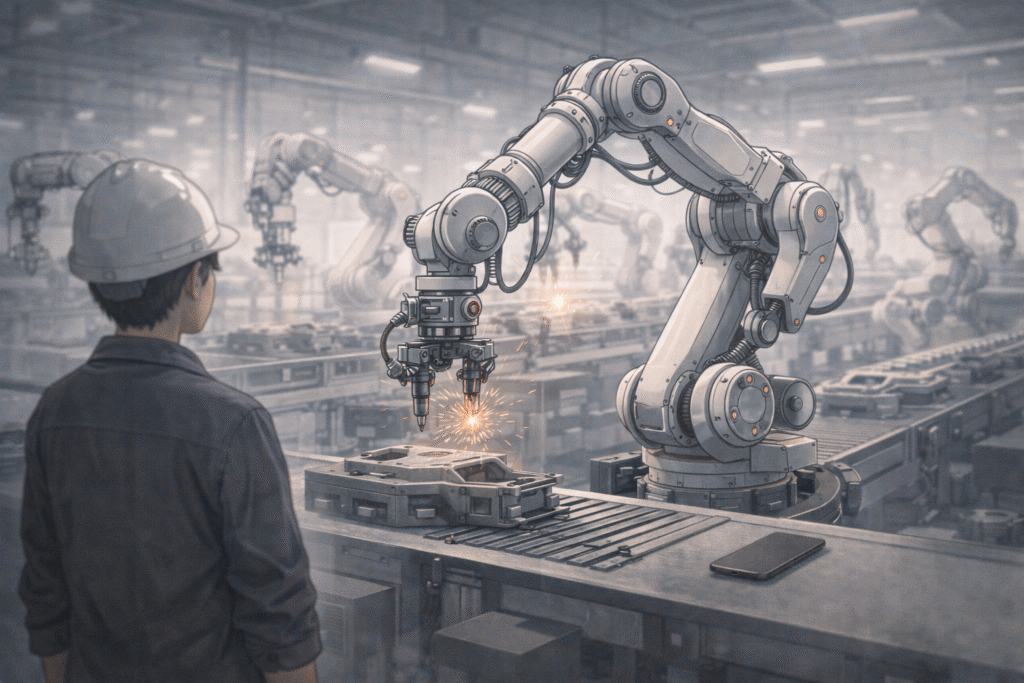
    Robots replacing human labor in modern workplace

    1. The Replacement of Labor — Toward a Workplace Without Humans

    What if a society emerges in which humans no longer need to work?
    As machines take over more tasks, efficiency rises—but at the same time, a deeper question begins to surface.

    Factory lines, logistics centers, cafés, even news article writing—
    robots and artificial intelligence are already at work.

    They do not tire, complain, or demand rest.
    They operate twenty-four hours a day with consistent productivity.

    According to a McKinsey report, up to 30 percent of global jobs may be automated by 2030.
    The more routine and rule-based the task, the faster it is replaced.

    Yet here lies the paradox of technological progress.
    As efficiency increases, the dignity attached to human labor begins to erode.

    When a job that once provided pride and identity is no longer “needed,”
    people experience more than economic unemployment.
    They confront an existential anxiety:

    Who am I, if my work no longer has a place in society?

    Work has never been merely a means of survival.
    It is how humans relate to society—and how they affirm their own value.


    2. Human–Robot Coexistence — Collaboration or Subordination?
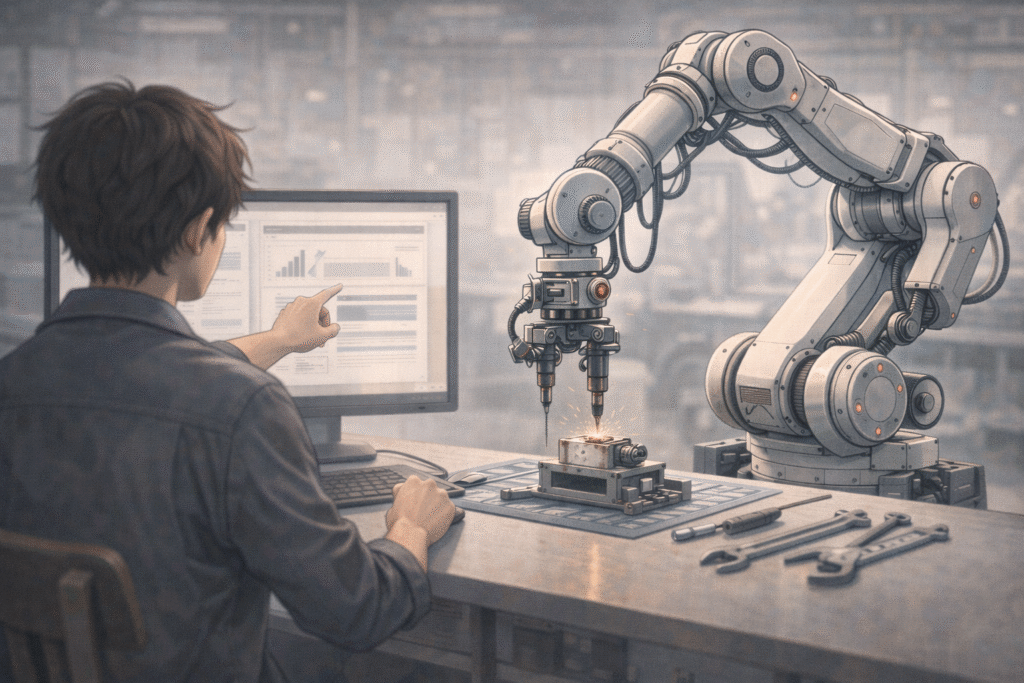
    Human and robot collaboration showing workplace hierarchy

    As robots enter workplaces, humans are expected to collaborate with them.

    In factories, machines handle heavy or repetitive tasks,
    while humans become supervisors or assistants.

    On the surface, this looks like coexistence.
    In reality, a hierarchy quietly emerges.

    Robots are evaluated purely by efficiency,
    and humans are increasingly measured by the same standard.

    The “inefficient human” is gradually pushed to the margins.

    This creates a new pressure:
    humans must now outperform machines on machine-like terms.

    As a result, workplaces lose space for emotion, rest, and imperfection.

    The question inevitably arises:

    Do robots assist human labor—or do they redefine how humans are judged?


    3. Universal Basic Income — The Ethics of Living Without Work

    As automation expands, societies search for new institutional responses.

    One prominent proposal is Universal Basic Income (UBI)
    a system in which AI-generated wealth is shared,
    and every citizen receives a guaranteed income regardless of employment.

    Pilot programs have been tested in countries such as Finland, Canada, and Switzerland.

    Supporters argue that UBI can reduce inequality and allow people
    to focus on creative, social, and caring activities.

    Critics worry that it weakens the meaning of work
    and blurs the sense of social responsibility.

    UBI is not merely an economic policy.
    It is an ethical debate about the value of work and the meaning of life.

    Are we ready to accept a society where survival is detached from labor?


    4. A New Work Ethic — From Productivity to Meaning

    The industrial era celebrated diligence, discipline, and productivity.

    In the age of AI, these virtues are no longer absolute.

    Philosopher Byung-Chul Han argues in The Burnout Society
    that modern individuals become “achievement subjects,”
    endlessly exploiting themselves in the name of performance.

    If machines take over production, humans no longer need to exist
    solely as producers of measurable output.

    Instead, human labor can be reoriented toward
    creation, care, empathy, education, and reflection.

    The ethical center of work must shift
    from efficiency to human meaning.


    5. Redefining the Meaning of Work — Toward a Dignified Human Life

    Even in an era that speaks of the “end of work,”
    the meaning of work remains central to human life.

    It is not disappearing—it is transforming.

    If robots replace physical labor,
    humans must reclaim work as an activity of thinking, feeling, and relating.

    Caring for others, building social bonds,
    creating art, teaching, and nurturing communities—
    these forms of non-economic labor must be revalued.

    A society where humans do not have to work
    is not a society where work loses meaning.

    It is a society that must rediscover what work truly means.


    Conclusion — Human Dignity Still Resides in Work

    Even if robots and AI dominate the workplace,
    human dignity cannot be automated.

    Humans are not merely beings who work.
    They are beings who create meaning through work.

    The task ahead is not to exclude robots,
    but to ensure that technology and humanity together
    shape forms of labor worthy of human dignity.

    What we must protect is not jobs themselves,
    but the dignity that emerges through meaningful work.

    Human reflecting on dignity and meaning of work

    A society where one can live without working—
    yet still wants to work—
    that is a truly human society.


    References

    1. Brynjolfsson, E., & McAfee, A. (2014). The Second Machine Age. New York: W. W. Norton & Company.
      This influential work analyzes how digital technologies transform labor and productivity, highlighting both economic growth and the risk of job displacement in automated societies.
    2. Srnicek, N., & Williams, A. (2015). Inventing the Future: Postcapitalism and a World Without Work. London: Verso.
      The authors explore post-work futures, automation, and basic income, offering a philosophical vision of how societies might reorganize labor beyond traditional employment.
    3. Frey, C. B., & Osborne, M. A. (2017). “The Future of Employment: How Susceptible Are Jobs to Computerisation?” Technological Forecasting and Social Change, 114, 254–280.
      This empirical study estimates the probability of job automation across occupations, providing a data-driven foundation for debates on technological unemployment.
    4. Han, B.-C. (2015). The Burnout Society. Stanford, CA: Stanford University Press.
      Han critiques contemporary performance-driven culture, arguing that excessive self-optimization erodes human dignity and leads to psychological exhaustion.
    5. Arendt, H. (1958). The Human Condition. Chicago: University of Chicago Press.
      Arendt’s classic distinction between labor, work, and action offers a philosophical framework for rethinking human dignity and meaningful activity in post-industrial societies.

  • The Standardization of Experience

    Why Travel, Hobbies, and Life Are Becoming Increasingly Similar

    Similar travel photos repeating across social media

    1. Why Are Our Experiences Becoming So Alike?

    Scrolling through travel photos online, familiar scenes appear again and again.

    Similar cafés, identical poses, the same backdrops, almost interchangeable captions.

    Hobbies follow the same pattern.
    Trending workouts, recommended activities, and “hot right now” interests spread rapidly.

    Although we live separate lives,
    the shape of our experiences is becoming strikingly similar.

    This question naturally arises:

    Why are “personal experiences” slowly disappearing?


    2. How Recommendation Systems Flatten Experience

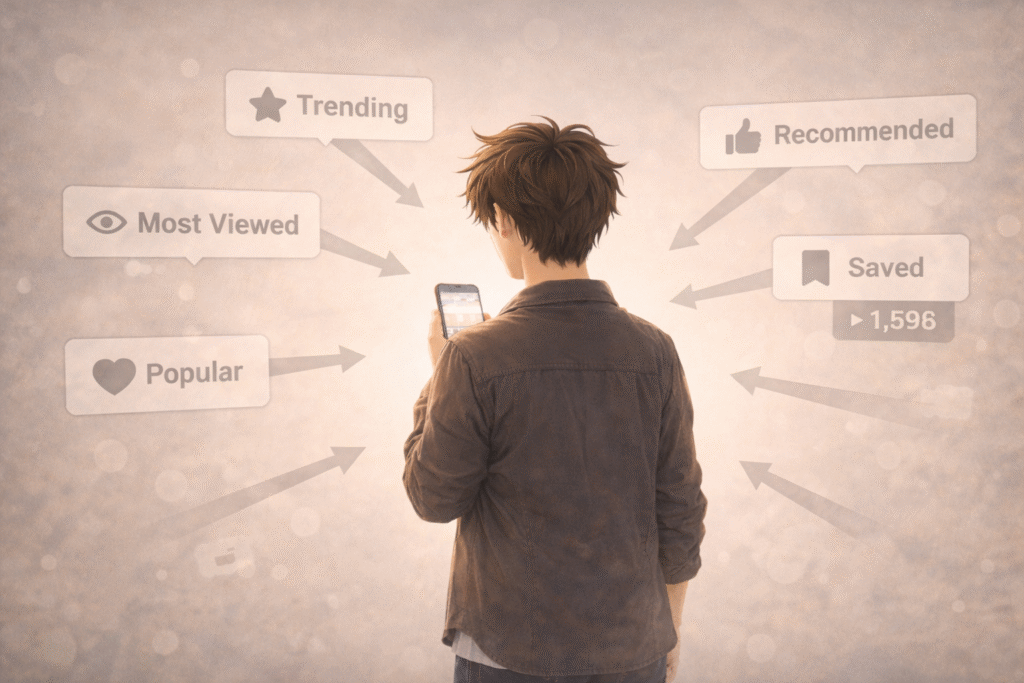
    AI-assisted imagery:
    A person hesitating in front of a recommendation screen, surrounded by repeated choices.


    2.1 The Age of Algorithmic Choice

    Today, many experiences begin not with exploration, but with recommendation.

    Travel destinations are introduced as “most saved places.”
    Music arrives as “playlists curated for you.”
    Hobbies are presented as “what people are doing most right now.”

    Algorithms reduce decision fatigue efficiently,
    but they also guide experiences along similar paths.

    In exchange for convenience,
    we receive experiences that are increasingly standardized.

    Algorithm recommendations shaping similar life choices

    2.2 Social Proof and the Comfort of Safe Choices

    Psychology describes our tendency to value what many others choose as social proof.

    Likes, reviews, and view counts function as indicators of quality.
    As a result, people select experiences that seem less likely to fail.

    Unfamiliar or uncertain experiences are avoided,
    and this repetition gradually erodes diversity.


    2.3 When Experience Becomes Performance

    Experience is no longer just something we live through.

    It becomes something to display, document, and explain.

    Places that photograph well are favored.
    Experiences that are easy to describe are preferred.
    Personal yet inexpressible moments quietly disappear.


    3. Is Experience a Commodity — or a Trace of Being?

    Philosophically, experience is not something to be consumed or exchanged.

    It is a trace of time that shapes who we are.

    Standardized experience shifts the question from
    “What did this mean to me?”
    to
    “How will this look to others?”

    At that moment, experience becomes an external product rather than internal accumulation.

    True experience is often inefficient, difficult to explain,
    and sometimes includes failure.

    Yet it is precisely there that people discover their own rhythm and sensibility.


    4. Conclusion: Reclaiming One’s Own Experience

    AI-assisted imagery:
    A solitary figure reflecting in a quiet space, recovering personal experience.


    The problem is not recommendation systems themselves,
    but our uncritical dependence on them.

    When we follow the same paths without asking what they mean to us,
    our lives begin to resemble one another.

    Wisdom today does not lie in endlessly seeking novelty.

    Quiet reflection on reclaiming personal experience

    It lies in pausing before a given choice and asking:

    “Why does this experience matter to me?”

    Returning experience to the individual —
    that is the most personal form of resistance
    in an age of standardization.


    📚 References

    1. Han, B.-C. (2017). The Expulsion of the Other. Cambridge: Polity Press.
      Han analyzes how sameness replaces difference in contemporary society, offering insight into how standardized experiences weaken individuality.
    2. Zuboff, S. (2019). The Age of Surveillance Capitalism. New York: PublicAffairs.
      Zuboff examines how platforms and algorithms predict and shape human behavior, revealing how experience design is shifting from individuals to systems.
    3. Pine, B. J., & Gilmore, J. H. (1999). The Experience Economy. Boston: Harvard Business School Press.
      This foundational work explains how experiences become economic goods, providing a framework for understanding the commodification and standardization of experience today.
  • Is Freedom an Expansion of Choice — or an Expansion of Anxiety?

    The Paradox of Modern Freedom and Its Psychological Burden

    Person standing at crossroads facing multiple choices

    1. “Why Does More Choice Make Us Feel More Anxious?”

    From the moment we begin our day, we are confronted with countless choices.

    What to wear, what to eat, what to watch, which platform to use.

    Modern society tells us that the wider our range of choices becomes, the freer we are.
    Yet strangely, as choices multiply, what arrives more often is not lightness or ease, but a quiet and persistent anxiety.

    Perhaps the expansion of choice is not the expansion of freedom,
    but the expansion of responsibility — and anxiety.

    If so, what does freedom really mean in contemporary society?
    Is it truly the freedom we believe it to be?


    2. Why Anxiety Grows as Choice Expands

    2.1 Choice Grants Freedom — and Assigns Responsibility

    As options increase, so does the pressure of a single message:

    “The outcome is entirely your responsibility.”

    In a world where both success and failure are framed as personal results,
    choice becomes less a form of freedom and more a psychological burden.


    2.2 The Fear of Missing Out (FOMO)

    Psychological research suggests that as the number of choices increases, satisfaction often decreases.

    Before choosing, we worry that something better might exist.
    After choosing, we wonder whether we made the right decision.

    This is known as FOMO (Fear of Missing Out) — the anxiety of potential loss.
    Choice, instead of liberating us, traps us between anticipation and regret.

    Overwhelming digital choices creating social pressure

    2.3 Expanded Choice as a Market Strategy

    Diversity appears to empower consumers, but it also functions as a strategy through which responsibility is transferred.

    Under the logic of “free choice,” corporations distance themselves from outcomes.
    Dissatisfaction, regret, and failure are returned to the individual consumer.

    What looks like freedom often masks a redistribution of responsibility.


    2.4 Choice in the Age of Social Media

    In the era of social media, comparison is unavoidable.

    Online spaces are filled with people who appear to have made better, faster, more efficient choices.
    Against this backdrop, our own decisions begin to feel insufficient.

    Freedom of choice gradually turns into a prison of comparison.


    3. What Is Freedom — and Why Does It Become a Paradox?

    3.1 Existential Freedom: “Freedom Is Heavy”

    Existentialist philosopher Jean-Paul Sartre argued that human beings are fundamentally free — but not in a comforting sense.

    “We are condemned to be free,” he wrote.

    Freedom implies choice.
    Choice implies responsibility.
    Responsibility inevitably produces anxiety.

    As freedom expands, anxiety does not disappear — it grows alongside it.


    3.2 Zygmunt Bauman: Freedom as a Structure of Anxiety

    According to Bauman, modern society systematically shifts responsibility onto individuals.

    Under the banner of personal choice, corporations, states, and institutions withdraw their obligations.
    Although choices seem to increase, the social foundations needed to sustain them weaken.

    The result is a paradox:
    freedom expands, while stability erodes.


    3.3 Isaiah Berlin: The Difference Between Choosing and Living Freely

    Berlin distinguished between two forms of freedom:

    • Negative freedom: freedom from external interference
    • Positive freedom: the ability to shape one’s life with meaning and purpose

    Modern society focuses heavily on expanding negative freedom by multiplying options.
    But without positive freedom — self-understanding and direction — more choice can actually diminish freedom.

    Choice is external.
    Freedom is internal.


    4. Freedom Is Not a Question of Choice — but of Criteria

    We often overlook a more fundamental issue than choice itself:

    By what criteria do we choose?

    No matter how many options exist, without internal values and standards, choice leads only to anxiety.

    Freedom does not emerge from the number of options available,
    but from the ability to orient oneself within them.


    5. Conclusion: True Freedom Begins with the Depth of One’s Criteria

    Modern society tells us:

    “The more choices you have, the freer you are.”

    Yet as choices expand, anxiety deepens and stability weakens.
    The expansion of choice often enlarges uncertainty rather than freedom.

    Quiet reflection on inner criteria and freedom

    So where does genuine freedom begin?

    Not in the breadth of options,
    but in personal values, inner standards, and a sense of direction.

    Choice belongs to the external world.
    Freedom belongs to the inner one.

    In an age of limitless options, freedom becomes less about choosing more —
    and more about understanding oneself.

    Only those who possess clear criteria for their lives can remain free, even amid uncertainty.


    References

    1. Schwartz, B. (2004). The Paradox of Choice: Why More Is Less. New York: HarperCollins.
      Schwartz argues that an excess of choice increases anxiety and regret rather than freedom. His work provides a foundational psychological explanation for why modern societies experience the paradox of choice.
    2. Fromm, E. (1941). Escape from Freedom. New York: Farrar & Rinehart.
      Fromm explains that freedom involves responsibility and fear, leading individuals to flee from it. His analysis offers deep insight into why expanded choice can generate insecurity rather than empowerment.
    3. Bauman, Z. (2000). Liquid Modernity. Cambridge: Polity Press.
      Bauman describes a social condition where constant change undermines stable identity. His concept of liquid modernity explains how freedom and anxiety become structurally intertwined.
    4. Han, B.-C. (2010). The Burnout Society. Berlin: Matthes & Seitz.
      Han critiques modern society’s culture of unlimited possibility, arguing that excessive self-choice leads to exhaustion and self-exploitation rather than liberation.
    5. Taylor, C. (1989). Sources of the Self. Cambridge, MA: Harvard University Press.
      Taylor explores how modern identity is formed through moral frameworks and self-interpretation. His work clarifies why freedom cannot be reduced to mere choice, but must involve meaningful self-orientation.
  • The Memory of Receipts – How Everyday Consumption Leaves Social Traces

    Reflections sparked by a discarded piece of paper

    Faded receipt on a café table capturing a moment of everyday consumption

    A Discarded Receipt, A Social Trace

    A few days ago, while organizing my wallet, I found a receipt from a café I had visited months earlier.
    The text had faded, leaving only fragments — the price of a cup of coffee, the time of payment, part of a familiar card number.

    For a moment, I paused.

    It was just a small piece of paper, yet it quietly preserved where I had been and, in some subtle way, how I had felt at the time. What we casually throw away as receipts are, in fact, traces of a day — and records of society itself.

    A single receipt reflects not only personal consumption, but also the rhythm of a city, the preferences of a generation, and the flow of an economy. In that sense, it becomes a small yet powerful piece of sociological evidence.

    1. A Transparent Society, Recorded Consumption

    Modern society places great value on transparency.
    Card payments, loyalty points, and digital receipts ensure that nearly all consumption is stored, tracked, and analyzed as data.

    This brings convenience — but it also signals the surveillance of memory.

    In the past, spending money meant that the moment disappeared as soon as the transaction ended. Today, we live in a society where every act of consumption remains as a record.

    French philosopher Jean Baudrillard, in The Consumer Society, argued that modern consumption is not merely an economic act but a symbolic one. Receipts function as evidence of this symbolic consumption, revealing our social position, preferences, and psychological desires.

    Even a casually discarded receipt contains traces of the social self — a reminder that individual consumption has become a social signal. What we buy, where we eat, and which brands we choose now speak a language of identity on our behalf.

    Discarded receipts symbolizing recorded consumption in a data-driven society

    2. Receipts as Personal Diaries

    Sociologist Zygmunt Bauman described modern individuals as consuming beings. Consumption, in this sense, is not a simple act but a form of self-expression.

    Receipts are the most concrete records of that expression.

    If one were to glance at someone else’s receipt, it would not be difficult to imagine their preferences — what they like to eat, where they spend time, even hints of their mood that day. Beneath the numbers lies far more context than accounting alone can capture.

    A receipt is not just a financial document. It is a fragment of a human story written through consumption.


    3. Discarded Memories, Persistent Traces

    A pile of discarded receipts next to a card reader — a quiet symbol of everyday records being left behind.

    The problem is how easily these fragments of memory are thrown away.

    Receipts piled on café tables or dropped into street-side trash bins reflect a society in which consumption ends in immediate forgetting. When we say, “I don’t need the receipt,” we may unknowingly be erasing a small trace of memory.

    And yet, the data does not disappear.

    While the paper vanishes, the record remains — stored in corporate databases, used for marketing strategies, tax policies, and consumption pattern analysis. The receipt as an object may be gone, but the system remembers.


    4. Conclusion: Receipts and the Shadow of Transparency

    Sociologist Maurice Halbwachs argued that memory is formed within social frameworks. A receipt, then, is not merely a private record of a transaction, but a fragment of collective memory.

    A café receipt from a journey, a purchase made on the day of one’s first paycheck — these small records trace the ways individuals relate to their time and society. Through such fragments, personal experience quietly becomes social history.

    Receipts also symbolize the promise — and the shadow — of a transparent society. Within them coexist convenience and accountability, remembrance and erasure. While the paper itself may disappear, the data it represents continues to circulate, shaping markets, policies, and identities.

    We live between what is easily forgotten and what is endlessly stored. A faded receipt tucked inside a wallet becomes a silent portrait of the self — a social self written through consumption.

    And the numbers printed on that fragile paper ask us, quietly but persistently:

    “For what purpose, and with what state of mind, did you choose to consume?”

    Hand holding an old receipt inviting reflection on personal consumption

    References

    1. Baudrillard, J. (1970). The Consumer Society. Paris: Gallimard.
      This seminal work interprets modern consumption as a system of signs and symbols. It provides a theoretical foundation for reading receipts not as neutral transaction records but as social texts encoding symbolic meaning.
    2. Halbwachs, M. (1950). The Collective Memory. Paris: Presses Universitaires de France.
      Halbwachs’ concept of collective memory emphasizes that memory is socially constructed. His framework is essential for understanding receipts as social artifacts that extend beyond individual experience.
    3. Hoskins, A. (2011). Digital Memory Studies: Media Pasts in Transition. London: Routledge.
      This work explores how memory is stored, transmitted, and erased in the digital age. It is particularly useful for interpreting the transition from paper receipts to digital records as a process of memory dematerialization.
  • Reversing Aging: Is Eternal Youth a Blessing or a Curse for Humanity?

    Human silhouette questioning aging reversal and time

    If Humans Never Aged

    Until the late twentieth century, “anti-aging” was little more than a marketing phrase in cosmetic advertisements.
    Today, however, advances in biotechnology and artificial intelligence have brought the idea of reversing aging out of the realm of imagination and into scientific reality.

    Genetic reprogramming that restores aged cells, regenerative medicine capable of repairing damaged organs, and even attempts to digitally preserve neural patterns—humanity is steadily pulling its ancient dream of conquering death into the laboratory.

    As science accelerates, a deeper question quietly emerges:

    If aging could be reversed, would eternal youth truly make us happier?
    And if humans no longer grew old, what would become of the meaning of life itself?

    We may believe we are chasing youth, but in truth, we may be redefining what it means to be human.


    1. Mapping Immortality: How Science Reimagines Aging

    Cellular aging and biotechnology research illustration

    Aging is no longer treated as an unavoidable destiny, but increasingly as a treatable biological condition.

    Research institutions such as Altos Labs, Google-backed Calico, and longevity startups funded by figures like Elon Musk and Jeff Bezos focus on cellular reprogramming—switching aged cells back into a youthful state.

    A landmark breakthrough came from Japanese scientist Shinya Yamanaka, whose discovery of the Yamanaka factors demonstrated that mature cells could revert to pluripotent stem cells. Alongside this, researchers explore telomere extension, suppression of senescence-associated secretory phenotypes (SASP), and molecular repair of age-related damage.

    The goal is singular: to halt or reverse aging itself.

    Yet as scientific possibility expands, so too does the ethical weight of what such power implies.


    2. The Case for Blessing: Health, Knowledge, and Human Potential

    Supporters of age-reversal technologies view them as a profound advance in human welfare.

    2.1 Extending Healthy Lifespans

    The promise is not merely longer life, but longer healthy life. Reductions in age-related diseases such as dementia, cardiovascular illness, and cancer could ease healthcare burdens while improving overall well-being.

    2.2 Accumulated Wisdom

    Longer lifespans allow individuals to accumulate deeper knowledge and experience, potentially transforming society into one guided by long-term insight rather than short-term urgency.

    2.3 Liberation from Biological Limits

    From this perspective, overcoming aging is framed as the ultimate expression of human progress—liberation from suffering, decay, and biological constraint.


    3. The Case for Curse: Inequality, Stagnation, and Emptiness

    Critics argue that eternal youth may carry consequences far darker than its promise.

    3.1 Longevity Inequality

    Life-extension technologies are likely to remain expensive and exclusive, creating a new class divide based not on wealth alone, but on lifespan itself. In such a world, life becomes a commodity—and dignity risks becoming conditional.

    3.2 Frozen Generations

    If humans live for centuries, social renewal may stall. Power structures could calcify, innovation slow, and younger generations struggle to find space in a world ruled by the perpetually young.

    3.3 Loss of Meaning

    Mortality gives urgency to human life. Without death, the pressure that gives meaning to choice, love, and responsibility may quietly dissolve—replacing purpose with endless repetition.

    Eternal life, critics warn, may ultimately become eternal fatigue.


    4. Philosophical Reflections: Does Immortality Humanize Us?

    Philosopher Martin Heidegger described humans as beings toward death (Sein-zum-Tode). Death, in his view, is not merely an end, but the condition that makes authentic living possible.

    Similarly, Hans Jonas warned that technological mastery over life demands an ethics of responsibility. Just because something can be done does not mean it should be done.

    From this perspective, age reversal is not simply a medical innovation—it is an existential experiment that reshapes the boundary between life and death itself.


    5. Humanity’s Choice: Desire Versus Responsibility

    The ability to reverse aging is both a scientific marvel and a moral trial.

    Technology can reduce suffering, but it can also erode our understanding of limits. Extending life is meaningful only if we also preserve the wisdom required to live it well.

    Without that wisdom, humanity risks becoming not immortal—but endlessly exhausted.


    Conclusion — What Truly Matters More Than Eternal Life

    Age-reversal technologies symbolize extraordinary medical progress. Yet progress alone does not guarantee happiness.

    What humans may ultimately seek is not infinite time, but meaningful time—a finite life lived with depth, urgency, and care.

    More important than a body that never ages
    may be a mind that can still accept aging.

    Human reflection on longevity and aging ethics

    Related Reading

    The ethical and existential implications of redesigning the human body are further explored in AI Beauty Standards and Human Diversity – Does Algorithmic Beauty Threaten Us? , where technological norms begin to redefine what it means to be human.

    At a psychological level, the experience of aging and the perception of time are deepened in The Texture of Time: How the Mind Shapes the Weight of Our Moments which reflects on how lived experience gives meaning to the passage of time.

    References

    Yamanaka, S. (2012). Induced Pluripotent Stem Cells: Past, Present, and Future. Cell Stem Cell, 10(6), 678–684.
    → Foundational research demonstrating the biological possibility of cellular rejuvenation through reprogramming.

    de Grey, A. (2007). Ending Aging: The Rejuvenation Breakthroughs That Could Reverse Human Aging in Our Lifetime. New York: St. Martin’s Press.
    → A comprehensive exploration of life-extension science alongside its ethical implications.

    Jonas, H. (1984). The Imperative of Responsibility: In Search of an Ethics for the Technological Age. University of Chicago Press.
    → A philosophical framework emphasizing ethical restraint in the face of powerful technologies.

    Kass, L. R. (2003). Ageless Bodies, Happy Souls: Biotechnology and the Pursuit of Perfection. The New Atlantis, 1, 9–28.
    → A critical examination of how biotechnology challenges human dignity and meaning.

  • Leaning Into the Wind – Standing with Invisible Forces

    Emotional watercolor illustration, person standing in the wind

    1. Introduction – A Small Moment of the Day

    It became clear that today was a windy day the moment one stepped outside.
    The wind could not be seen, yet coats fluttered and hair lost its shape.
    There was no doubt—it was there.

    “Why does the heart feel unsettled as well?”
    A pause followed, and the sky came into view.

    Life has winds like this.
    Invisible forces that still move us—
    expectations, relationships, circumstances, time.

    Today felt like standing quietly before those unseen forces.


    2. A Light Thought for Today

    As the wind tugged at the coat, a quiet thought surfaced:
    “Could you be a little gentler today?”

    Then came a soft smile.
    “Or maybe it isn’t the wind at all.
    Maybe the mind is simply louder than usual.” 😄

    Humor, even in small moments, lightens the stance.


    3. Reflection – What This Moment Revealed

    Emotional watercolor illustration, person adjusting stance in the wind

    We often believe that strength means standing firm on our own.
    Not swaying. Not leaning. Not relying.

    Yet the truth is simpler.
    Human beings are not meant to stand alone.

    The wind sometimes pushes us back.
    At other times, it presses gently from behind.

    Leaning—briefly—into an invisible force
    is not weakness.

    Sensing the direction of the wind
    and adjusting one’s posture accordingly
    may be the wiser form of balance.


    4. A Gentle Practice

    Naming Today’s Wind

    Take a moment to recall one invisible force that unsettled you today.

    • Someone’s words
    • An unexpected situation
    • A quiet emotion
    • A vague sense of unease

    Then complete this sentence:

    “The wind that moved me today was ___.”

    This single line reveals where you have been standing.


    5. A Small Action for the Day

    Try shifting your stance—
    standing with the wind at your back, then slightly to the side.

    Say this quietly, if it helps:
    “I don’t need to block every wind.
    Some arrive only to show me my direction.”

    The wind may continue to blow,
    but the body often feels steadier once resistance softens.


    6. Quote of the Day

    “Life is like riding a bicycle. To keep your balance, you must keep moving.”
    — Albert Einstein

    Balance is not stillness—it is motion within change.


    7. Closing – Returning Gently to Ourselves

    Emotional watercolor illustration, calm figure leaning into soft wind

    Invisible forces can unsettle us,
    but they can also support us.

    What matters is not denying their presence,
    but noticing their direction
    and gently adjusting our stance.

    Even in the wind,
    it is possible to stand without collapsing.

    And perhaps to say, quietly:

    “I am leaning into invisible forces,
    and I am still standing.”


    8. A Thought to Remember

    In psychology, this approach is known as adaptive coping
    responding to uncontrollable external stressors
    not by resisting them entirely,
    but by adjusting flexibly while protecting oneself.

    It is not avoidance.
    It is an active, grounded choice.


    Today’s One-Line Insight

    “Even unseen winds can help us remain upright.”

  • The Cultural Meaning Between Companion Animals and Livestock

    How culture determines whether animals become companions or commodities?

    A pet dog indoors contrasted with farm animals in the distance

    1. Introduction: How Culture Draws the Line Between Animals

    The animals we live alongside often fall into two broad categories.
    Some share our homes and emotional lives, while others provide food, labor, or materials essential for survival.

    At first glance, this difference seems purely functional.
    However, culture plays a far greater role than biology alone.

    In many societies, people treat the same animal as a beloved companion,
    while in others, they raise it as livestock.
    As a result, animals do not carry fixed meanings by nature.

    Instead, humans assign them value through social norms and cultural choices.
    In this sense, the distinction between companion animals and farm animals reveals the cultural meaning of pets and livestock, shaped not by biology, but by social values.


    2. Companion Animals: Animals as Family Members

    In many contemporary societies, companion animals—especially dogs and cats—are treated as members of the family rather than as property.

    2.1 Emotional Bonds

    Companion animals offer emotional comfort, reduce loneliness, and contribute to psychological well-being.
    Numerous studies show that interaction with pets lowers stress hormones and increases feelings of happiness and security.

    2.2 Social Identity

    For some people, the type of animal they keep—and even the animal’s personality—becomes a way of expressing their own identity and lifestyle.
    In this sense, companion animals function as an extension of the self.

    2.3 Legal and Institutional Change

    In several countries, animals are no longer legally defined as mere property, but as living beings deserving protection.
    This shift reflects changing moral attitudes toward animals and their place in society.


    3. Livestock: The Foundation of Survival and Economy

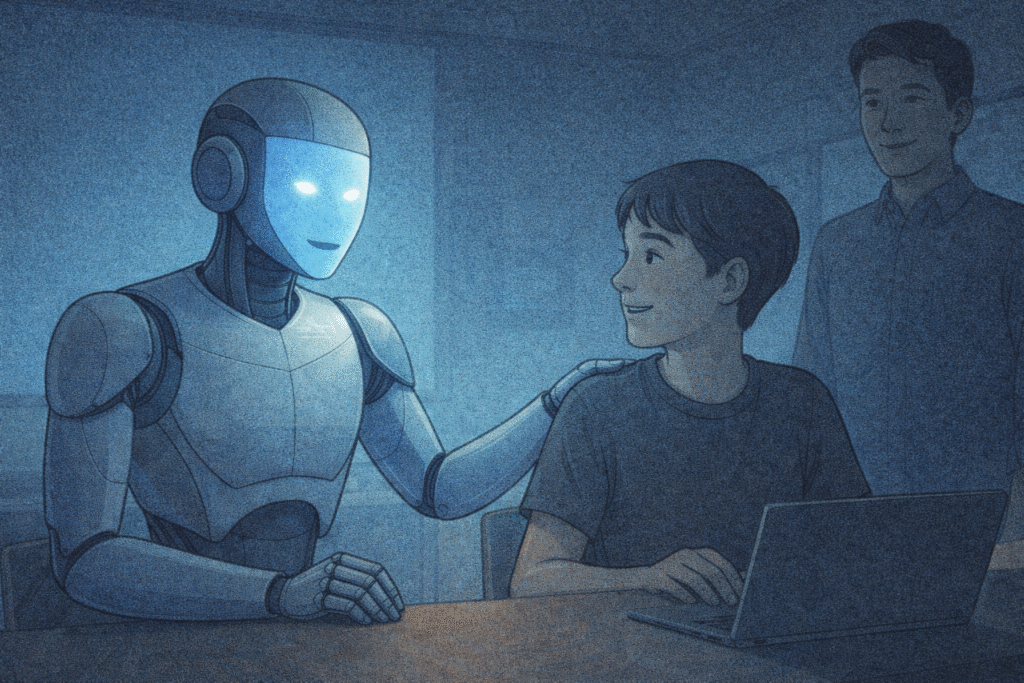
    The same animal shown as a pet in one culture and livestock in another

    Livestock, by contrast, have played a central role in the development of human civilization.

    3.1 Food Production

    Animals such as cattle, pigs, and chickens have long served as vital sources of protein, forming the backbone of agricultural societies.
    3.2 Labor and Energy

    Before industrialization, animals like horses, oxen, and donkeys were essential sources of labor—plowing fields, transporting goods, and powering economies.

    3.3 Materials for Daily Life

    Wool, leather, milk, and other animal-derived resources have shaped clothing, housing, and everyday necessities.

    Livestock have historically been valued for their productivity and economic function. Yet even this meaning is now being questioned and reshaped.


    4. Blurred Boundaries: One Animal, Different Cultures

    One of the most revealing aspects of human–animal relationships is how dramatically meanings shift across cultures.

    4.1 Dogs

    In many Western societies, dogs are celebrated as “humanity’s best friend.”
    In other regions, they have historically been raised for food.

    4.2 Rabbits

    In parts of Europe, rabbits exist simultaneously as pets, food animals, and storybook characters—occupying multiple symbolic roles at once.

    4.3 Cattle

    In India, cows are sacred and protected. Elsewhere, they are central livestock animals raised primarily for meat and dairy.

    These examples illustrate a crucial point: animals do not carry fixed meanings. Culture assigns their status.


    5. Contemporary Shifts: Rethinking the Boundary

    In modern societies, the line between companion animals and livestock is increasingly unstable.

    5.1 Animal Welfare Movements

    There is growing recognition that livestock are sentient beings capable of suffering.
    “Animal welfare farming” reflects an effort to balance production with ethical responsibility.

    5.2 New Forms of Companionship

    Animals once considered strictly livestock—such as pigs or chickens—are now sometimes kept as companions, especially in urban settings.

    5.3 Ethical Consumption

    As emotional bonds with companion animals deepen, some people begin questioning the moral implications of consuming other animals.


    This has contributed to the rise of vegetarian and vegan lifestyles.

    Human–animal relationships are no longer merely practical—they are ethical and philosophical.


    6. Conclusion: Animals as Cultural Mirrors

    A human quietly facing an animal, reflecting on coexistence

    The distinction between companion animals and livestock is not rooted in the animals themselves, but in human culture, values, and historical context.

    Some animals become friends.
    Some become resources.
    Some occupy both roles at once.

    As societies evolve, so do these categories.

    Today, we are increasingly called to reconsider what it means to live alongside animals—not only as users of their labor or bodies, but as co-inhabitants of a shared world.

    When we encounter a dog on the street or a cow on a farm, we are not simply seeing an animal.
    We are seeing a reflection of our own culture, ethics, and choices.


    References

    Serpell, J. (1996). In the Company of Animals: A Study of Human–Animal Relationships. Cambridge: Cambridge University Press.
    → Explores the historical and cultural diversity of human–animal relationships, offering a foundational framework for understanding why animals occupy different social roles.

    Digard, J.-P. (1988). L’homme et les animaux domestiques: Anthropologie d’une passion. Paris: Fayard.
    → An anthropological study of domestication, emphasizing that animals hold symbolic and social meanings beyond their economic functions.

    Franklin, A. (1999). Animals and Modern Cultures: A Sociology of Human–Animal Relations in Modernity. London: SAGE Publications.
    → Examines how modern societies assign animals different statuses—companions, livestock, or commodities—within changing cultural contexts.

  • Automation of Politics: Can Democracy Survive AI Governance?

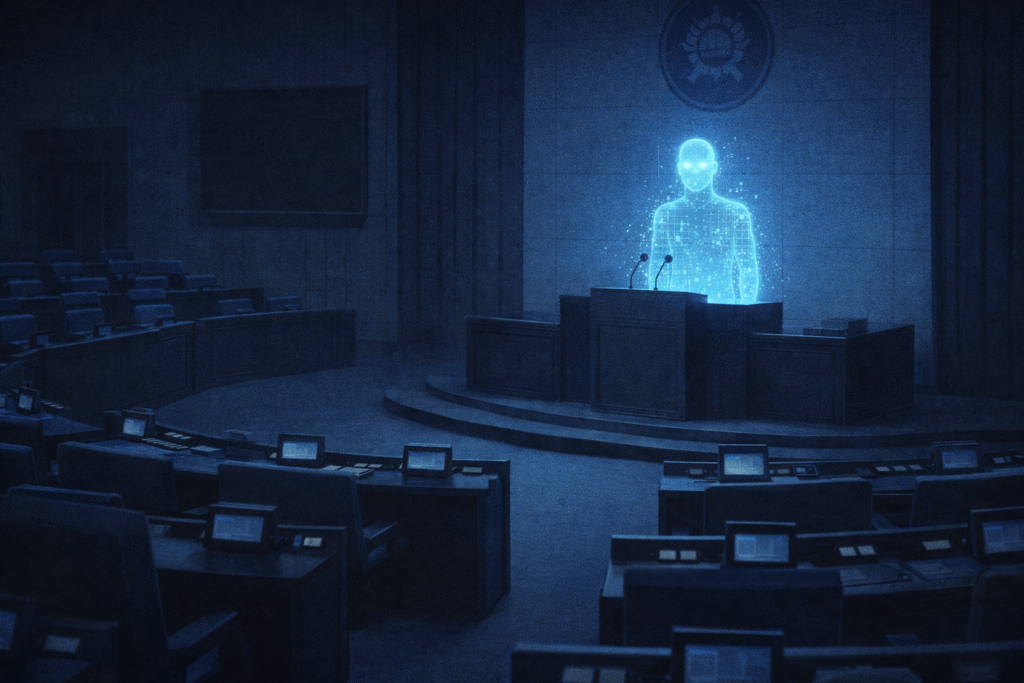
    If AI can govern more efficiently than humans, does democracy still need human judgment?

    AI hologram standing in an empty parliament chamber

    1. Introduction – The Temptation of Automated Politics

    In recent years, a curious sentiment has become increasingly common on social media:
    “Perhaps an AI president would be better.”

    As frustration with corruption, inefficiency, and political dishonesty deepens, many people begin to imagine an alternative—one in which algorithms replace politicians, and data replaces debate. In such a vision, democracy appears faster, cleaner, and more rational. Voting feels slow; a click feels immediate.

    This is the quiet temptation of what might be called automated politics—a form of governance that promises decisions faster than ballots and calculations more precise than deliberation.

    In practice, artificial intelligence is already embedded in the machinery of the state. Governments analyze public opinion through social media data, predict the outcomes of policy proposals, optimize welfare distribution, and even experiment with algorithmic sentencing tools in judicial systems.

    At first glance, the advantages seem undeniable.
    Human bias and emotional judgment appear to fade, replaced by “objective” data-driven decisions. Declining voter participation and distorted public opinion seem less threatening when algorithms promise accuracy and efficiency.

    Yet beneath this efficiency lies a heavier question.

    If politics becomes merely a technology for producing correct outcomes, where does political freedom reside?
    If algorithms calculate every decision in advance, do citizens remain thinking participants—or do they become residents of a pre-decided society?

    The automation of politics does not simply change how decisions are made.
    It reshapes what it means to be a political subject.


    Humans and AI debating governance in a modern conference room

    2. Technology and the New Political Order

    Under the banner of data democracy, AI has become an active political actor.

    Algorithms map public sentiment more quickly than opinion polls, forecast electoral behavior, and design policy simulations that claim to minimize risk. Administrative systems increasingly rely on “policy algorithms” to distribute resources, while predictive models guide policing and judicial decisions.

    On the surface, this appears to resolve a long-standing crisis of political trust. Technology presents itself as a neutral solution to flawed human governance.

    But technology is never neutral.

    Algorithms learn from historical data—data shaped by social inequality, exclusion, and bias. A welfare optimization model may quietly exclude marginalized groups in the name of efficiency. Crime prediction systems may reinforce existing prejudices by labeling entire communities as “high risk.”

    In such cases, objectivity becomes a mask.
    Under the language of rational calculation, political power risks transforming into a new form of invisible domination—one that is harder to contest precisely because it claims to be impartial.


    3. Can Rationality Replace Justice?

    The logic of automated governance rests on rational optimization: calculating the best possible outcome among countless variables.

    Yet democracy is not sustained by efficiency alone.

    As Jürgen Habermas argued, democratic legitimacy arises from communicative rationality—from public reasoning, debate, and mutual justification. Democracy depends not only on outcomes, but on the process through which decisions are reached.

    Automated politics bypasses this process.
    Human emotions, ethical dilemmas, historical memory, and moral disagreement are pushed outside the domain of calculation.

    When laws are enforced by algorithms, taxes distributed by models, and policies generated by data systems, citizens risk becoming passive recipients of technical decisions rather than active participants in political life.

    Hannah Arendt famously described politics as the space where humans appear before one another. Politics begins not with calculation, but with plurality—with the unpredictable presence of others.

    No matter how accurate an algorithm may be, the ethical weight of its decisions must still be borne by humans.


    4. The Crisis of Representation and Post-Human Politics

    Automated politics introduces a deeper structural rupture: the erosion of representation.

    Democracy rests on the premise that someone speaks on behalf of others. But when AI systems aggregate the data of millions and generate policies automatically, representatives appear unnecessary.

    Politics shifts from dialogue to administration—governance without conversation.

    Political philosopher Pierre Rosanvallon described this condition as the paradox of transparency: a society in which everything is visible, yet no one truly speaks. All opinions are collected, but none are articulated as meaningful political voices.

    In such a system, dissent becomes statistical noise.
    Ethical resistance, moral imagination, and collective protest lose their place.

    The automation of politics risks reducing moral autonomy to computational output—an experiment not merely in governance, but in redefining humanity’s political existence.


    5. Conclusion – Politics Without Humans Is Not Democracy

    The pace at which AI enters political systems is accelerating.
    But democracy is not measured by speed.

    Its foundation lies in responsibility, empathy, and shared judgment. Political decision-making is not simply information processing—it is an ethical act grounded in understanding human vulnerability.

    AI may help govern a state.
    But can it govern a society worth living in?

    Politics is not merely a technique for managing populations.
    It is an art of understanding people.

    Artificial intelligence is a tool, not a political subject.
    What we must prepare for is not the arrival of AI politics, but the challenge of remaining human political beings in an age of automation.

    A young person reflecting on democracy at sunset

    References

    Arendt, H. (1958). The Human Condition. Chicago, IL: University of Chicago Press.
    → Explores political action as a uniquely human domain, emphasizing responsibility and plurality beyond technical governance.

    Danaher, J. (2019). Automation and Utopia. Cambridge, MA: Harvard University Press.
    → Philosophically examines how automation reshapes human autonomy, meaning, and governance.

    Morozov, E. (2013). To Save Everything, Click Here. New York: PublicAffairs.
    → Critiques technological solutionism and warns against reducing democracy to data efficiency.

    Rosanvallon, P. (2008). Counter-Democracy: Politics in an Age of Distrust. Cambridge: Cambridge University Press.
    → Analyzes representation, surveillance, and the erosion of political voice in modern democracies.

    Floridi, L. (2014). The Fourth Revolution: How the Infosphere Is Reshaping Human Reality. Oxford: Oxford University Press.
    → Discusses the ethical implications of information technologies for political and civic life.

  • The Social History of Vending Machines

    How Unattended Transactions Reshaped Everyday Life

    Urban vending machine glowing in everyday city life

    1. The Origins of Vending Machines: Convenience Enters Everyday Life

    When walking down the street feeling thirsty, waiting at a subway station, or searching for a late-night alternative to a convenience store, we often encounter a familiar machine: the vending machine. With a single press of a button, drinks or snacks appear instantly. Today, vending machines feel like a natural and almost invisible part of everyday life.

    Yet vending machines are more than simple devices. They are inventions that have quietly transformed how people consume, interact, and organize daily routines. Their history reveals not only technological progress, but also shifting expectations about convenience, time, and human presence in economic exchange.

    1.1 Ancient beginnings of automated exchange

    The idea of automated selling is far older than modern society. Records from ancient Alexandria describe a device that dispensed holy water when a coin was inserted. Even in antiquity, people imagined systems in which exchange could occur without direct human mediation.

    1.2 The rise of the modern vending machine

    Modern vending machines began spreading in the late nineteenth century in Britain and the United States. Early machines sold stamps, postcards, and chewing gum. The possibility of purchasing goods without encountering a seller was initially perceived as novel—and sometimes unsettling. Over time, however, vending machines gained public trust and became symbols of a new kind of convenience: reliable, predictable, and independent of human availability.

    From that moment on, consumption no longer required dialogue, negotiation, or shared time. A button, a coin, and a machine were enough.

    2. The 20th Century: Industrialization Meets Consumer Culture

    2.1 Urban life and efficiency

    As industrialization accelerated and cities expanded, vending machines became increasingly important. After World War II, they spread rapidly in countries such as the United States and Japan, where busy urban life demanded faster and more efficient consumption.

    2.2 The American experience

    In the United States, beverage and cigarette vending machines became iconic. Coca-Cola machines in particular symbolized a new promise of modern consumption: the same taste, available anywhere, at any time.

    2.3 Japan and vending machine density

    In Japan, vending machines proliferated dramatically from the 1960s onward. Compact, reliable, and operating 24 hours a day, they suited dense urban environments. Over time, Japan became the country with the highest vending-machine density in the world.


    3. How Unattended Transactions Changed Daily Life

    Vending machines did more than sell products—they reshaped everyday habits.

    3.1 The rise of 24-hour consumption

    Vending machines introduced the experience of “buying anything at any time.” This expanded the temporal boundaries of consumption and paved the way for 24-hour convenience stores.

    3.2 Normalizing contactless exchange

    By enabling transactions without face-to-face interaction, vending machines became an early form of contactless consumption. Today’s self-service kiosks, unmanned stores, and automated checkout systems all trace their roots back to this experience.

    3.3 Expanding consumption spaces

    Vending machines challenged the assumption that consumption required designated spaces. They appeared in subways, schools, hospitals, streets, and offices, allowing consumption to permeate nearly every corner of daily life.

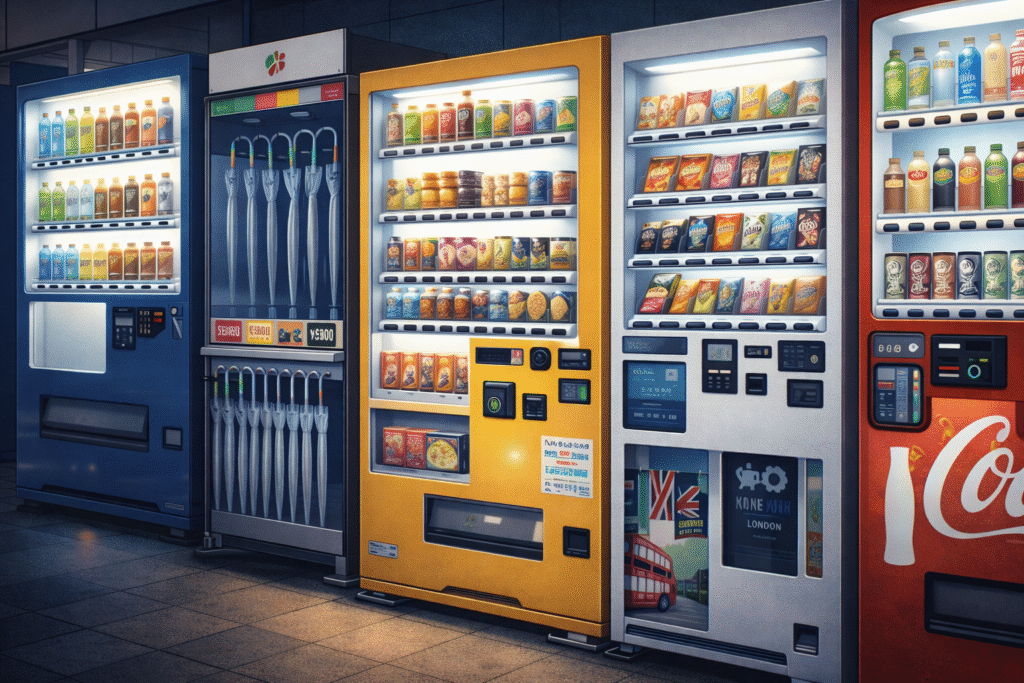
    Japanese vending machines reflecting urban consumer culture

    4. Vending Machines as Cultural Symbols

    Vending machines also function as cultural codes that reflect societal values.

    4.1 Japan: everyday creativity

    In Japan, vending machines sell far more than drinks and snacks—umbrellas, flowers, and even hot meals are available. This reflects how deeply vending machines are integrated into everyday life.

    4.2 The United States: speed and immediacy

    American vending machines align with a culture that values speed and instant gratification. Pressing a button to satisfy a need mirrors the broader logic of fast consumption.

    4.3 Korea: memory and social space

    In South Korea, vending machines—especially coffee machines in the 1980s and 1990s—were part of street and campus culture. They often functioned as informal spaces for conversation and brief rest.


    5. Notable and Contemporary Examples

    • High-tech vending machines in Tokyo: AI-powered machines now recommend drinks based on season and user preferences.
    • Pizza vending machines in New York: Some machines prepare fresh pizza on demand, from dough to toppings.
    • Korean coffee vending culture: Low-cost coffee machines became symbols of everyday leisure and social interaction.
    • Vending machines during the COVID-19 pandemic: Machines selling masks and hand sanitizer demonstrated the value of unattended transactions during crises.
    Solitary vending machine glowing at night in empty street

    6. Conclusion

    Vending machines are not merely mechanical tools. They are agents that have reshaped consumption patterns and everyday life. The experience of purchasing without human interaction expanded consumption across time, space, and social boundaries.

    Today’s unmanned stores, online shopping platforms, and automated kiosks all follow paths first opened by vending machines. They stand simultaneously as nostalgic artifacts and as foundations of future consumption culture—quietly reminding us that even the simplest machines can leave lasting social footprints.


    📚 References

    Fishman, C. (2007). The Wal-Mart Effect: How the World’s Most Powerful Company Really Works—and How It’s Transforming the American Economy. Penguin.
    → While not focused solely on vending machines, this work explains how large-scale, automated distribution systems reshape modern consumption culture, offering valuable context for understanding unattended transactions.

    Miller, D. (1998). A Theory of Shopping. Cornell University Press.
    → A sociocultural analysis of shopping behavior that provides a theoretical framework for understanding how automated consumption devices influence everyday life and identity.

    Bestor, T. C. (2004). Tsukiji: The Fish Market at the Center of the World. University of California Press.
    → An ethnographic study of Japanese market culture that helps contextualize Japan’s unique vending-machine landscape and its broader consumer environment.

  • The Paradox of AI Education

    Can Learning Exist Without a Human Teacher?

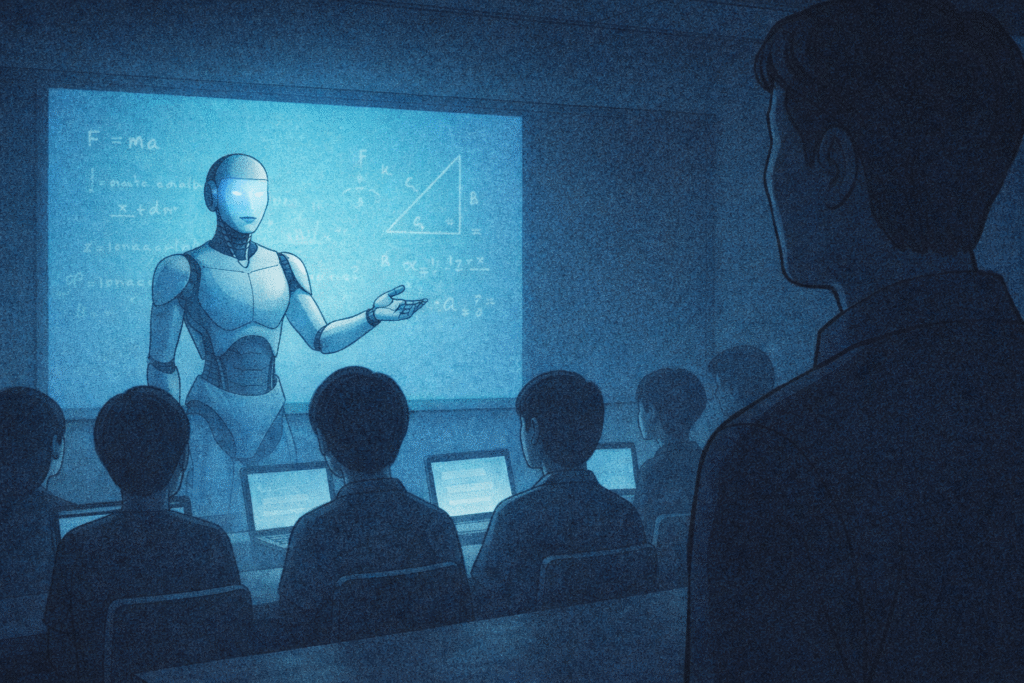
    AI-led classroom with human teacher observing students

    1. A Classroom Without Teachers — What Is Missing?

    Children now sit in front of AI tutors, asking questions and receiving answers faster and more accurately than any textbook ever could.
    Artificial intelligence explains formulas, corrects mistakes instantly, and adapts lessons to each student’s level with remarkable precision.

    The students say they understand.

    Yet something quietly lingers beneath that confidence.
    Beyond the correct answers and optimized learning paths, a deeper question remains — whether learning can truly be complete in a classroom without human teachers, and why we learn at all in the first place.

    If learning were merely the efficient transfer of knowledge, AI might already be the ideal instructor.
    But education has never been only about knowing what is correct. It has always been about understanding why something matters, how it connects to one’s life, and who one becomes through the process of learning.

    In a classroom guided entirely by algorithms, knowledge may be delivered flawlessly, yet meaning does not automatically follow.
    This gap — between information and formation — marks the starting point of the paradox at the heart of AI education.

    2. The Nature of Learning: Knowledge and Teaching as Relationship

    Educational philosopher Paulo Freire famously argued that education is not a one-way transfer of information, but a dialogical process.

    Learning, in this sense, is not the movement of knowledge but the formation of relationships.

    AI can study millions of textbooks,
    but it cannot read anxiety in a student’s eyes,
    nor can it sense why understanding failed in the first place.

    Human learning involves more than knowledge acquisition; it requires the internalization of meaning.
    Knowledge becomes real only when it connects to one’s own life.

    No matter how accurate AI may be,
    if its teaching does not resonate, it remains information — not understanding.


    3. The Advantages of AI Education: Access and Opportunity

    Student using personalized AI learning system

    AI Visual Concept
    Students engaging in personalized AI-based learning — representing adaptive education.

    It would be unfair to deny the benefits of AI in education.

    3.1 Personalized Learning

    By analyzing learning data, AI can tailor educational paths to each student’s pace and level of understanding. This overcomes the limitations of one-size-fits-all instruction.

    3.2 Reducing Educational Inequality

    AI expands access to high-quality educational content regardless of geography or socioeconomic status. Students in underserved regions or difficult home environments gain new learning opportunities.

    3.3 Reducing Teachers’ Administrative Burden

    By automating grading, diagnostics, and basic feedback, AI allows teachers to focus on relational guidance and creative lesson design.

    AI can democratize education —
    but in doing so, it also risks overshadowing the human role of teachers.


    4. The Paradox: More Knowledge, Less Learning

    AI-driven education has dramatically increased the amount of accessible knowledge.
    Paradoxically, students’ capacity for deep thinking, concentration, and empathy is often declining.

    When knowledge becomes too easily available,
    the process of inquiry disappears,
    and learning shifts toward results rather than exploration.

    AI tells us what is correct,
    but it does not invite us to ask why.

    This is the core paradox of AI education:

    Learning increases,
    yet learners become increasingly passive.

    The true purpose of education is not to create humans who know answers,
    but humans who can ask meaningful questions.

    And the ability to question cannot be acquired through data training alone.

    Human teacher and AI supporting student learning together

    5. Why Teachers Still Matter: Learning Through Relationship

    No matter how advanced AI becomes,
    the role of teachers cannot be reduced to information delivery.

    Teachers help students discover why learning matters.
    They encourage students not to fear failure and explore how knowledge functions within real life.

    A teacher is not simply someone who knows the answer,
    but someone who thinks alongside the learner.

    AI provides answers.
    Teachers provide context.

    Within that context, students grow not as information consumers, but as agents of learning.


    Conclusion: Machine Knowledge and Human Meaning

    AI Visual Concept
    An AI teacher and students in dialogue, while a human teacher observes warmly — symbolizing cooperation between human wisdom and technology.

    AI is undeniably transforming education.
    But it cannot replace the meaning of human teachers.

    At its core, education remains a human encounter —
    a space where growth, uncertainty, and emotional transformation occur.

    AI can teach knowledge.
    Only humans can teach why learning matters.

    The classroom of the future should not be a choice between AI and teachers,
    but a model of collaboration.

    Machines handle information.
    Humans cultivate meaning.

    Only then does learning become whole.

    📚 References

    1. Freire, P. (1970). Pedagogy of the Oppressed. New York: Continuum.
      Freire conceptualizes education as a dialogical and emancipatory process rather than a one-way transmission of knowledge. His work provides a critical foundation for understanding why AI-driven instruction, focused on efficiency and information delivery, may fall short in fostering critical consciousness and human agency.
    2. Biesta, G. (2013). The Beautiful Risk of Education. Boulder, CO: Paradigm Publishers.
      Biesta argues that genuine education involves uncertainty, relational encounters, and the formation of subjectivity. This perspective challenges AI-centered educational models that prioritize predictability, optimization, and measurable outcomes over human development.
    3. Han, Byung-Chul. (2015). The Burnout Society. Stanford, CA: Stanford University Press.
      Han analyzes how contemporary societies driven by performance and optimization exhaust individuals psychologically and emotionally. His critique is highly relevant to AI education, where constant efficiency and self-management risk transforming learners into passive performers rather than reflective thinkers.
    4. Noddings, N. (2005). The Challenge to Care in Schools. New York: Teachers College Press.
      Noddings emphasizes care, empathy, and relational ethics as the core of meaningful education. Her work highlights why human teachers remain irreplaceable in cultivating emotional understanding and moral growth—dimensions that algorithmic systems cannot fully replicate.
    5. Postman, N. (1995). Technopoly: The Surrender of Culture to Technology. New York: Vintage Books.
      Postman warns against societies in which technology becomes an unquestioned authority rather than a tool. His analysis offers a critical lens for examining how AI in education may redefine not only how we learn, but what we believe education is for.