Finding the delicate balance between protection and connection.
Beneath a transparent umbrella, someone learns how to stay protected without turning away from the world.
Between shelter and connection, the heart slowly becomes stronger.
Rain fell softly along the morning street.
Someone walked through the drizzle holding a transparent umbrella. Raindrops tapped gently on its surface.
The umbrella shielded the rain, yet the colors of the city were still visible through it.
The passing cars. The glow of streetlights on wet pavement. The quiet rhythm of people moving through the day.
And a thought appeared:
“I want protection… but I don’t want to be completely separated from the world.”
The Small Comfort of Shelter
An umbrella is meant to protect.
It keeps the rain away, gives us a small space of dryness in the middle of a storm.
But sometimes protection becomes distance.
When we guard ourselves too carefully, we may also block the warmth of connection.
The transparent umbrella feels different.
It protects, yet it allows the world to remain visible.
Perhaps the human heart longs for the same thing.
The Quiet Fear of Connection
Many people want closeness with others.
Yet the fear of being hurt often leads us to build invisible barriers.
We protect our feelings. We hide what we truly think.
And little by little, those protective layers become walls.
But connection does not require perfect safety.
It requires the courage to remain open while still caring for ourselves.
Learning to Tilt the Umbrella
Walking through the rain, the umbrella was tilted slightly.
A few drops landed softly on a shoulder.
Surprisingly, the feeling was comforting.
Perfect protection is not always necessary.
Sometimes, a gentle touch of the world— even a little rain— reminds us that we are still alive within it.
In that moment, the city no longer felt distant.
It felt shared.
Conclusion: Staying Open Beneath the Rain
Like the transparent umbrella, we cannot block every storm in life.
But we can choose how we face it.
We can protect ourselves while still allowing the world to reach us.
True maturity may not lie in building stronger walls.
Instead, it may lie in learning how to remain open— even when the rain is falling.
A Small Note on Psychology
In psychology, this balance is often described as emotional openness.
It refers to the ability to express feelings honestly while still maintaining emotional stability.
Being open does not mean being fragile.
It means allowing the world to be seen clearly— while still standing firmly beneath our own shelter.
Quote
“Rain is grace; rain is the sky descending to the earth; without rain, there would be no life.” — John Updike
Final Reflection
Under a transparent umbrella, we learn something important:
Protection does not have to mean isolation.
Sometimes the strongest heart is the one that stays open to the world— even in the rain.
One-line reflection
Beneath a transparent umbrella, I learned how to face the world without hiding from it.
Related Reading
The subtle tension between personal space and social connection is further explored in The Wall of Earphones – Why Do We Choose to Isolate Ourselves?, where everyday technologies designed for comfort and privacy quietly reshape the boundaries between individuals and the surrounding world.
At a broader societal level, the question of visibility and openness in modern life appears in The Transparency Society: Foundation of Trust or Culture of Surveillance?, where the growing demand for transparency raises deeper debates about whether openness strengthens trust—or gradually erodes personal freedom.
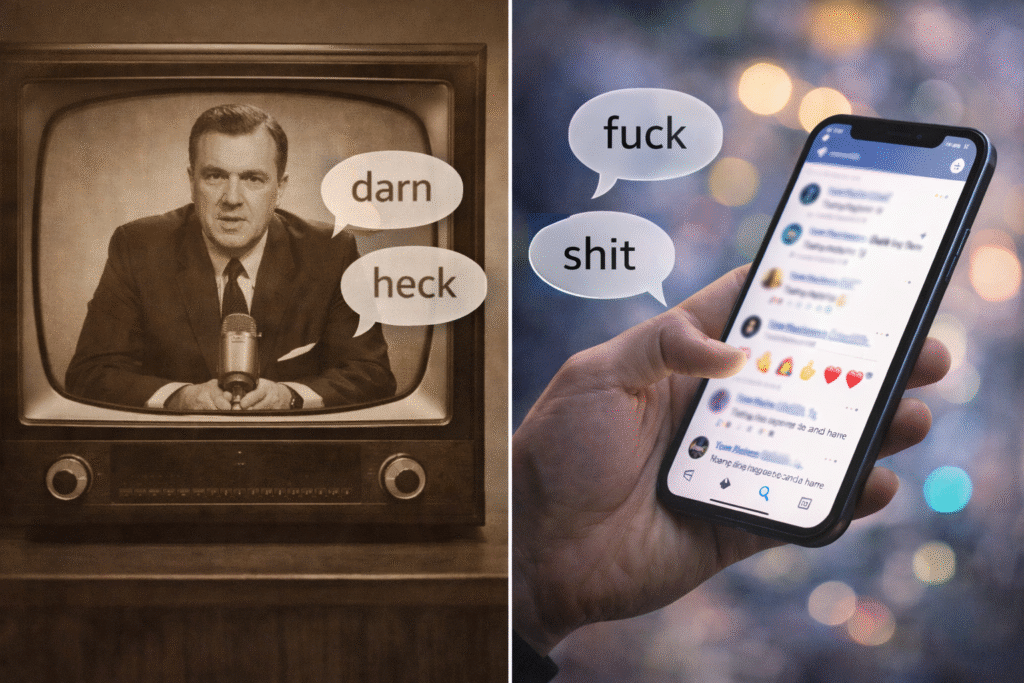
Some words feel uncomfortable to say out loud, even when they describe reality accurately.
Profanity, sexual expressions, references to death, illness, religion, or politics — many societies treat certain expressions as taboo words.
But why do these words become forbidden?
Is it simply because they are offensive?
In reality, taboo language reveals something deeper: how societies regulate emotion, maintain order, and exercise power.
1. Language Is a Form of Power
Language is not merely a tool for communication.
It also reflects the structure of social authority.
Who is allowed to speak certain words — and who is discouraged or forbidden from using them — often reveals underlying power relations.
For example, insulting terms targeting social groups can damage dignity and reinforce hierarchy.
By restricting such words, societies attempt to maintain stability and reduce conflict.
In this sense, taboo words function as informal systems of social regulation.
2. Euphemisms: Saying Without Saying
When people avoid taboo words, they often replace them with euphemisms.
Instead of saying someone “died,” we say they “passed away.”
Instead of describing harsh realities directly, language softens them.
Linguists sometimes call this process linguistic sanitization.
The purpose is not merely politeness.
It is a cultural strategy to reduce emotional shock and maintain social harmony.
3. Taboo Words Change Over Time
One fascinating aspect of taboo language is that it is never permanent.
Words once considered unspeakable can later become normal.
For example, topics related to mental health, sexuality, or reproductive health were often avoided in public discourse in earlier decades.
Today, many of these topics are discussed openly.
Taboo words therefore act as indicators of social boundaries — showing what a culture is ready to confront and what it still prefers to avoid.
4. When Language Becomes Harmful
Some taboo words are not merely uncomfortable.
They can reinforce discrimination and social exclusion.
Terms targeting race, gender, disability, or sexual orientation can perpetuate harmful stereotypes.
Avoiding such language is not simply about censorship.
It reflects a collective effort to protect dignity and foster respect within communities.
Language always carries responsibility.
Conclusion: What Taboo Words Reveal About Society
Taboo words are more than simply forbidden expressions. They reflect the values, fears, and power structures that shape a society.
Taboo words are more than forbidden expressions.
They act as mirrors of cultural values.
The words a society restricts reveal what it fears, what it respects, and what it is still struggling to confront.
Choosing our words carefully is not weakness.
It is a form of awareness — an acknowledgment that language shapes how we see one another.
Related Reading
The relationship between language and symbolic meaning is further reflected in The Power of Naming: Is Naming an Act of Control?, where the act of naming itself is explored as a subtle form of authority—shaping perception, identity, and the boundaries of what society recognizes as acceptable or unacceptable.
At a broader societal level, the power of words and symbols within collective discourse appears in Clicktivism in Digital Democracy: Participation or Illusion?, where digital expressions and simplified forms of political language raise deeper questions about whether communication empowers genuine participation or merely creates the appearance of engagement.
References
1. Allan, K., & Burridge, K. (2006). Forbidden Words: Taboo and the Censoring of Language. Cambridge University Press. → Allan and Burridge provide one of the most comprehensive studies of taboo language, examining how societies regulate profanity, sexual language, and insults through censorship and euphemism.
2. Foucault, M. (1978). The History of Sexuality, Volume 1: An Introduction. Pantheon Books. → Foucault analyzes how power structures shape what can and cannot be spoken about, showing how silence and taboo are often produced through systems of knowledge and authority.
3. Pinker, S. (2007). The Stuff of Thought: Language as a Window into Human Nature. Viking. → Pinker explains how taboo words trigger strong emotional responses and explores the cognitive and social mechanisms that give language its psychological force.
Every day, we make countless choices—what to wear, what to study, what to buy, what opinions to express online, and even which news to trust. Modern societies often celebrate this abundance of choice as evidence of freedom. Yet psychologists and philosophers have long suggested that unlimited freedom can also produce anxiety, uncertainty, and an unexpected desire for guidance.
Freedom has long been one of humanity’s most celebrated ideals.
Revolutions have been fought in its name. Movements for civil rights, democracy, and independence have all been driven by the promise of freedom.
Yet freedom has always carried a hidden tension.
For some, it represents possibility, self-determination, and the chance to shape one’s own life. For others, freedom brings anxiety, responsibility, and the burden of choosing.
This raises a difficult question:
Do human beings truly desire freedom, or do we secretly fear it?
1. The Philosophical Paradox: Freedom and Anxiety
Sartre and the Burden of Freedom
The existentialist philosopher Jean-Paul Sartre famously claimed that human beings are “condemned to be free.”
For Sartre, freedom is unavoidable. We cannot escape the responsibility of choosing, and every decision becomes an act through which we define ourselves.
But this freedom is not always liberating. Because if we are truly free, we must also accept full responsibility for the consequences of our actions.
In this sense, freedom is both possibility and burden.
The Fear of Unrestricted Freedom
Other philosophers approached freedom with caution.
Plato worried that unrestrained freedom could lead to chaos within a political community. Thomas Hobbes warned that without strong authority, society would collapse into a “war of all against all.”
From this perspective, freedom requires limits in order to preserve social order.
Thus, the philosophical tradition reveals a recurring tension: freedom is both a cherished value and a potential danger.
2. The Social Dimension: Freedom and Order
Freedom within Rules
Freedom rarely exists in isolation.
Democratic societies aim to protect individual liberty, yet they also establish laws and institutions that restrict certain actions.
Freedom of expression, for example, cannot justify harming others through defamation or incitement. Similarly, personal freedom must coexist with collective security.
Freedom therefore exists not as absolute independence, but as a negotiated balance between liberty and order.
Unequal Access to Freedom
Another complication is that freedom is rarely distributed equally.
Social class, gender, race, and nationality all influence how much freedom individuals actually experience.
In one society, expressing political opinions may be protected speech. In another, the same act could result in punishment.
Thus, while freedom is often described as a universal value, its reality is deeply shaped by social and political conditions.
3. The Psychological Dimension: The Burden of Choice
The Paradox of Choice
Psychological research suggests that freedom can sometimes undermine happiness.
Psychologist Barry Schwartz, in The Paradox of Choice, argues that while greater choice appears to expand freedom, excessive choice often increases decision fatigue, regret, and dissatisfaction. Rather than feeling liberated, individuals may become overwhelmed by the pressure to make the “best” possible decision.
More freedom can mean more responsibility — and more potential regret.
The Comfort of Authority
Because freedom brings responsibility and uncertainty, people may sometimes seek security in authority, conformity, or established social structures.
Erich Fromm explored this paradox in Escape from Freedom. He argued that modern freedom can liberate individuals from traditional constraints while also leaving them feeling isolated, uncertain, and burdened by responsibility. Under such conditions, freedom itself can become psychologically difficult to bear.
Rules and institutions can provide stability, while traditions and established communities may offer guidance and a sense of belonging.
The danger begins when the desire for security becomes so strong that people willingly surrender the freedom they once sought.
4. Freedom in the Digital Age
The Expansion of Expression
In the digital age, the question of freedom has become even more complex.
The internet has dramatically expanded freedom of expression, allowing individuals across the world to share ideas instantly.
Yet the same digital platforms have also produced misinformation, online harassment, and new forms of manipulation.
Governments and societies increasingly debate how much regulation is necessary — and how much freedom should remain unrestricted.
Algorithmic Influence
Another challenge comes from the growing influence of algorithms.
Artificial intelligence and data-driven platforms shape what we see, read, and purchase. In many cases, they subtly guide our decisions.
This raises an unsettling possibility:
Are we still exercising genuine freedom, or are our choices quietly being steered by invisible systems?
Conclusion: Between Desire and Fear
Freedom is never a simple gift.
It is inseparable from responsibility, uncertainty, and the weight of decision.
Some people embrace that burden. Others seek the safety of rules, traditions, or authority.
Perhaps the truth is that human beings both desire freedom and fear it at the same time.
The real question, then, is not simply whether we possess freedom.
It is whether we are prepared to live with everything that freedom demands.
Perhaps genuine freedom is not the absence of all limits, but the willingness to make responsible choices despite uncertainty. In that sense, freedom is not something we simply possess—it is something we continuously learn to practice.
A Question for Readers
If human beings were given complete freedom without restrictions or guidance, would they truly feel liberated?
Or would unlimited freedom eventually become another form of fear and uncertainty?
Related Reading
The broader debate over freedom and political authority is explored further inIs the State a Guardian of Freedom—or a Leviathan of Control?, which examines whether the state exists primarily to protect individual liberty or whether expanding political power gradually limits the very freedom it claims to defend. This wider perspective provides an essential framework for understanding why human beings often experience both a desire for freedom and a longing for security.
The subtle psychological tension between autonomy and social perception is explored further in Why It Feels Like Everyone Is Watching You: The Spotlight Effect, where the tendency to overestimate how closely others observe us reveals how internal pressure and self-consciousness quietly shape our sense of freedom.
At a broader technological level, the invisible forces shaping modern choice are examined in Algorithmic Bias: How Recommendation Systems Narrow Our Worldview, which explores how digital recommendation systems increasingly influence what we see, think, and ultimately decide. Together, these discussions suggest that the limits of freedom arise not only from governments, but also from psychological expectations and technological environments.
References
1. Fromm, Erich. (1941). Escape from Freedom. New York: Farrar & Rinehart. In this influential work, Fromm argues that modern individuals often experience freedom as a source of anxiety rather than liberation. Faced with the burden of responsibility, many people seek psychological refuge in authority, conformity, or submission. His analysis reveals the paradox that humans may escape from the very freedom they claim to desire.
2. Berlin, Isaiah. (1969). Two Concepts of Liberty. Oxford: Oxford University Press. Berlin distinguishes between “negative liberty,” the absence of external constraints, and “positive liberty,” the capacity to be one’s own master. This distinction has become central to modern political philosophy, highlighting how freedom can be understood both as protection from interference and as the realization of self-governance.
3. Mill, John Stuart. (1859). On Liberty. London: John W. Parker & Son. Mill defends individual liberty as a fundamental condition for human progress and social development. At the same time, he introduces the “harm principle,” arguing that freedom should only be limited to prevent harm to others. His work remains one of the most influential philosophical defenses of liberal freedom.
4. Arendt, Hannah. (1958). The Human Condition. Chicago: University of Chicago Press. Arendt interprets freedom not simply as independence from constraint but as the capacity for action within a shared public world. For her, genuine freedom emerges when individuals participate in collective life and take responsibility for their actions within the political sphere.
5. Taylor, Charles. (1991). The Ethics of Authenticity. Cambridge, MA: Harvard University Press. Taylor examines the modern pursuit of authenticity and personal freedom, arguing that contemporary individualism often produces both empowerment and alienation. His work explores how the modern ideal of self-expression can deepen personal meaning while also creating new forms of social and psychological tension.
6. Schwartz, Barry. (2004). The Paradox of Choice: Why More Is Less. New York: Harper Perennial.
Schwartz explains that while modern societies offer unprecedented freedom of choice, excessive options often increase anxiety, regret, and decision fatigue. His work demonstrates that greater freedom does not always lead to greater satisfaction.
At a broader social level, the question of how environments silently shape behavior and inclusion is examined in Uncomfortable by Design: How Spaces Are Built to Exclude, where structural expectations and hidden norms reveal how pressure is embedded into everyday life.
References
1. Baumeister, R. F., & Tierney, J. (2011). Willpower: Rediscovering the Greatest Human Strength. Penguin Press. → This work explores self-control and ego depletion, explaining how repeated acts of regulation can drain psychological resources and lead to fatigue.
2. Bloom, P. (2016). Against Empathy: The Case for Rational Compassion. HarperCollins. → Bloom argues that emotional empathy, when unchecked, can produce burnout and distorted moral decisions, advocating for balanced and sustainable compassion.
3. Figley, C. R. (1995). Compassion Fatigue. Brunner/Mazel. → Figley analyzes how sustained caregiving and emotional labor lead to compassion fatigue, expanding understanding of moral exhaustion in professional and personal contexts.
Even small rewards can shape how people pursue recognition and validation. In Why Is Candy a Symbol of Reward for Children?, the emotional roots of reward-based behavior are explored through the symbolic role of sweetness in childhood.
References
Bourdieu, P. (1984). Distinction: A social critique of the judgement of taste. Harvard University Press. → Bourdieu demonstrates that taste and lifestyle choices are socially structured rather than purely individual. His concept of cultural capital explains how travel, hobbies, and aesthetic experiences function as markers of social distinction, making “experience” a form of symbolic capital in modern societies.
Pine, B. J., & Gilmore, J. H. (1999). The experience economy: Work is theatre & every business a stage. Harvard Business School Press. → Pine and Gilmore argue that advanced economies increasingly sell memorable experiences rather than goods or services. Their framework clarifies how emotions and staged experiences become economic commodities within contemporary consumer culture.
Schulze, G. (1992). Die Erlebnisgesellschaft: Kultursoziologie der Gegenwart. Campus Verlag. → Schulze introduces the idea of the “experience society,” in which individuals pursue intensity, uniqueness, and emotional stimulation as central life goals. His analysis helps explain the cultural shift from stability-oriented values to experience-driven identity formation.
Festinger, L. (1954). A theory of social comparison processes. Human Relations, 7(2), 117–140. → Festinger’s foundational theory explains how individuals evaluate themselves through comparison with others. In digital environments, this mechanism becomes amplified as experiences are constantly visible and quantifiable.
Goffman, E. (1959). The presentation of self in everyday life. Doubleday. → Goffman conceptualizes everyday interaction as a form of performance. His dramaturgical framework offers a powerful lens for interpreting social media culture, where experiences are curated and identities are staged before an imagined audience.
It represents courage, obedience, growth, and celebration.
These associations become part of early emotional memory.
5. From Candy to Digital Rewards
The logic behind candy rewards did not disappear with childhood.
It evolved.
Today, adults respond to different forms of reward: social media likes, shopping points, notification badges, and algorithmic validation systems.
Just as candy once reinforced behavior through immediate pleasure, digital platforms now use instant feedback to shape attention and emotional response.
In this sense, modern society has not abandoned the psychology of candy.
It has scaled it.
The reward systems that once guided children through sweetness now quietly organize adult behavior through digital stimulation.
Conclusion: A Small Object, A Big Meaning
Candy is not merely sugar.
It is a compact emotional language.
It links biology (reward circuits), economics (mass production of sugar), and culture (ritualized childhood practices).
For children, candy often means:
“You did well.” “You are loved.” “You belong.”
Perhaps that is why its sweetness lingers far beyond taste.
A Question for You
Have you ever realized that something as small as candy once meant recognition, comfort, or love?
Related Reading
The meaning of small rewards changes as everyday experiences become increasingly shaped by recognition and social comparison. When Experience Becomes Competition explores how ordinary moments are transformed into performances measured through visibility, achievement, and approval. This broader perspective helps explain why even childhood rewards can continue to influence the ways people seek validation throughout life.
1. Mintz, S. W. (1985). Sweetness and Power: The Place of Sugar in Modern History. Viking Penguin. → Mintz explores how sugar became embedded in systems of power, consumption, and social meaning, showing how sweetness evolved from luxury to everyday reward.
2. Allison, A. (2006). Millennial Monsters: Japanese Toys and the Global Imagination. University of California Press. → Allison examines how children’s consumer culture connects toys, treats, and reward structures, highlighting how material goods mediate emotion and identity.
3. Zelizer, V. A. (1994). Pricing the Priceless Child. Princeton University Press. → Zelizer analyzes the changing cultural value of children in modern society, explaining how material tokens such as gifts and treats became expressions of emotional recognition.
We live with the persistent feeling that we choose.
We choose what to eat in the morning, which career to pursue, how to respond in moments of crisis. These decisions feel like ours — deliberate, intentional, free.
But what if that feeling is deceptive?
What if every thought, every intention, every choice is simply the unfolding of prior causes — neural activity, genetic predispositions, environmental influences?
Today, we step onto a stage of inquiry where two long-standing rivals confront one another: determinism and the defense of free will.
1. The Case for Determinism: Freedom as Illusion
Determinism holds that every event is caused by preceding conditions in accordance with natural laws. From this perspective, human thought and action are no exception.
Spinoza famously argued that free will is merely our ignorance of causes. We feel free because we do not perceive the chain of necessity behind our desires.
Modern neuroscience adds further tension to the debate. In Benjamin Libet’s experiments, brain activity signaling an action appeared before participants reported consciously deciding to act. If the brain initiates movement before conscious intention arises, then what becomes of free choice?
From this view, free will may be little more than post-hoc rationalization — a story we tell ourselves after the brain has already acted.
2. The Defense of Freedom: Responsibility and Moral Agency
Yet the opposing side insists: freedom must be real.
If every action were predetermined, how could moral responsibility exist? Praise, blame, justice — all would lose their grounding.
Immanuel Kant argued that freedom is a necessary condition for moral law. Jean-Paul Sartre went further, claiming that human beings are “condemned to be free,” burdened with the responsibility of choice.
Defenders of free will also caution against over-interpreting neuroscience. Libet’s experiments concern simple motor movements, not complex moral deliberation. The act of resisting temptation, reflecting on consequences, or sacrificing personal gain for ethical principles may not be reducible to automatic neural impulses.
3. A Third Path: Compatibilism
Between these poles lies compatibilism — the attempt to reconcile causality and freedom.
Philosophers such as Daniel Dennett argue that freedom does not require independence from causation. Rather, freedom consists in acting according to one’s own motives and reasoning processes, even if those processes have causal histories.
In this sense, we may inhabit a determined universe yet still possess a form of agency “worth wanting.”
4. Why This Debate Matters Today
This is not merely an abstract philosophical puzzle.
Law and Justice
If free will is illusory, should punishment give way entirely to rehabilitation?
Moral Judgment
Can we meaningfully blame or praise individuals if they could not have acted otherwise?
Artificial Intelligence
As AI systems become increasingly autonomous, the debate takes on new urgency. If humans themselves operate under deterministic constraints, what distinguishes human agency from machine decision-making.
Conclusion: An Open Verdict
The stage remains undecided.
Determinism offers scientific weight. Free will defends moral dignity. Compatibilism seeks reconciliation.
Perhaps the deeper question is not whether we are metaphysically free, but how we ought to live in light of this uncertainty.
If we are not free, who is responsible? If we are free, how do we bear the weight of that freedom?
The trial continues — not in a courtroom, but within each of us.
A Question for the Reader
If your choices are shaped by factors you did not choose—your biology, your environment, your past—can you still call them truly yours?
Or is freedom not about escaping causality, but about how you understand and respond to it?
From a broader cognitive perspective, the limits of human decision-making appear in The Illusion of “Free”: How Zero Price Changes Our Decisions, which shows how subtle psychological and economic influences shape choices we often believe to be entirely our own.
References
1. Spinoza, Baruch. (1677/1994). Ethics. Translated by Edwin Curley. Princeton: Princeton University Press. Spinoza argues that human beings are entirely subject to the causal order of nature. What we call “free will,” he contends, is merely ignorance of the causes that determine our actions. His determinist framework continues to serve as a foundational critique of autonomous agency.
2. Kant, Immanuel. (1788/1997). Critique of Practical Reason. Translated by Mary Gregor. Cambridge: Cambridge University Press. Kant maintains that moral responsibility presupposes freedom. For him, free will is not an empirical observation but a necessary postulate of practical reason. Without freedom, the coherence of moral law and ethical accountability would dissolve.
3. Sartre, Jean-Paul. (1943/1992). Being and Nothingness. Translated by Hazel E. Barnes. New York: Washington Square Press. Sartre famously describes human beings as “condemned to be free.” In his existentialist account, freedom is inseparable from responsibility, and individuals continuously define themselves through their choices. His perspective intensifies the debate by grounding freedom in lived experience rather than abstract metaphysics.
4. Libet, Benjamin. (2004). Mind Time: The Temporal Factor in Consciousness. Cambridge, MA: Harvard University Press. Libet’s neuroscientific experiments suggest that neural activity associated with decision-making can precede conscious awareness. This finding has been widely interpreted as evidence challenging traditional conceptions of free will, reinforcing determinist interpretations from a scientific perspective.
5. Dennett, Daniel C. (1984/2003). Elbow Room: The Varieties of Free Will Worth Wanting. Cambridge, MA: MIT Press. Dennett defends compatibilism, arguing that meaningful forms of freedom can exist within a causally structured universe. Rather than seeking absolute metaphysical independence, he reframes free will as the kind of agency that sustains responsibility, rational deliberation, and social cooperation.
Each season paints the leaves differently. Sunlight leaves traces on the benches. Footsteps carve quiet paths along the stone walkway.
At the heart of it stands an old clock tower.
Once the center of the neighborhood, the clock now moves slightly slower— sometimes almost as if it has forgotten to hurry.
Yet people still pass beneath it, carrying their days forward.
For some, it is a meeting place. For others, a waiting place. And for a few, a stage where memories never quite fade.
An Elderly Man’s Morning
At eight o’clock each morning, an elderly man walks slowly toward the tower.
In his hand, he holds an old wristwatch.
He looks up and murmurs softly, “This clock still remembers my younger days.”
He once waited here for his grandson. He stood beneath this clock the day the boy left for military service.
Time has moved on. His footsteps have not.
For him, this is not just a park. It is a timetable of memories.
A Young Girl’s Afternoon
Around noon, a young girl sits beneath the clock tower.
She opens a book while waiting for a friend, but her eyes drift toward the clock.
“I wish it would move a little slower today.”
For her, this is not just a meeting place.
It is a small stage where anticipation quietly grows.
As the second hand moves, her own day gently unfolds.
A Worker Taking a Short Break
Toward evening, a worker sits on the bench and exhales.
The drink in his hand has grown warm, but there is a quiet peace on his face.
He looks up at the tower and smiles.
“You don’t hear bells like this anymore.”
All day long, he runs on schedules and deadlines.
But here, beneath the tower, he pauses.
The chime of the clock sounds like a quiet message:
“You made it through today.”
Where Days Overlap
As sunset approaches, the park fills with different lives.
A commuter on the way home. A parent pushing a stroller. A couple walking hand in hand.
They do not know one another.
Yet at the same hour, in the same place, their days briefly intersect.
Beneath the clock tower, time overlaps.
And in that overlap, a quiet sense of connection forms.
Conclusion: Where Time Continues to Remember
At night, the clock tower lights up.
The hands still move slowly, but beneath that light thousands of days have passed.
For someone, it was a beginning. For another, a farewell. For someone else, a place to gather strength.
Time moves forward.
But the stories of those who stood there linger in the air.
And if one day we pass beneath it again, the clock tower might quietly say:
“Your time was here, too.”
A Question for Readers
Is there a place in your life where time seems to pause—somewhere that still holds the people, memories, or moments you once shared there?
Related Reading
The quiet weight of time and memory is also reflected in The Texture of Time: How the Mind Shapes the Weight of Our Moments, where psychological time and lived experience are explored in depth. At a broader social level, the question of how technology reshapes our perception of time is examined in The Standardization of Experience, which considers how modern systems structure everyday life.
When someone else makes the same mistake, “What’s wrong with them?”
Have you noticed this pattern?
If someone cuts in traffic, we feel anger. But when we cut in because we are late, we expect understanding.
This common psychological tendency is known as the Actor–Observer Bias.
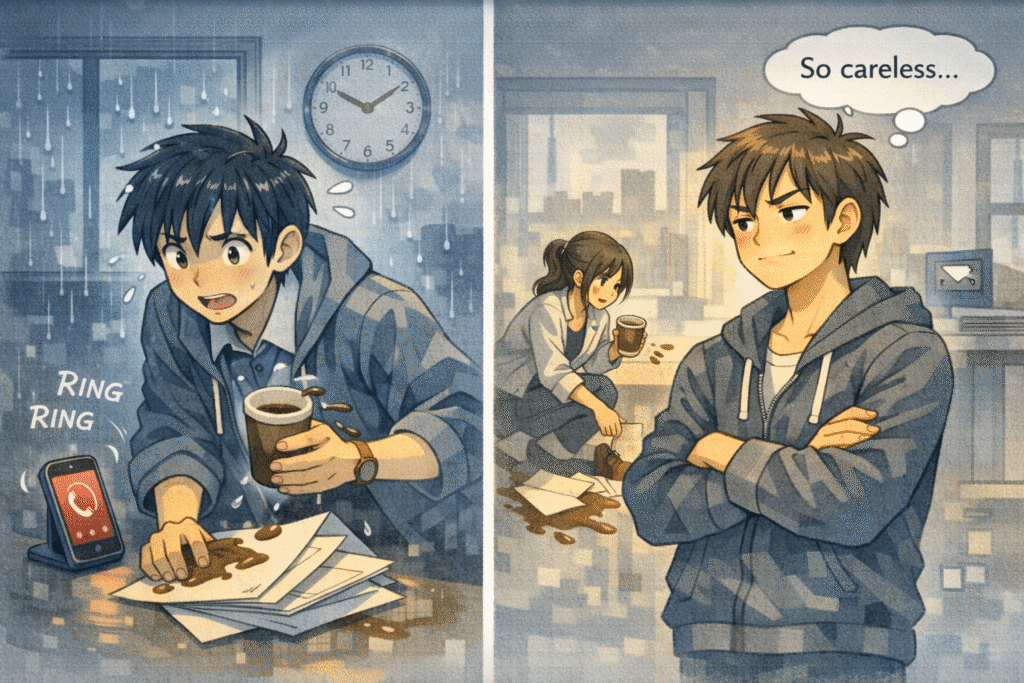
1. My Behavior Is Situational. Yours Is Personal.
The concept was introduced by Edward Jones and Richard Nisbett in the 1970s.
The idea is simple:
When I fail → It was the situation. When you fail → It was your personality.
If I miss a deadline, “I was overwhelmed.”
If you miss a deadline, “You’re irresponsible.”
As actors in our own lives, we see context. As observers of others, we see character.
2. The Power of Perspective
This bias stems from point of view.
When I act, I know what I was feeling, what constraints I faced, what pressure I experienced.
When I observe you, I see only the visible behavior.
My inner world is vivid to me. Yours is invisible.
That asymmetry creates distorted judgment.
3. Why It Damages Relationships
The bias becomes sharper in close relationships.
If I respond late: “I had a stressful day.”
If you respond late: “You don’t care anymore.”
We interpret our own behavior through circumstance, but others’ behavior through intention.
Over time, this pattern breeds misunderstanding and resentment.
4. How to Reduce the Bias
Awareness is the first step.
Before judging, try asking:
“What situation might they be in?” “Would I act differently under the same pressure?”
Switching perspective softens attribution.
Replacing “Why are they like that?” with “What might have happened?”
can transform conflict into understanding.
5. The Bias in the Digital Age
Social media often intensifies the actor–observer bias.
Online, we usually see only fragments of other people’s behavior: a short comment, a delayed reply, a single mistake.
Without context, people quickly judge character instead of circumstance.
At the same time, we continue to interpret our own actions through stress, intention, and personal explanation.
Digital communication reduces visible context, making empathy more fragile and rapid judgment more common.
Conclusion
We see ourselves in full color and others in outline.
The Actor–Observer Bias is not a flaw of bad character. It is a built-in feature of human cognition.
But once we recognize it, we gain a choice.
A choice to pause. A choice to interpret more gently. A choice to understand before blaming.
Sometimes, empathy begins with changing the angle of view.
A Question for You
Have you ever judged someone harshly— only to realize later that you might have acted the same way?
Related Reading
The psychological roots of self-perception and social comparison are further explored in The Sociology of Selfies, where identity and recognition are analyzed in digital contexts. From a structural perspective, The Age of Overexposure: Why Do We Turn Ourselves into Products? expands this discussion by questioning how social systems amplify performative identity.
References
1. Jones, E. E., & Nisbett, R. E. (1972). The Actor and the Observer: Divergent Perceptions of the Causes of Behavior. In Attribution: Perceiving the Causes of Behavior. → This foundational work formally introduced the actor–observer bias and demonstrated how individuals attribute their own actions to situational factors while attributing others’ actions to personality traits.
2. Ross, L. (1977). The Intuitive Psychologist and His Shortcomings. In Advances in Experimental Social Psychology. → Ross developed the concept of the fundamental attribution error, closely related to the actor–observer bias, highlighting how people underestimate situational influences when judging others.
3. Gilbert, D. T. (1998). Ordinary Personology. In The Handbook of Social Psychology. → Gilbert explains how everyday people form quick judgments about others and why attribution biases persist even when we attempt to be objective.
When the album Buena Vista Social Club was released in 1997, it became more than a musical success. It was a global event.
Veteran Cuban musicians—many of them previously forgotten outside Havana—were suddenly performing on the world’s largest stages. The album sold millions of copies and won a Grammy Award. Director Wim Wenders’ documentary further transformed their story into a cinematic narrative of rediscovery and cultural revival.
The project seemed to signal something hopeful: a widening of the global music market to include non-Western traditions.
Yet it also raised an unsettling question:
Was this truly a revival of Cuban music—or a carefully curated product shaped by Western cultural industries?
1. Expansion of Diversity: A Case for Cultural Exchange
From one perspective, Buena Vista Social Club represents a triumph of global cultural exchange.
Traditional Cuban genres such as son, bolero, and guajira reached audiences who had never encountered them before. A generation of elderly musicians gained renewed artistic life and global recognition.
The project bridged generations and geographies. Traditional rhythms met modern recording techniques. Local heritage became part of a shared global soundscape.
In this light, the project stands as an example of how globalization can expand cultural visibility rather than erase it.
2. The World Music Industry and Structural Inequality
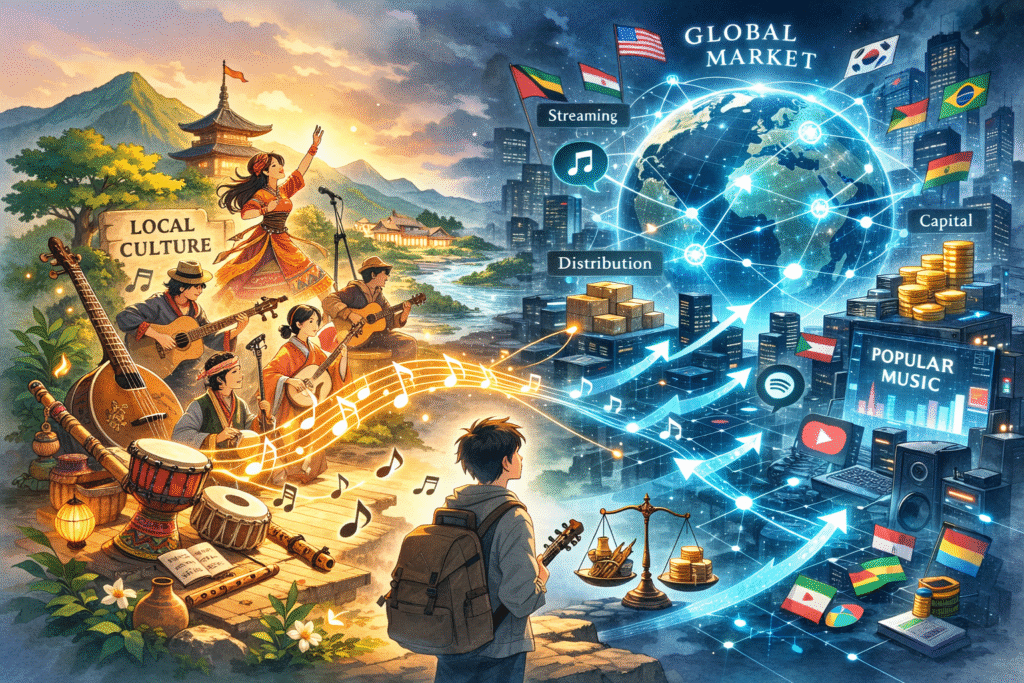
A more critical interpretation situates Buena Vista Social Club within the broader “world music” industry.
Although Cuban musicians were the visible protagonists, the project was initiated and largely shaped by American guitarist Ry Cooder and German filmmaker Wim Wenders.
Capital, distribution networks, and global media exposure remained concentrated in Western hands.
Moreover, the imagery surrounding the album and film emphasized nostalgic Havana— vintage cars, faded architecture, and romanticized poverty.
The Cuba presented to global audiences was not necessarily contemporary reality, but a version filtered through Western aesthetic expectations.
In this sense, the project may have reinforced a familiar hierarchy: non-Western culture as an exotic product for Western consumption.
3. Authenticity and Commercial Framing
At the heart of the debate lies the question of authenticity.
On the one hand, the musicians undeniably benefited. Their art gained global recognition, and their personal stories were preserved and celebrated.
On the other hand, their music was framed within a market logic that catered to international tastes.
Cuban music entered the global stage—but did it speak entirely in its own voice, or in a voice shaped by external demand?
The tension between cultural authenticity and commercial packaging remains unresolved.
4. Theoretical Perspectives: Hybridity or Cultural Imperialism?
Cultural theory offers two contrasting lenses.
The concept of hybridity, associated with scholars such as Homi Bhabha, interprets such projects as spaces of creative cultural mixing. New meanings emerge from cross-cultural encounters.
Conversely, theories of cultural imperialism—articulated by thinkers like Herbert Schiller—warn that global circulation often masks unequal power structures.
From this angle, world music may not represent equality, but rather a system in which Western markets determine visibility and value.
Buena Vista Social Club thus becomes a case study in global asymmetry.
5. Beyond Nostalgia: Toward Fair Cultural Exchange
The project demonstrates both possibility and limitation.
It shows that non-Western music can captivate global audiences. Yet it also reveals who controls the mechanisms of amplification.
If global diversity is to move beyond aesthetic appreciation, several conditions must be strengthened:
Greater autonomy for local artists in production and distribution
Cultural engagement that respects historical and social context
Only then can global exchange avoid reproducing subtle forms of dependency.
Conclusion: Listening with Awareness
Buena Vista Social Club remains a beautiful musical achievement. Its melodies continue to resonate across continents.
Yet its legacy is more complex than nostalgia.
The deeper question is not whether the music was authentic or not. It is whether global recognition can occur without reproducing structural inequality.
Was this an expansion of diversity—or the refinement of a new dependency?
The answer lies not only in the music itself, but in how global audiences choose to listen.
A Question for You
When a local culture reaches global success, does it gain independence—or become shaped by outside forces?
Aparicio, Frances R., & Jáquez, Cándida F. (Eds.). (2003). Musical Migrations: Transnationalism and Cultural Hybridity in Latin/o America, Volume I. → This volume explores how Latin music circulates across borders and becomes reinterpreted within global markets. It provides a framework for understanding cultural hybridity and transnational exchange, helping situate Buena Vista Social Club within broader processes of global musical migration.
Moore, Robin D. (1997). Nationalizing Blackness: Afrocubanismo and Artistic Revolution in Havana, 1920–1940. → Moore examines the historical formation of Afro-Cuban musical identity and its political significance. His work illuminates the cultural roots that predate Buena Vista Social Club and clarifies how Cuban music became intertwined with national and racial narratives.
Hernandez-Reguant, Ariana (Ed.). (2009). Cuba in the Special Period: Culture and Ideology in the 1990s. → This collection analyzes Cuba’s economic crisis and cultural transformation during the 1990s. It provides essential context for understanding how Cuban music became globally marketable during the same period that Buena Vista Social Club emerged.
Taylor, Timothy D. (1997). Global Pop: World Music, World Markets. → Taylor critically investigates how the “world music” industry packages and distributes non-Western music for Western consumption. His analysis helps frame Buena Vista Social Club within debates about globalization, commodification, and cultural dependency.
Fairley, Jan. (2000). “How to Make Money from Music: The Case of the Buena Vista Social Club.” Popular Music, 19(3), 199–210. → Fairley offers a detailed case study of the production, marketing, and commercial success of Buena Vista Social Club. The article exposes the economic structures behind the project and highlights tensions between cultural revival and market-driven representation.