Blog

  • The Psychology of Handwriting

    The Warmth of the Human Touch in an Age Without Pens

    Handwritten letter and fountain pen on a sunlit wooden desk

    1. When Was the Last Time You Wrote a Letter by Hand?

    When was the last time you wrote a letter by hand?

    A few days ago, I found myself holding a pen again.
    After hours of typing on a keyboard, my hand felt strangely unfamiliar with the weight of ink and paper.
    Yet as the pen moved across the page, there was a quiet satisfaction—
    a subtle texture that no digital font could reproduce.

    The handwriting was imperfect, even clumsy at times,
    but each letter seemed to carry intention.
    I could have sent an email.
    Instead, I chose to write by hand because I wanted to send something warmer than words alone.

    Sometimes, when we look at old letters, we recognize the person before we read the message.
    In the curves and pressure of the writing, we sense their presence.
    Handwriting is not merely text—it is a trace of a human moment.


    2. Handwriting as Language: Movement That Holds Emotion

    Handwritten notes beside a laptop and smartphone

    Handwriting has often been called a mirror of the mind.

    Psychologist Ludwig Klages once wrote that “writing is not done by the hand, but by the soul.”
    Tension appears in tight, rigid letters.
    Calmness flows through generous, open strokes.

    Unlike typing—where emotion is flattened into uniform fonts—
    handwriting records the body’s rhythm, hesitation, and emotional state.
    The tremble of a line, the uneven spacing, the sudden pressure of ink
    all become part of the message.

    That is why we often feel closer to handwritten words.
    Even when the writing is messy, it feels honest.
    Its imperfection makes it unmistakably human.


    3. The Digital Paradox: Speed Without Intimacy

    In the digital age, handwriting is slowly disappearing.

    Schools rely less on handwritten assignments.
    Workplaces replace signatures with digital approvals.
    Efficiency dominates communication.

    And yet, the longing for handwriting remains.

    People photograph handwritten notes and share them online,
    as if trying to reinsert warmth into a cold medium.
    We instinctively trust handwritten words more than typed ones,
    because speed cannot replace sincerity.

    The paradox is clear:
    the faster communication becomes,
    the more we crave signs of slowness.


    4. Handwriting as a Vessel of Memory

    Handwriting is also a carrier of memory.

    Letters, notebooks, and postcards left behind
    preserve more than information—they preserve presence.
    They hold the movement of a person’s hand,
    a silent echo of how they once existed in the world.

    People pass away, but their handwriting remains.
    Long after voices fade, written traces continue to testify:
    someone was here.

    In this sense, handwriting becomes an emotional artifact—
    a human imprint that time does not easily erase.


    5. Conclusion: Writing by Hand Is Writing the Self

    In a world driven by speed, handwriting returns as an act of resistance.

    Keyboards offer convenience,
    but the warmth of meaning still emerges from the hand.

    Writing a handwritten letter in warm window light

    When you wish to convey care rather than efficiency,
    consider writing a single line by hand.

    Ink fades slowly.
    Paper ages gently.
    And the words you write today may one day carry your presence
    long after the moment has passed.

    Handwriting is not about nostalgia.
    It is about leaving behind something unmistakably human.

    📚 References

    Sennett, Richard. (2008). The Craftsman. Yale University Press.
    → Sennett examines how manual practices shape self-formation and human dignity. Handwriting can be understood within this framework as a bodily language through which identity and presence are expressed.

    Varnhagen, Vera. (2006). “Handwriting and Personality: An Analysis of Expressive Movement.” Journal of Nonverbal Behavior, 30(2), 91–107.
    → This study explores how emotional states and personality traits are reflected in handwriting through movement, pressure, and rhythm, offering a psychological basis for interpreting handwritten expression.

    Baron, Naomi S. (2000). Alphabet to Email: How Written English Evolved and Where It’s Heading. Routledge.
    → Baron traces the evolution of written communication and analyzes how digital writing alters emotional expression and interpersonal connection, providing essential context for understanding the loss of handwriting’s affective depth.
  • The Age of Overexposure: Why Do We Turn Ourselves into Products?

    Why do we feel compelled to show ourselves in order to exist?

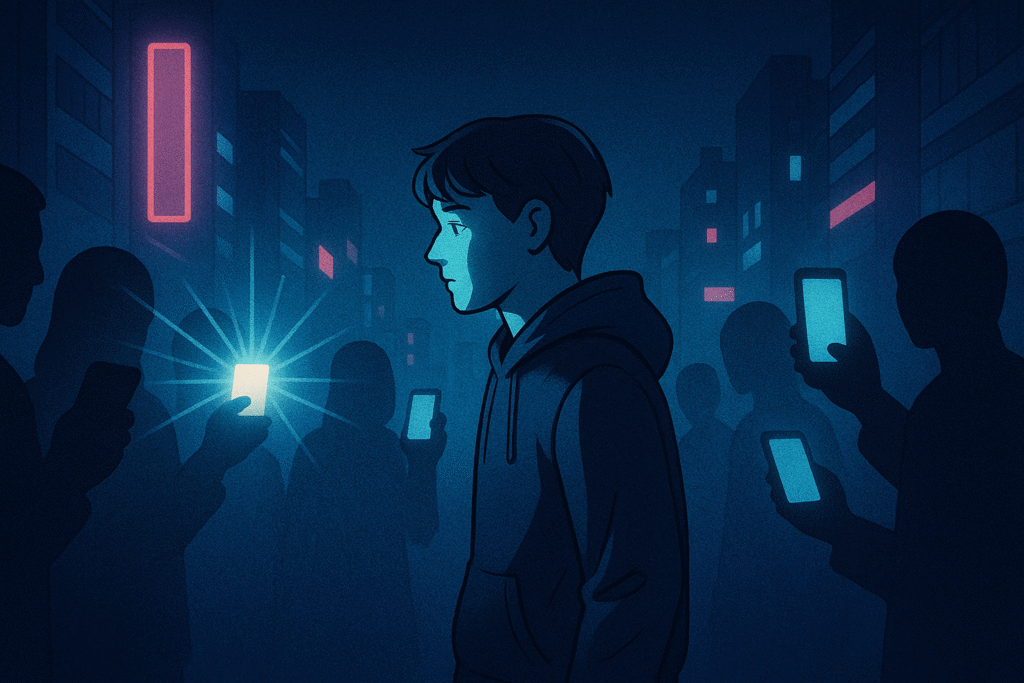
    A figure surrounded by camera flashes in a neon-lit city, symbolizing self commodification

    1. “If You Are Not Seen, You Feel as If You Do Not Exist”

    Under the constant flash of social media, the self gradually becomes an image.
    And that image, in turn, begins to define who we are.

    There is a scene I often notice in cafés.

    Two friends sit across from each other, yet they spend more time facing their camera screens than one another.
    They adjust facial angles, background lighting, and filters—sometimes for several minutes.

    Once the photo is posted, their eyes immediately turn to the numbers:
    likes, comments, reactions.

    Instead of conversation, the space between them fills with unspoken questions:

    How do I look?
    What will people think?

    Our era whispers to us relentlessly:

    If you are not visible, you do not exist.
    If you are not visible, you are falling behind.
    If you are not visible, you are no one.

    At what point did self-expression stop being expression—and become self-marketing?


    2. Why Does Social Media Turn Us into “Products”?

    2.1 The Attention Economy: When Attention Becomes Currency

    TikTok, Instagram, Reels, YouTube Shorts—
    all compete for momentary attention.

    In this system, we do not only sell content.
    We sell ourselves along with it.

    Likes resemble price tags.
    Comments feel like consumer feedback.
    Follower counts begin to look like brand value.

    The self becomes measurable.


    2.2 Self-Branding: Packaging the Self

    “Knowing how to present yourself” is now treated as a skill—and an asset.

    The problem is not presentation itself,
    but the fact that the package increasingly matters more than the person inside it.

    What was once a tool becomes a standard of worth.


    2.3 Algorithms and the Logic of Exposure

    Algorithms are simple:

    The more stimulating something is, the more it spreads.
    The more it spreads, the more it is rewarded.

    Social media quietly teaches us one rule:

    Reveal a little more. Then you will be remembered.


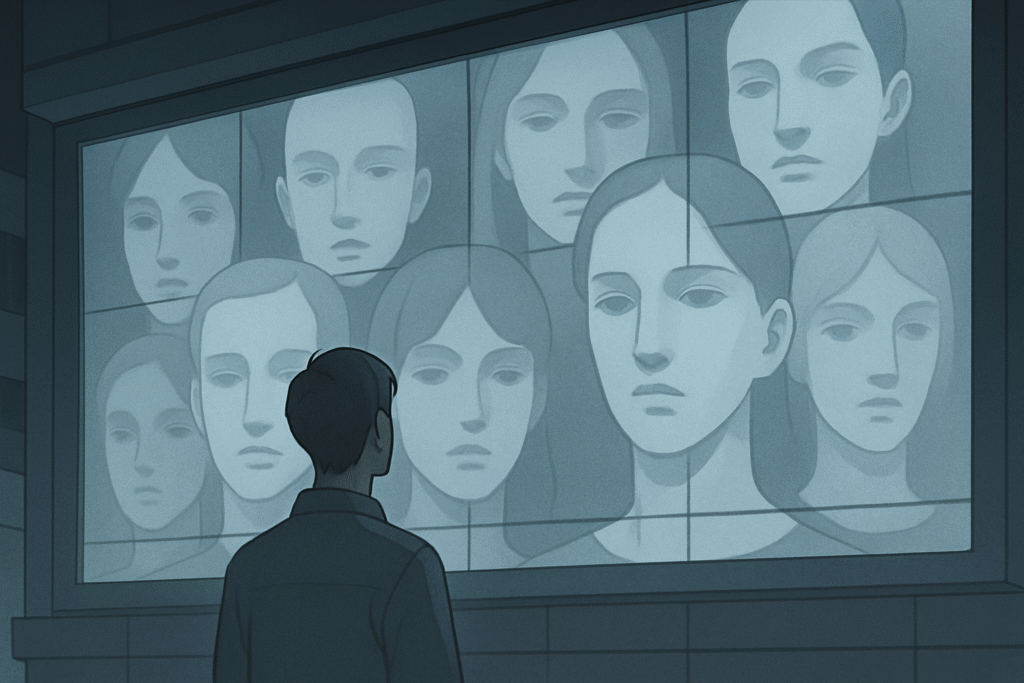
    Digital faces displayed on a city billboard, representing identities consumed as content

    3. Why Do We Consume One Another Like Products?

    3.1 Byung-Chul Han: The Performance Society

    In The Burnout Society, Byung-Chul Han argues that modern individuals constantly turn themselves into projects—measured by performance and visibility.

    As a result, relationships shift.

    They are no longer about encountering a person,
    but about consuming outcomes.

    We scroll through others as content,
    and others scroll through us in return.


    3.2 Bourdieu: The Market of Symbolic Capital

    Through Pierre Bourdieu’s framework, social media appears as a battlefield of symbolic capital.

    Age, appearance, profession, taste, emotional expression—
    all become resources to be evaluated and ranked.

    Within this system, an unspoken rule emerges:

    You must learn to sell yourself better.


    3.3 Foucault: When Surveillance Becomes Internal

    Michel Foucault described modern power as a system that makes individuals discipline themselves.

    Social media is precisely such a space.

    Before anyone else judges how we look,
    we examine ourselves first.

    At that moment, we are no longer simply expressing ourselves.
    We become our own supervisors—
    and our own editors.


    4. Conclusion: Beyond Visibility, Toward Existence

    A quiet figure by a window at dawn, symbolizing a return from visibility to existence

    The age of overexposure urges us to define ourselves by how we appear to others.

    Yet visibility is not existence.
    Packaging is not essence.

    Exposure does not deepen relationships.
    Often, it produces a more profound loneliness.

    The question is no longer vague:

    Do we want to be seen more,
    or do we want to exist more deeply?

    Returning from the “visible self” to the “lived self” requires courage—
    more courage than constant exposure ever does.

    And that courage does not begin with dramatic gestures,
    but with a quiet permission:

    Allowing ourselves moments that do not need to be shown at all.


    References

    Han, Byung-Chul. (2010). The Transparency Society. Stanford University Press.
    → Han analyzes how the obsession with transparency leads individuals to voluntarily overexpose themselves, participating in systems of surveillance and self-commodification. His work provides a crucial framework for understanding overexposure in the digital age.

    Foucault, Michel. (1977). Discipline and Punish: The Birth of the Prison. Pantheon Books.
    → Foucault explains how modern power operates through surveillance that individuals internalize. His theory directly illuminates how social media users monitor and regulate their own self-presentation.

    Bourdieu, Pierre. (1986). The Forms of Capital. Greenwood.
    → Bourdieu’s concept of symbolic capital helps explain why individuals in social media environments feel compelled to package and market their identities as competitive assets.

    Goffman, Erving. (1959). The Presentation of Self in Everyday Life. Doubleday.
    → Goffman’s theory of social performance provides the foundational lens for interpreting self-branding and identity management on digital platforms.

    Turkle, Sherry. (2011). Alone Together. Basic Books.
    → Turkle critiques how digital technologies create the illusion of connection while deepening isolation, reinforcing the paradox of overexposure without intimacy.

  • The Inner House

    A Day of Clearing the Rooms of the Mind

    Soft light entering a quiet room, symbolizing the inner house of the mind

    1. Opening – Cleaning More Than a Space

    One afternoon, I decided it was time for a long-overdue deep cleaning.

    Unfinished books were stacked on the desk.
    Clothes from different seasons were tangled together in the closet.
    As I sorted through these small messes, a quiet thought surfaced:

    Perhaps my mind looks much the same.

    I opened the window to let fresh air in.
    Soft sunlight filled the room, and something inside felt lighter.
    That was when I realized that cleaning is not only about space—
    it is also about letting air move through the mind.


    2. A Small Moment of Humor

    “Even the mind needs cleaning,” someone once joked.
    “Then what is the dust?”
    “Perhaps,” came the answer, “unattended emotions.”


    3. Insight – The Rooms We Carry Inside

    Inside each of us are many rooms.

    A room of joy.
    A room of sorrow.
    A room of regret we hesitate to enter.

    We often live with these doors closed.
    Yet emotions left untouched do not disappear.
    They quietly accumulate, making the inner air heavy.

    To organize the mind is not to erase feelings,
    but to become honest with oneself.

    When an old wound is gently brought into the light,
    it transforms—from a burden into understanding.

    The essence of inner organization is not discarding emotions,
    but finding the courage to look at them again.


    Hands gently organizing notes on a desk, reflecting emotional clarity

    4. Today’s Practice – Creating an Emotional Storage Map

    Take a sheet of paper and name the rooms of your inner house.

    For example:
    The Room of Joy
    The Room of Regret
    The Room of Gratitude

    Write down, in a single line, what each room contains.
    Then choose one room to tend to today.

    When emotions are given structure,
    what once felt overwhelming begins to take shape.


    5. A Small Act of Courage

    Later that afternoon, with a warm cup of tea nearby,
    I opened a page labeled The Room of Regret.

    Slowly, I wrote what I had long postponed:
    “Why wasn’t I kinder then?”

    Tears welled up—not from regret, but from understanding.
    When the page was complete, the weight inside had eased.

    “This room,” I thought, “can finally breathe.”


    6. Quote of the Day

    “The unexamined life is not worth living.”
    Socrates

    A calm figure by the window in warm light, symbolizing inner peace

    7. Closing Reflection – Letting Light In

    Organizing the inner house is not about removing emotions.
    It is about returning them to their rightful place.

    As scattered thoughts are gently arranged,
    new feelings find space to enter.

    Everyone carries at least one room that remains unorganized.
    Today, consider opening its door—
    and letting in a line of sunlight and a breath of air.


    8. A Thought from Psychology

    Psychologist D. W. Winnicott emphasized that reconnecting with the True Self
    begins by recognizing one’s inner emotional space.

    This process is not about meeting external expectations,
    but about noticing what is genuinely felt within.

    To clean the rooms of the mind
    is to begin finding one’s way back to the self.


    9. One-Sentence Takeaway

    “Caring for the inner house is the quietest way of loving who you are today.”

  • The Sociology of Selfies

    How Self-Representation and the Desire for Recognition Shape Digital Identity

    selfie and digital identity reflection

    Introduction: A Selfie Is Not Just a Photo

    On the subway, in cafés, or while traveling, we instinctively raise our smartphones.
    In the frame, we appear slightly brighter, slightly more confident, slightly more composed.

    A selfie is not merely a record of the self.
    It is a carefully constructed moment shaped by the awareness of being seen.

    Behind this seemingly casual gesture lies a deeper social message—
    a desire for recognition and a question that quietly follows us:
    How do I want to be perceived by others?


    Selfies as a Technology of Self-Presentation

    The evolution of smartphone cameras has turned everyday users into curators of their own personal brands.

    Lighting, filters, angles, and backgrounds are not neutral choices.
    They function as symbols that communicate identity.

    A selfie taken against a scenic landscape performs freedom.
    A selfie at a desk performs discipline and diligence.

    In this sense, selfies are not simple records of reality.
    They are acts of self-presentation, or what sociologists describe as a performance of identity.


    Recognition and the Social Psychology of “Likes”

    When we upload a selfie, we are not simply waiting for numbers to increase.
    We are waiting for acknowledgment.

    Each “like” operates as a social signal that says, I see you.

    Sociologist Charles Horton Cooley famously described the looking-glass self
    the idea that individuals form their self-image through the imagined reactions of others.

    In the digital age, selfies place this mirror directly onto the smartphone screen.
    As a result, people often begin to prioritize the visible self over the experienced self.

    Self-expression becomes inseparable from social validation,
    and identity turns into a negotiation between who we are and how we are received.

    social media likes and recognition desire

    The Paradox of Freedom and Anxiety

    Selfies promise freedom.
    We choose how to present ourselves, when to post, and what to reveal.

    Yet this freedom often coexists with anxiety.

    Filters subtly reflect perceived social expectations.
    Endless streams of perfected faces invite comparison and self-doubt.

    For younger generations especially, selfies can become tools of proof—
    evidence that one is worthy, attractive, or socially accepted.

    Thus, selfie culture exists at the boundary between autonomy and control,
    where self-expression is constantly shaped by imagined audiences.


    From the Seen Self to the Lived Self

    Selfies are mirrors of contemporary society.
    They express a human desire to be acknowledged, remembered, and valued.

    But when attention shifts entirely to the seen self,
    there is a risk of losing contact with the lived self.

    Occasionally lowering the camera and stepping outside the frame
    allows space to reconnect with experience beyond representation.

    Only then can selfies transform from instruments of performance
    into tools of self-understanding.

    stepping away from social media reflection

    Conclusion

    Selfies are neither shallow nor inherently harmful.
    They are social languages shaped by recognition, identity, and visibility.

    The challenge is not to abandon selfies,
    but to remain aware of the difference between being seen and truly existing.

    In that awareness, digital self-representation can become
    not a performance for approval,
    but a reflection of a life genuinely lived.


    📚 References

    Senft, T. M., & Baym, N. K. (2015).
    What Does the Selfie Say? Investigating a Global Phenomenon.
    International Journal of Communication, 9, 1588–1606.
    This study frames selfies as social and communicative acts rather than trivial images, explaining how identity and recognition are negotiated through digital self-representation.

    Goffman, E. (1959).
    The Presentation of Self in Everyday Life.
    New York: Anchor Books.
    Goffman’s theory of social performance provides a foundational framework for understanding selfies as staged expressions of identity in everyday interactions.

    Marwick, A. E. (2013).
    Status Update: Celebrity, Publicity, and Branding in the Social Media Age.
    New Haven, CT: Yale University Press.
    This work explores how social media encourages self-branding and visibility-seeking behaviors, offering crucial insight into recognition economies that shape selfie culture.

  • The Texture of Time: How the Mind Shapes the Weight of Our Moments

    How psychological time expands, contracts, and gives meaning to our lives.

    Abstract flowing ribbon of light symbolizing the texture of time.

    Two Kinds of Time: Measured vs. Experienced

    We often say, “Today felt so long” or “This week went by in a flash.”
    Interestingly, these statements have nothing to do with physical time.
    Physics tells us that time flows at a constant rate—24 hours a day, without exception.

    Yet human beings do not live inside clocks.
    We live inside perceived time, or what psychologist Daniel Zakay called “experienced time.”

    Zakay distinguishes between:

    • Measured time — the objective ticking of the clock
    • Experienced time — the subjective feeling of duration shaped by attention, emotion, and memory

    The gap between these two creates what we might call the texture of time.
    This texture is not a mere feeling—it emerges from the brain’s information-processing, emotional state, and social environment.

    In other words:

    The quality of our time mirrors the quality of our perception.


    When Time Slows Down

    Some moments stretch endlessly: waiting for exam results, entering a new environment, or standing in an unfamiliar place. Slow time appears in three main situations:

    1. Novelty — a world rich in unfamiliar details

    The brain works harder to process new information, which creates the sensation of longer time.
    A first-time trip feels longer than a daily commute because novelty increases mental recording.

    2. Anxiety and hyper-awareness

    Before an interview, during turbulence on a plane, or in moments of threat, the mind becomes highly alert.
    This heightened attention makes even seconds feel elongated.

    3. Waiting — the pressure of the expected future

    Waiting is not an empty pause.
    It is a psychological space where expectation and uncertainty weigh on the present.
    This emotional tension stretches time.

    In slow time, the brain is collecting more data—hence the long, heavy texture.


    When Time Speeds Up

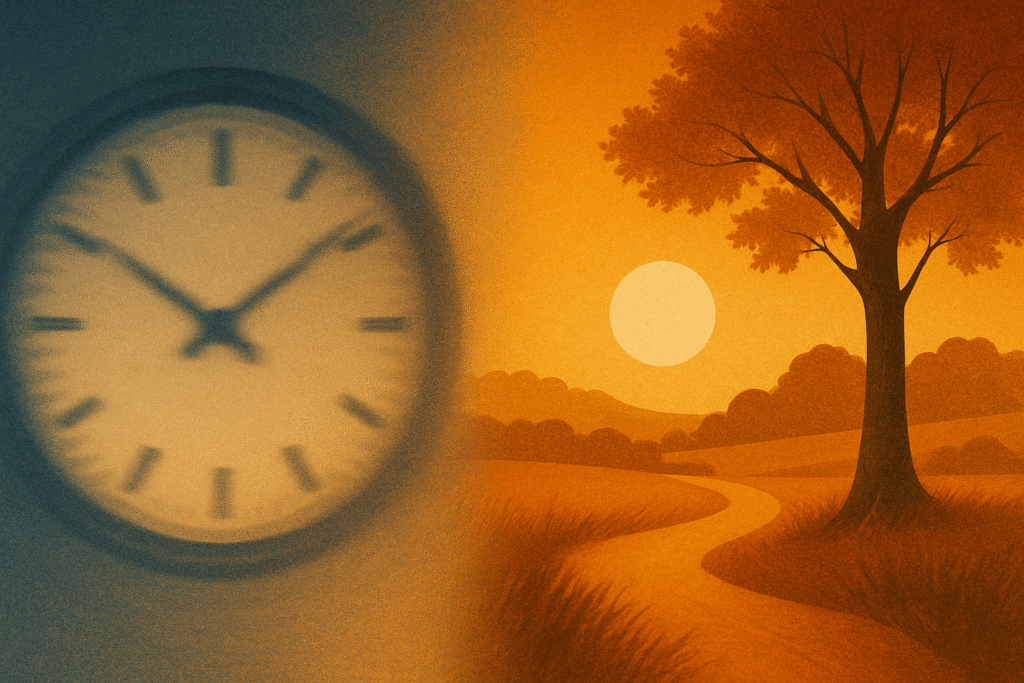
    Contrast of fast-blurred clock and slow-detailed landscape showing measured vs experienced time.

    Other times, a whole day slips through our fingers before we notice.

    1. Flow — when the self momentarily disappears

    In deep concentration, the brain’s time-tracking function weakens.
    Artists, athletes, and writers often describe the sensation of timelessness during full absorption.

    2. Routine — the unrecorded hours

    Repetition and familiarity reduce memory formation.
    When the brain doesn’t “save” the moment, the duration feels shorter.

    This explains why:

    • Children experience long, expansive time (full of new stimuli)
    • Adults feel time accelerating with age (reduced novelty = reduced memory density)

    Fast time is not a sign of aging itself—it is a sign of decreased newness.


    Time Is a Social Experience

    Time is not only psychological—it is also social.
    Sociologist Norbert Elias argued that time is a symbolic tool societies use to coordinate life.

    1. Modern society demands speed

    Efficiency has become a virtue, and the pressure to be fast creates a culture of urgency.
    This accelerates our inner tempo.

    2. The smartphone era fragments our time

    Notifications, updates, and alerts constantly break our attention.
    Our day becomes a series of small interruptions—fast, jagged, and thin.

    3. The best days aren’t the busiest—they are the densest

    A day feels meaningful not because it was filled with tasks,
    but because it contained a memorable moment.

    The value of time is measured not in quantity, but in density.


    How to Change the Texture of Your Time

    We cannot control time’s speed, but we can change how we experience it.

    1. Create memorable moments — the art of novelty

    Try a new café, walk a different street, listen to unfamiliar music.
    Small variations build richer memories.

    2. Practice intentional pauses — the art of stillness

    A few minutes of silence, deep breathing, or opening a window resets the mind.

    3. Record your experiences — the art of memory

    Write, photograph, or journal.
    Recorded moments gain texture and depth.

    4. Cultivate flow — the art of immersion

    Engage fully in one activity.
    Flow compresses time but enriches meaning.


    Conclusion: Time Is Not Managed—It Is Felt

    Physical time flows steadily.
    Psychological time flows according to meaning, emotion, and attention.

    • Pleasant experiences pass quickly—but their resonance is long.
    • Anxious moments drag—but leave shallow memory.

    What truly matters is not how much time we have,
    but how deeply we live inside the time we experience.

    The texture of time is shaped by how we see, feel, and remember our days.

    Hands gently holding a warm glowing moment symbolizing meaningful time.

    References

    Zakay, D., & Block, R. (1997). Temporal Cognition. Annual Review of Psychology.
    → A foundational study explaining the difference between measured time and experienced time, and how attention and emotion shape time perception.

    Csikszentmihalyi, M. (1990). Flow: The Psychology of Optimal Experience. Harper & Row.
    → Explores how deep immersion alters our sense of time and how flow enriches lived experience.

    Bergson, H. (1911). Time and Free Will. Macmillan.
    → Introduces the concept of “duration,” distinguishing clock time from the qualitative, subjective dimension of psychological time.

  • Walking as a Way of Thinking

    How a simple walk becomes a quiet conversation with the self.

    How a simple walk becomes a quiet conversation with the self

    Opening – A Walk That Slows the Mind

    Walking has a quiet power.
    It doesn’t force answers, yet it softens the questions we carry.

    Some paths slow us down just enough to hear the thoughts we’ve been ignoring.
    Today’s walk was one of those rare moments when movement becomes reflection.


    Sunlit forest path winding through a quiet autumn field

    A Small Moment of Humor

    “When a good idea comes to me while walking… is that exercise, or is it studying?”

    Maybe it’s both.
    Walking might be the only workout that strengthens the heart and clears the mind at the same time.


    When Thoughts Begin to Walk Too

    With each steady step, the inner noise began to fade.
    Not because solutions arrived, but because the questions felt less urgent—
    as if they finally had space to breathe.

    Walking never demands a conclusion.
    It simply offers a quieter place for thoughts to wander.

    Sometimes the ideas that surface mid-stride
    are the ones we’ve postponed the longest.
    Today felt like the right day to let them speak.


    A Simple Practice for the Day

    The 10-Minute Reflective Walk
    Take a short walk with no destination.
    Choose one guiding question:

    • What thought has been weighing on me?
    • What emotion does this path bring up?
    • If I could choose freely, where would I go next?

    If one clear sentence emerges, capture it before it drifts away.


    A Moment of Presence

    A soft breeze brushed the face.
    Light filtered gently through the leaves.
    Breathing slowed.

    Walking is not merely moving forward—
    it is quietly returning to oneself.


    A lone figure facing a calm sunset horizon

    Quote of the Day

    All truly great thoughts are conceived while walking.
    — Friedrich Nietzsche


    Closing Insight

    In the rhythm of our steps, we rediscover the rhythm of our thoughts.

    Walking clears space without demanding effort—
    a small ritual,
    a mental reset,
    a return to clarity.


    Today’s Insight (Science Notes)

    Studies from Stanford and the American Psychological Association highlight that walking significantly boosts divergent thinking and emotional clarity.

    Neuroscientific research shows that walking:

    • increases activity in the prefrontal cortex,
    • boosts creativity and emotional regulation,
    • reduces stress hormones,
    • and raises serotonin levels.

    This is why ideas often arrive precisely when we aren’t trying to find them.


    Summary Sentence

    “Walking is not a physical act, but a quiet conversation with the mind.”

    1. The New Inequality of the AI Age: The Rise of Digital Refugees

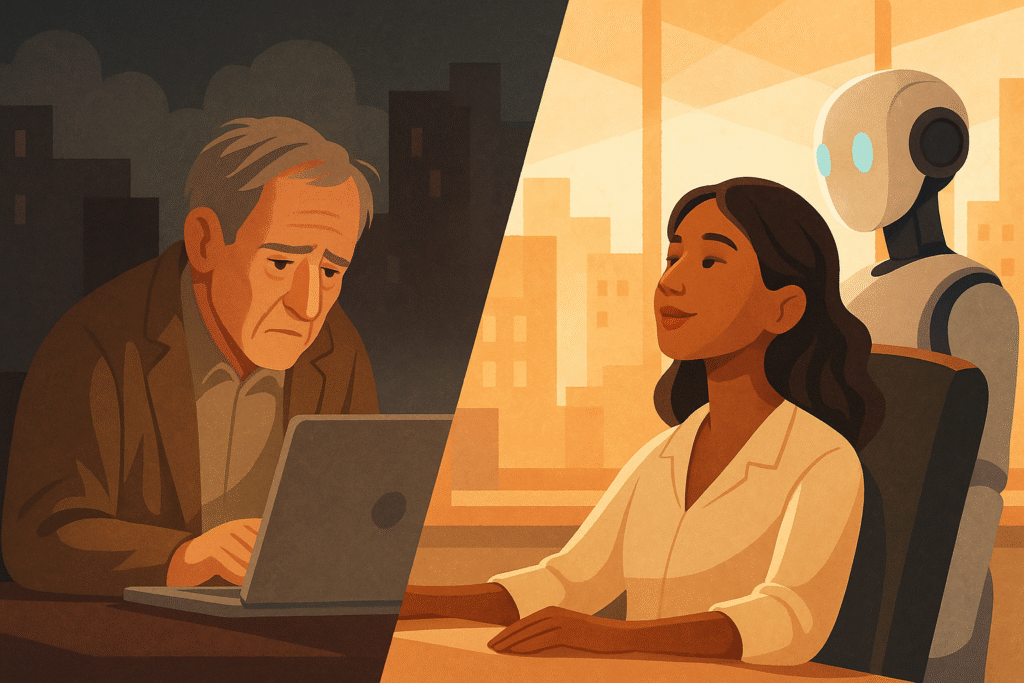
      A visual contrast between connected AI users and people struggling with technology, symbolizing digital inequality.

      Introduction — Those Left Behind in a Connected World

      We now live in a world where AI assistants manage our schedules, banking happens on smartphones, and education unfolds on digital platforms.
      But not everyone can access these tools—or understand how to use them.

      What feels like a simple click for some becomes an insurmountable barrier for others.

      This is where the term “digital refugee” emerges.

      Technology was meant to connect us, but for those excluded from the digital ecosystem, it creates a new form of social isolation and inequality.

      Today, the vulnerable population is no longer defined only as
      “those without internet,”
      but increasingly as
      “those who cannot interact with AI.”


      1. What Are Digital Refugees? — Invisible Migrants of the Information Age

      Digital refugees are not people crossing physical borders.
      They are people pushed to the margins of society because they cannot cross the technological border of the digital world.

      This includes individuals who lack:

      • access to devices
      • stable internet
      • digital literacy
      • the ability to use AI-driven systems

      For example:

      When government services move entirely online, many seniors or low-income citizens struggle with complex application systems. As a result, they become excluded—not legally, but digitally.

      UNESCO defines this as a Digital Access Rights issue, arguing that access to the internet and digital tools is now a fundamental human right.

      This is no longer a matter of convenience but a matter of dignity and civic participation.


      2. Technology’s New Inequality — Who Truly Has the Freedom to Connect?

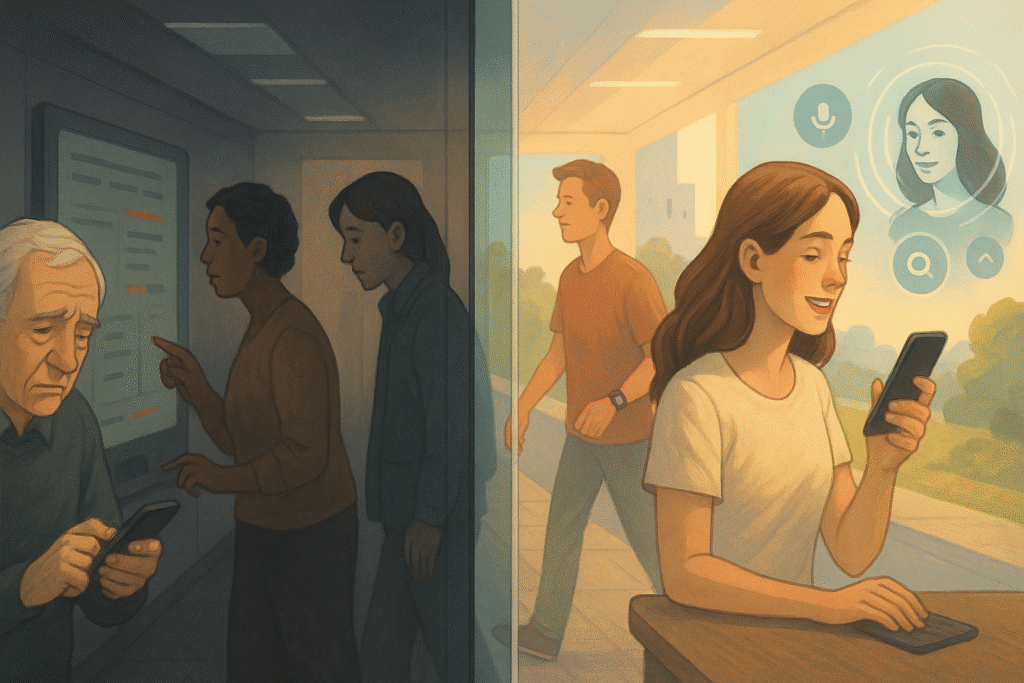
      A contrasting scene showing AI-powered life beside those excluded from technology.

      AI and automation bring efficiency, but they also sort society into new classes:

      • those who understand and utilize digital tools, and
      • those who cannot

      People with advanced digital skills gain better jobs, information, and influence.
      Those without them gradually lose access to healthcare, finance, transportation, and even public voice.

      For someone unfamiliar with smartphones, tasks like medical appointments, transportation schedules, banking, and government forms become overwhelming.

      In such cases, technology stops being a tool and becomes a barrier.

      AI also filters the information we see.
      Low digital literacy increases exposure to narrow or biased content, reinforcing social division and weakening democratic participation.

      Thus, digital inequality is not just economic—it is structural, cultural, and political.


      3. Expanding Human Rights — Technology Access Is Not a Luxury but a Right

      In 2016, the UN Human Rights Council declared internet access a prerequisite for freedom of expression.
      Since then, Digital Access Rights have become central to global human rights discourse.

      This shift demands that states treat digital inclusion as a form of social welfare.

      Some examples:

      • Finland declared broadband access a legal right in 2010.
      • South Korea is expanding digital education for seniors and people with disabilities.

      Yet despite progress, rural communities, low-income citizens, and elderly populations remain cut off from AI-driven services.

      As AI becomes embedded in public policy, education, and healthcare,
      digital literacy becomes a condition for survival, not a privilege.

      People who cannot interact with AI systems risk becoming citizens who exist but cannot participate.


      4. Is Technology a Liberation—or a New Language of Discrimination?

      AI reads text, interprets images, and even writes.
      But behind this intelligence lies:

      • biased data
      • unequal representation
      • structural discrimination

      AI often replicates the inequalities it learns.

      For instance, if AI hiring systems are trained on biased historical data, they reproduce those disparities—reinforcing societal injustice under the illusion of neutrality.

      Thus, digital inequality expands beyond “access” to become a question of design:

      Who is technology built for?
      Whose needs were ignored?
      Who gets left out of the system entirely?

      AI-era human rights must address not only access but also inclusive design.


      5. Conclusion — Does Technology Make Us More Equal?

      Technology can enhance human life—but only if its benefits are shared.

      Digital refugees are not people who “failed to adapt.”
      They are people whom the system failed to include.

      In the AI era, equality requires more than distributing devices.
      It requires rethinking how technologies are built, implemented, and accessed.

      Digital literacy is the new civic education.
      Digital access is the new condition of existence.

      We must ask:

      “Does technology liberate humanity—or does it divide us further?”

      The answer depends not on the machines,
      but on the choices we make as a society.

      📚 References

      1. Gurumurthy, A., & Chami, N. (2020). Digital Justice: Reflections on the Digitalization of Governance and the Rights of Citizens. IT for Change.
      https://itforchange.net
      A foundational work examining how digital governance reshapes citizenship, rights, and power structures.


      2. UNESCO. (2021). Reimagining Our Futures Together: A New Social Contract for Education. UNESCO Publishing.
      https://unesco.org
      A global report proposing a future-oriented educational framework with emphasis on equity, digital access, and social justice.


      3. Selwyn, N. (2016). Education and Technology: Key Issues and Debates. Bloomsbury Publishing.
      https://bloomsbury.com
      A critical analysis of technology’s promises and limits in education, challenging techno-optimism and highlighting structural inequalities.


      4. Couldry, N., & Mejias, U. A. (2019). The Costs of Connection: How Data is Colonizing Human Life and Appropriating It for Capitalism. Stanford University Press.
      https://sup.org
      An influential critique of the data economy arguing that digital systems extract, commodify, and govern human experience.


      5. Eubanks, V. (2018). Automating Inequality: How High-Tech Tools Profile, Police, and Punish the Poor. St. Martin’s Press.
      https://us.macmillan.com
      A groundbreaking investigation into how automated decision systems disproportionately harm marginalized communities.

    2. The Wall of Earphones – Why Do We Choose to Isolate Ourselves?

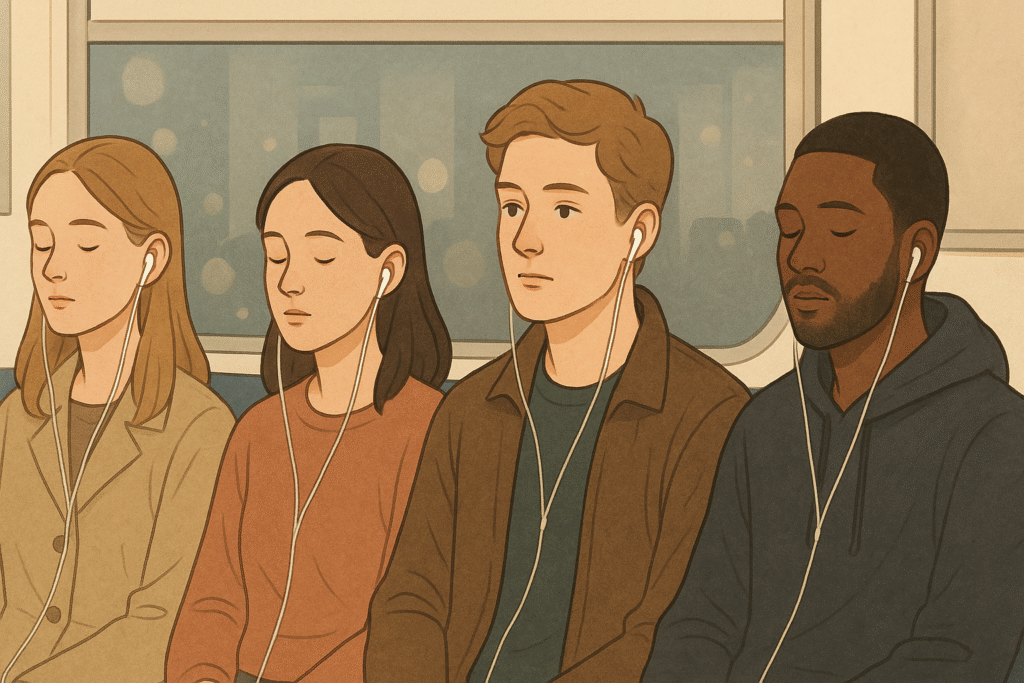
      Earphone wall theme, people isolated in a city scene.

      Introduction — Slipping Into a Small, Private World

      This essay explores earphone isolation in modern life.

      It was an unusually loud evening on the subway.
      Someone’s phone call, the repetitive ads, the metallic wheel noise…
      The day’s accumulated sounds filled my mind all at once.

      Without thinking, I reached into my bag, pulled out my earphones, and placed them in my ears.
      As soon as music began to flow, the world instantly grew distant.
      In that brief moment, a thin but unmistakable wall seemed to form between myself and the world.

      And then a thought emerged:

      “Escaping into sound — that is the wall of earphones.”

      Is this peaceful isolation a moment of self-care?
      Or is it a quiet form of disconnection?


      1. Earphones as a Small ‘Safety Net’

      Earphones are not just devices.
      They are psychological shields, subtle boundaries around our inner world.

      Sociologist Erving Goffman described daily life as a “stage of self-presentation.”
      In this sense, earphones function as a tool that regulates distance between performer and audience.

      In public spaces, earphones send a silent message:

      “I want to be alone right now.”

      Even without sound, simply wearing earphones becomes
      a nonverbal signal of refusal — a gentle but firm boundary.


      2. Personal Isolation or Emotional Self-Defense?

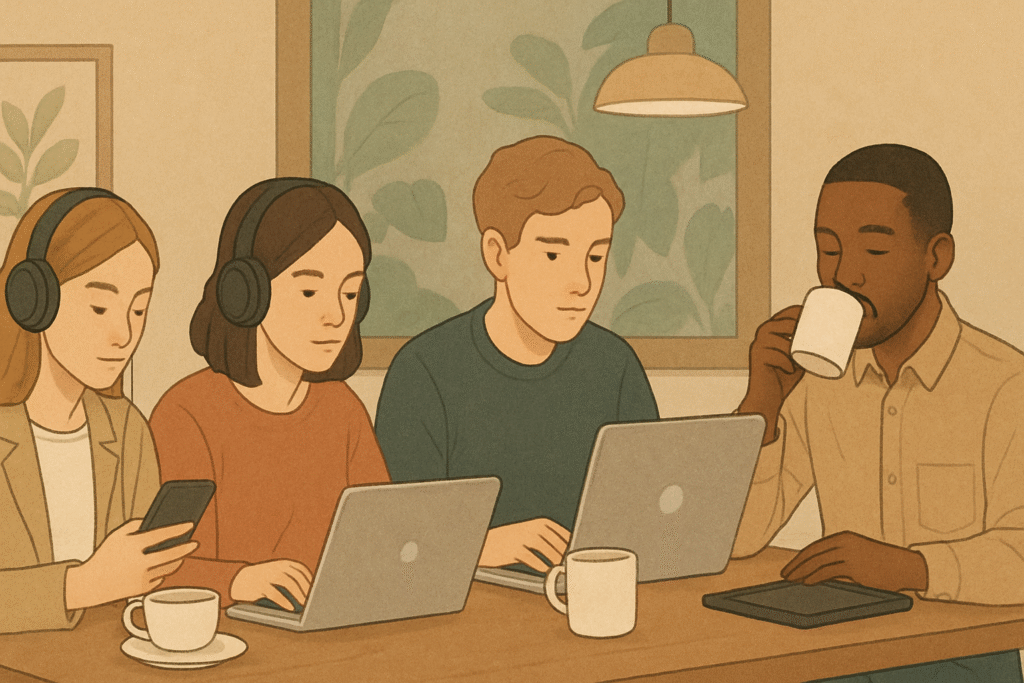
      Café scene showing earphone isolation in daily life.

      Modern life bombards us with noise and constant stimulation.
      Earphones help us regain our rhythm, process emotions,
      and briefly shut out the gaze of others.

      They are, in many ways, an emotional shield that maintains our personal world.

      Yet this small device also deepens social distance.
      We avoid eye contact, conversations fade before they begin,
      and public spaces drift into silent parallel worlds.

      Beyond the wall of earphones,
      there is always someone’s voice we no longer hear.


      3. The Identity of the Earphone Generation — ‘My Rhythm’ and ‘Social Fatigue’

      For Gen Z and Millennials, earphones are cultural markers of identity.
      White earbuds, Bluetooth headsets, noise-canceling devices —
      these are no longer audio tools but symbols of personal taste.

      Curated playlists express “today’s version of me,”
      yet the more softly the music plays,
      the thicker the wall of earphones becomes.

      Sociologist Ulrich Beck called our era a “risk society of individualization.”
      Everything is connected, yet people are more isolated than ever.

      When we put on earphones,
      we protect ourselves from overwhelming noise
      while also becoming part of the broader pattern of social withdrawal.

      Evening reflection after removing earphones.

      4. Conclusion — Opening the Heart Without Closing the Sound

      Understanding earphone isolation helps us see the balance between solitude and connection.

      Earphones are essential tools and emotional armor.
      They give us comfort, but they can also gently close the door to everyday connection.

      Sometimes we need to take them off —
      to hear the conversations, the footsteps, the subtle rhythms of the city.

      Noise can feel overwhelming,
      but within it lives the reminder that we still belong to a larger, living world.

      Closing sound does not have to mean closing the heart.
      May our earphones become windows, not walls.


      📚 References

      1. Bull, Michael. (2000). Sounding Out the City: Personal Stereos and the Management of Everyday Life.
      Berg Publishers.

      → A foundational work on how portable audio devices allow individuals to create private auditory spaces within noisy urban environments.

      2. Hosokawa, Shuhei. (1984). “The Walkman Effect.” Popular Music, 4, 165–180.
      → An early study on personal listening in public spaces and how it creates new social boundaries.

      3. Turkle, Sherry. (2011). Alone Together: Why We Expect More from Technology and Less from Each Other.
      Basic Books.

      → Explores how digital devices reshape emotional connection and human relationships, including the rise of “connected solitude.”

    3. AI Beauty Standards and Human Diversity – Does Algorithmic Beauty Threaten Us?

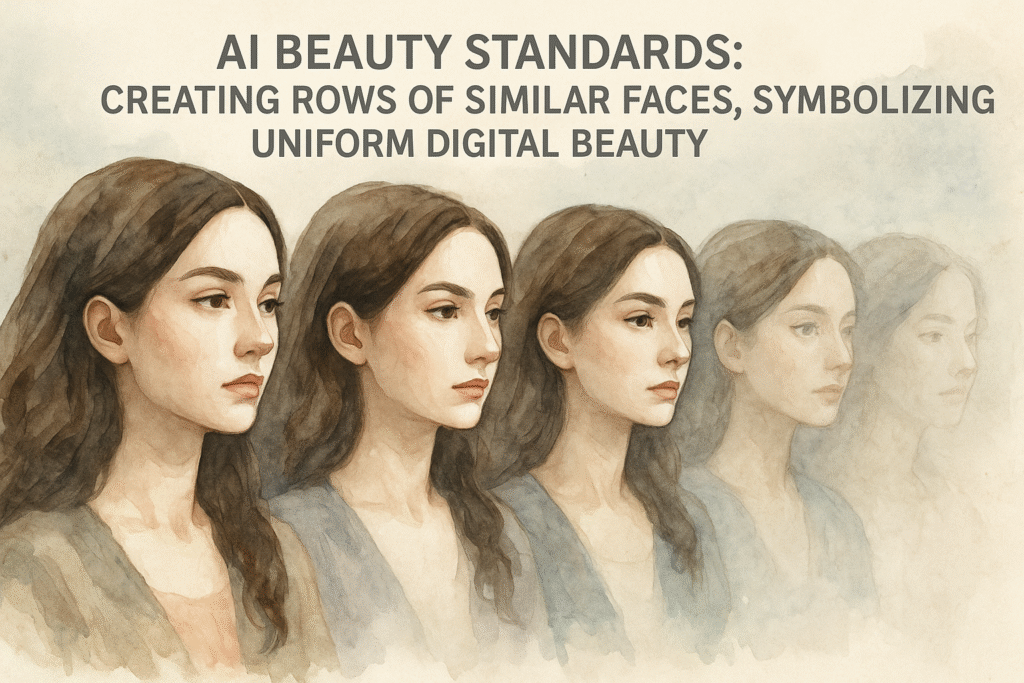
      AI beauty standards illustration with similar faces

      AI now creates a “perfect face” that circulates endlessly on social networks.
      Smooth skin, flawless symmetry, and ideal proportions — these images increasingly shape how society defines beauty.

      But as these faces grow more similar, a question emerges:
      Where does human uniqueness go in a world where technology determines the rules of beauty?

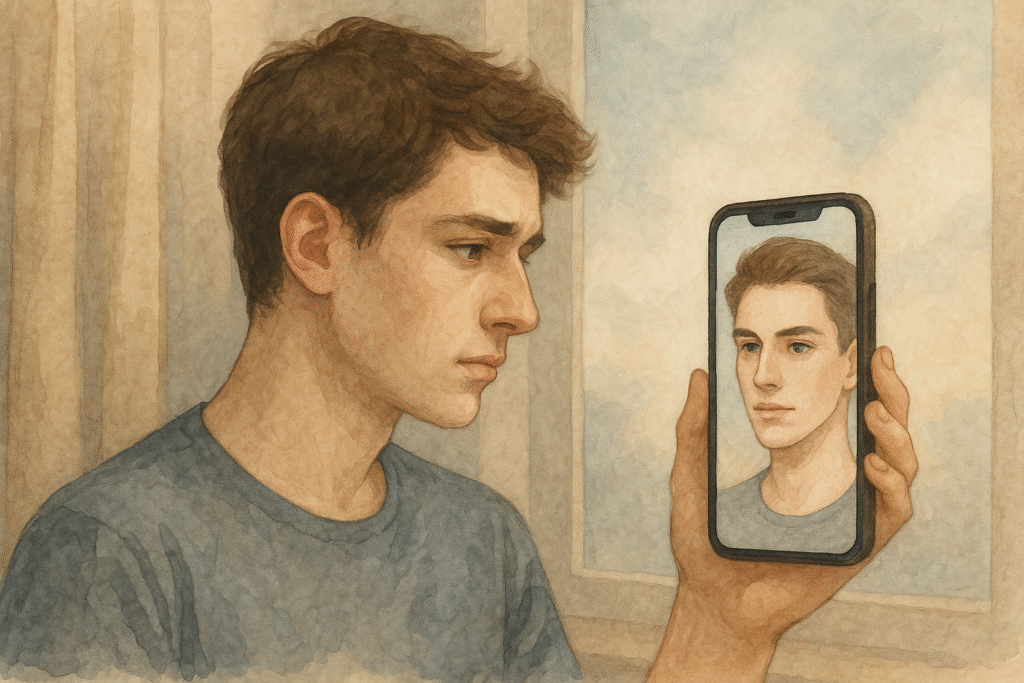
      Natural face in soft light under AI beauty standards

      1. Introduction — The Perfect Face, Yet Strangely Unfamiliar

      AI beauty standards are rapidly influencing how we perceive human faces. AI-generated portraits often line up like cloned models:
      identical smiles, balanced features, and overly harmonious proportions.

      Scrolling through today’s social media, we encounter a striking pattern:
      faces that look eerily alike — not entirely human, yet strangely familiar.
      Many of these aren’t real people at all, but AI-generated ideals produced through massive datasets and aesthetic algorithms.

      AI has moved beyond reproducing beauty to producing the template of an “ideal human face.”
      This template increasingly influences advertising, avatar design, entertainment, and even professional profile photos.

      Beauty, once shaped by culture, individuality, and personal preference, is slowly being replaced by an algorithmic answer key.


      2. Development — In the Age of AI Beauty, Where Did Diversity Go?

      AI systems learn from vast datasets that reflect dominant cultural and demographic patterns.
      In practice, these datasets often reinforce narrow standards:

      • Westernized facial proportions
      • Youthful, symmetrical features
      • Slim or angular facial outlines
      • Large eyes and sharp jawlines for women
      • Broad jawlines and balanced musculature for men

      These patterns then recirculate as “universal beauty,” despite being neither universal nor culturally neutral.

      As a result, AI helps accelerate:

      • The homogenization of beauty

      Different faces collapse into a single optimized “average.”

      • The digital reinforcement of bias

      AI does not intend to discriminate — but the bias within its training data becomes amplified in its outputs.

      • The evolution of lookism

      Instead of challenging social prejudices, AI updates and upgrades them into a more persuasive, polished form.

      Human uniqueness gets flattened into what the algorithm considers “efficient beauty.”
      In this sense, AI preserves bias more effectively than any institution ever could.


      Embracing a natural face beyond AI beauty standards

      3. Philosophical Reflection — Who Gets to Define Beauty?

      Plato once believed beauty reflected ideal forms.
      Modern philosophy, however, understands beauty as a cultural construction shaped by social, historical, and individual contexts.

      AI disrupts this paradigm by simplifying beauty into a pattern-recognition problem — something calculable, predictable, and reproducible.

      This leads us to a core question:

      Does AI liberate human perception, or does it imprison it within a single standardized template?

      Human creativity has always flourished in imperfection and difference.
      But as AI-driven standards push all faces toward a harmonious average, society risks losing the richness that diversity brings to our encounters with others.

      If AI removes difference as a “visual inefficiency,”
      then we face not only an aesthetic crisis but an ontological one:

      The erosion of the conditions that allow individuality, identity, and social coexistence to flourish.

      Beauty becomes not a celebration of human variation but an algorithmic filter that defines who fits and who falls outside the frame.


      Natural unfiltered face beyond AI beauty standards

      4. Conclusion — Choosing Imperfect Humanity Over Perfect Algorithms

      The “perfect face” generated by AI may look impressive,
      but it lacks the trembling of expression, the unpredictability of emotion,
      and the subtle imperfections that make a face truly human.

      To live meaningfully in the age of AI,
      we must learn not merely to consume algorithmic beauty
      but to interpret it, question it, and resist its sameness.

      Human beauty lies in difference — in asymmetry, age, texture, and lived experience.
      Ethics in the AI era begins not with perfection,
      but with the courage to recognize and respect faces that do not follow the algorithm.

      📚 References

      1. Wolf, N. (1991). The Beauty Myth. New York: HarperCollins.
      → This book critiques how beauty standards operate as a form of social control, arguing that modern societies weaponize appearance norms to reinforce structural power. It remains foundational for discussing lookism in relation to gender politics and cultural systems.

      2. Davis, K. (2017). The Making of Our Bodies, Ourselves. London: Routledge.
      → Davis examines how cultural norms around the body are constructed and reproduced, showing the deep connection between identity, embodiment, and technological mediation. This framework helps contextualize AI’s growing influence on self-image.

      3. Benjamin, R. (2019). Race After Technology. Cambridge: Polity Press.
      → Benjamin analyzes how algorithmic systems encode racial bias. Her insights illuminate why AI-generated beauty standards often reflect and amplify existing inequalities, rather than neutralizing them.

      4. Bourdieu, P. (1984). Distinction: A Social Critique of the Judgement of Taste. Cambridge: Harvard University Press.
      → Bourdieu demonstrates that taste is not neutral but shaped by social class structures. Applying his theory reveals how AI beauty standards reinforce — rather than transcend — cultural hierarchies.

      5. Rini, R. (2020). Deepfakes and the Infocalypse. Cambridge, MA: MIT Press.
      → Rini explores the destabilization of visual truth in the digital era. Her analysis helps explain how AI-generated faces complicate authenticity, trust, and identity in contemporary media environments.

    4. Is Perfect Happiness Possible?

      Is Perfect Happiness Possible?

      A philosophical examination of why perfect happiness cannot exist—
      and what this impossibility reveals about the human condition.

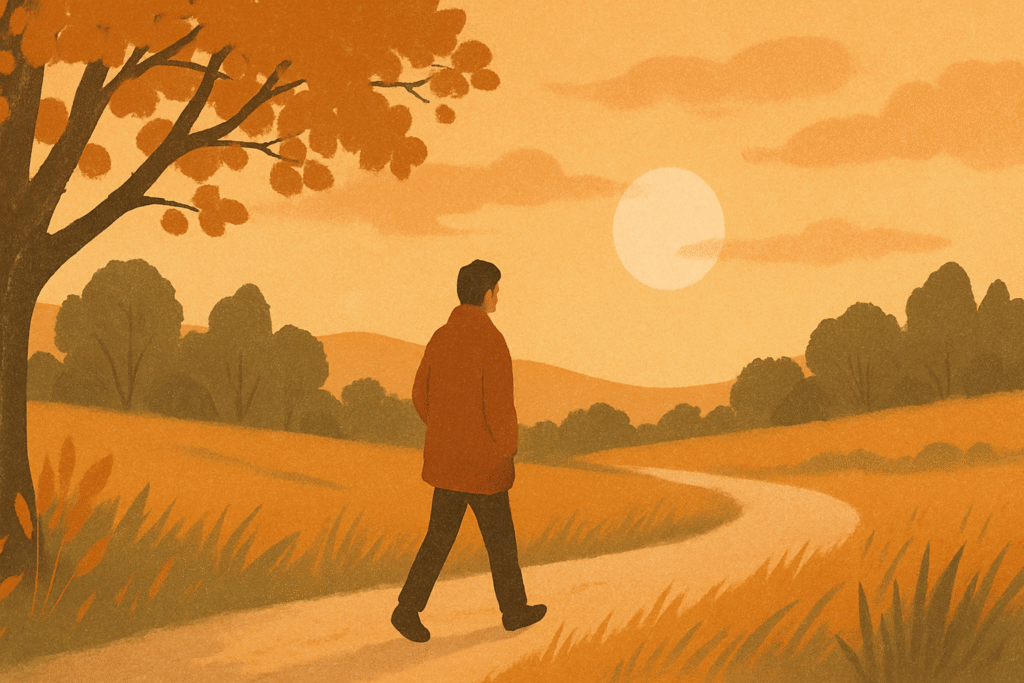
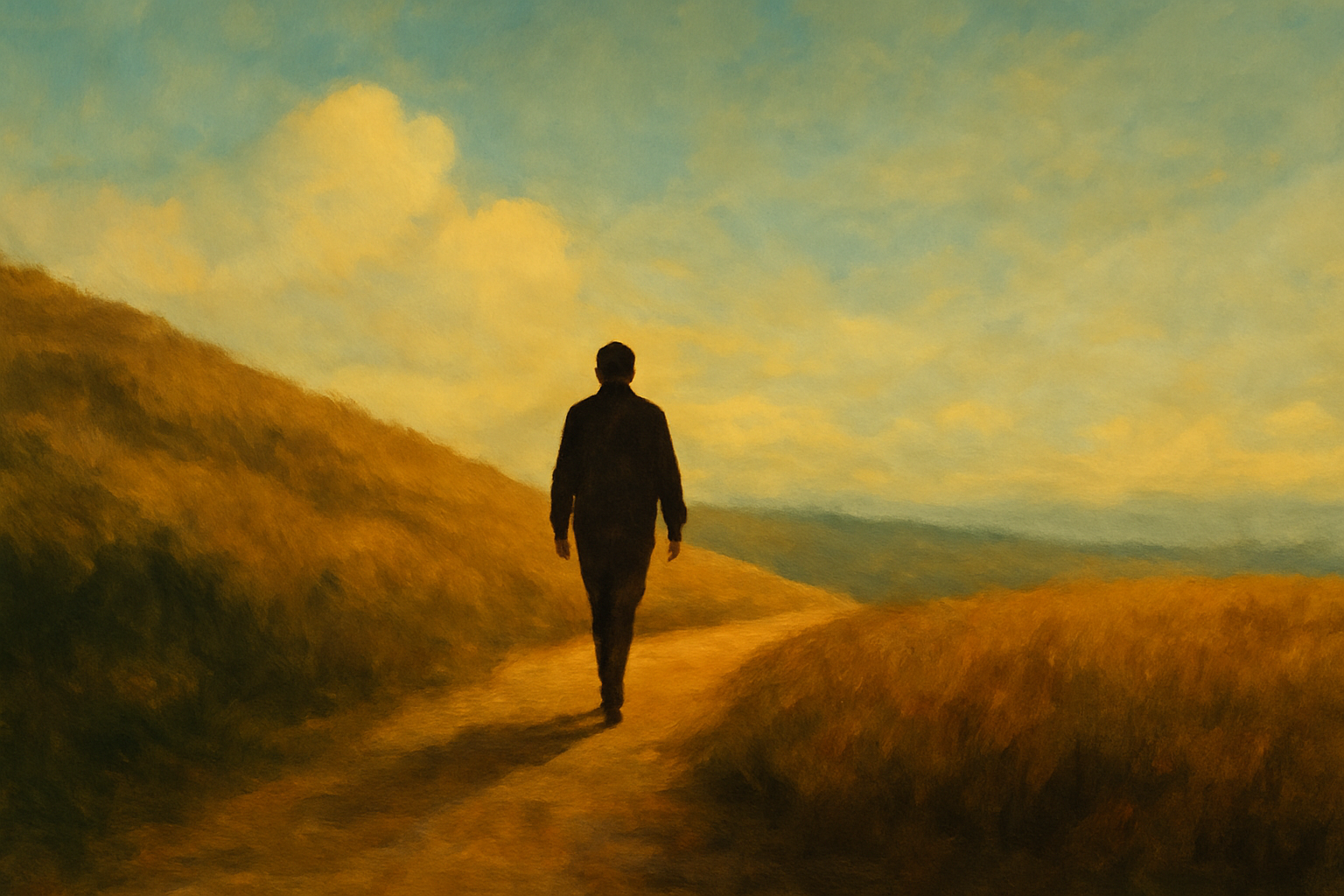
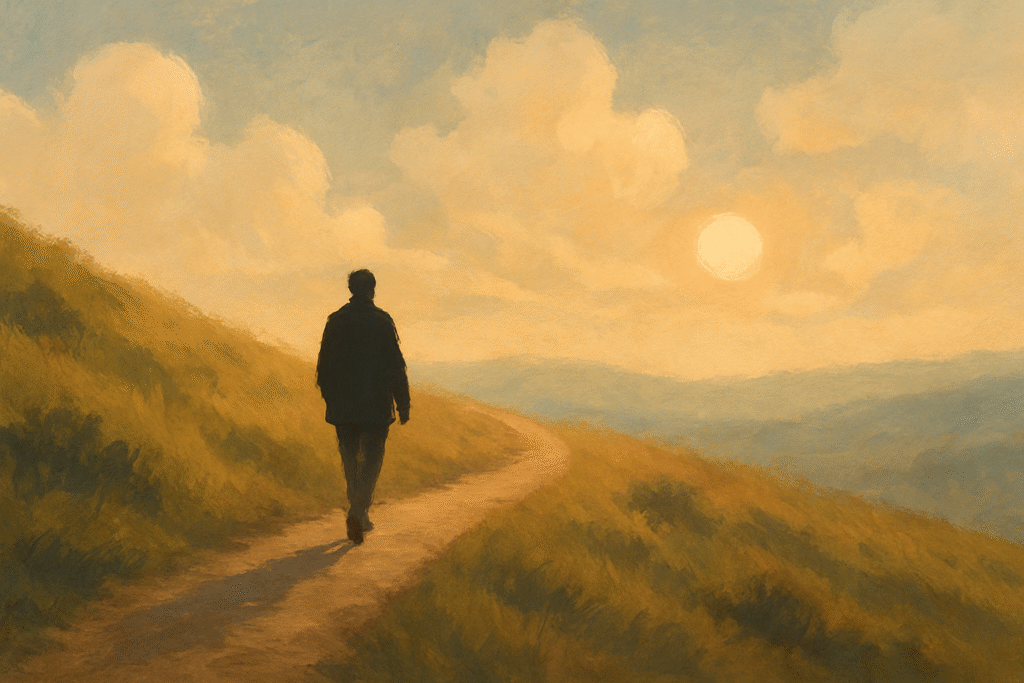
      Man walking along a golden-hour hillside path.

      Section 1. Introduction — The Desire for Completion

      Human beings have long pursued the idea of a complete and final state of happiness—a condition in which nothing is lacking, nothing threatens to change, and everything essential has been secured once and for all. This imagined form of happiness promises immunity from uncertainty and emotional fragility. Yet such an ideal immediately raises a deeper question: Can happiness ever be complete?

      To explore this question is to confront the tension between what the human imagination desires and what the human condition permits. Perfect happiness implies permanence, stability, and closure; human life, by contrast, is temporal, contingent, and continually unfolding. This fundamental mismatch is the starting point of our inquiry.

      Section 2. Conceptual Analysis — Perfection and Human Temporality

      Perfection presupposes two conditions:

      1. the absence of lack, and
      2. the cessation of change.

      A perfect state is static by definition—once attained, nothing further must be sought.

      Happiness, however, is inherently dynamic. It is shaped by evolving circumstances, shifting desires, and emotional variability. To impose the ideal of perfection upon the experience of happiness is thus conceptually incoherent.

      Modern psychology reinforces this view:

      • Hedonic adaptation shows that emotional highs fade quickly.
      • The paradox of choice reveals that abundance often increases dissatisfaction.
      • Expectation–reality gaps produce chronic disappointment even when conditions improve.

      These mechanisms demonstrate that the psyche itself resists a fixed, perfected happiness. Happiness moves; it cannot remain still.
      Life changes; no emotional state can be preserved.
      Thus, perfect happiness collapses under conceptual scrutiny.

      Hands balancing joy and anxiety on a symbolic scale.

      Section 3. Philosophical Frameworks — Three Perspectives on Imperfection

      3.1 Aristotle: Happiness as Activity, Not Completion

      Aristotle’s eudaimonia is often mistaken for a perfected state of flourishing. Yet Aristotle insists that happiness is an activity, not an achievement frozen in time. A flourishing life requires continued exercise of virtue, adaptation to circumstances, and meaningful engagement with the world.

      Happiness is therefore dynamic—a movement, not a monument.


      3.2 Spinoza: Joy Through Understanding, Not Emotional Perfection

      Spinoza locates happiness in rational clarity. For him, suffering does not disappear; rather, it becomes integrated through adequate understanding of one’s emotions and their causes.

      Happiness, in this sense, is the product of insight,
      not the elimination of negative emotions.

      Thus, Spinoza replaces the fantasy of perfect happiness with the practice of intellectual freedom.


      3.3 Buddhism: Abandoning the Illusion of Completion

      Buddhist thought offers a radical critique of perfection.
      The desire to maintain a permanent emotional state—whether happiness or peace—is the very root of suffering.

      Because all things are impermanent (anicca),
      the attempt to preserve happiness becomes a form of attachment (tanha),
      which inevitably leads to dissatisfaction.

      Happiness emerges not by fulfilling desire,
      but by releasing the demand that happiness remain unchanged.

      Section 4. Contemporary Implications — Happiness in an Age of Measurement

      Modern society converts happiness into a measurable commodity:

      • Governments publish well-being indices.
      • Corporations market “wellness” as a lifestyle product.
      • Individuals track emotions, productivity, and satisfaction.

      What results is a world where happiness becomes a performance.

      The neoliberal logic of self-optimization demands:

      • constant emotional positivity,
      • efficiency in self-management,
      • elimination of discomfort.

      But when happiness becomes an obligation,
      ordinary life becomes insufficient.
      Comparison intensifies.
      Imperfection becomes unacceptable.

      In this environment, the ideal of perfect happiness becomes not only unattainable but oppressive—an expectation that erodes genuine well-being.

      Section 5. Conclusion — The Necessity of Imperfection

      Perfect happiness does not exist—not because human beings fail to achieve it, but because the very concept contradicts the structure of human life. To be human is to be vulnerable, changing, unfinished.

      Happiness, then, is not a final emotional destination.
      It is the practice of engaging meaningfully with an imperfect world.

      Imperfection is not the enemy of happiness.
      It is the condition that makes happiness possible.

      Soft morning light entering through an open window

      📚 References


      Reference 1 — Philosophies of Happiness

      Lobel, D. (2014). Philosophies of Happiness: A Global, Cross-Cultural Introduction. New York, NY: Columbia University Press.

      This volume explores happiness as a form of human flourishing across diverse philosophical and cultural traditions. It helps contextualize happiness not as a singular ideal but as a varied conceptual landscape shaped by different civilizations. This supports the article’s theme that “perfect happiness” is inherently plural and culturally contingent.


      Reference 2 — Interdisciplinary Perspectives on Happiness

      Besser, P. (2017). The Philosophy of Happiness: An Interdisciplinary Introduction. London: Routledge.

      Besser integrates philosophy, psychology, and sociology to examine happiness from multiple angles. The text expands theoretical discussions found in this article by offering a broader comparative framework for thinkers such as Aristotle, Spinoza, and non-Western schools.


      Reference 3 — Ancient Wisdom Meets Modern Science

      Haidt, J. (2006). The Happiness Hypothesis: Finding Modern Truth in Ancient Wisdom. New York, NY: Basic Books.

      Haidt draws connections between ancient philosophical insights and contemporary psychological findings. It aligns closely with the article’s argument that happiness is not a state of perfection but a dynamic negotiation rooted in human nature and cognitive patterns.


      Reference 4 — Happiness as Inner Work

      Dalai Lama, & Cutler, H. (1998). The Art of Happiness. New York, NY: Riverhead Books.

      This book emphasizes happiness as an internal practice grounded in awareness and emotional discipline. Its approach resonates with the article’s perspective that accepting impermanence and embracing emotional imperfection is central to sustainable well-being.


      Reference 5 — The Commodification of Well-Being

      Davies, W. (2015). The Happiness Industry: How Government and Big Business Sold Us Well-Being. London: Verso.

      Davies critiques how modern institutions quantify, commercialize, and regulate happiness. His analysis directly reinforces the article’s examination of today’s measurement-driven culture, where happiness becomes a competitive metric rather than an authentic interior experience.